Best Surround Sound Receiver

31 October, 2022 by Admin

A workhorse receiver is at the heart of every impressive home theatre system. The best receivers will brilliantly reimagine your A/V equipment, delivering powerful sound to your speakers and stunning visuals to your TV.

If you enjoy gaming, watching videos, or listening to music, you're probably familiar with what surround or A/V receiver is. Although we consider the Marantz SR8015 to be the best all-around receiver on the market, there are many other options depending on your needs.

With a lifetime of experience reviewing TVs, amplifiers, A/V receivers, and other electronics, we've compiled a current list of the best A/V receivers available. You might also be interested in our guide on how to read A/V receiver specs.

Marantz SR8015 Review:

A lot of people don't want to spend money on this, but Marantz made sure to improve on previous A/V receivers by filling in empty spaces from previous models. The SR8015 has a wide range of A/V technologies to make it work in any home theater setting. There are a lot of options for audio, starting with Dolby Atmos and ending with DTS:X and DTS:X Pro. You can also connect a turntable for vinyl playback or stream music from Spotify, Tidal, Pandora, AirPlay 2, and more. HEOS also lets you set up multirotor setups in different rooms. You can also use Alexa, Google Assistant, and Siri.

If you want to listen to high-quality audio files or lossless formats that go up to 24-bit/192 kHz, this receiver can play them. You can stream them from a USB or network storage drive. A system with 11.2 channels can run in 7.2.4 or 9.2.2 configurations when all of the channels are being used. You can also keep some free music in different zones, where you can get two more. Each channel of the SR8015 has 140 watts of power, so Marantz built it to work with almost any speaker arrangement you can think of. To make things even better, the Odyssey MultEQ XT32 support has room-correction technology that makes sure the sound in the room isn't too loud.

With video, the SR8015 is no slouch either. It has HDMI-eARC, which lets you send full-resolution surround sound from your TV to your receiver. It has HDR (HDR10, HDR10+, HLG, Dynamic HDR, and Dolby Vision), as well as HDMI-eARC, which lets you send full-resolution surround sound from your TV to your receiver. There are 8 HDMI inputs and 3 HDMI outputs. There are also useful add-ons like a Variable Refresh Rate (VRR) and Auto Low Latency Mode (ALLM) for gamers who need them, so they can play their games.

This receiver is going to last a long time because Marantz didn't leave anything to chance.

Pros

· Excellent features for both music and movies

· Supports up to 11.2 Surround Sound

· High-Quality Audio

Cons

· For those looking for something simpler, this may be too much.

9.4 Mixed Usages
9.8 VIDEO FEATURES:
9 CONNECTIVITY OPTIONS:
9.5 AUDIO FEATURES:
9.3 MULTIZONE:
9.5 AMPLIFICATION:

Marantz SR8015 11.2 Channel AV Receiver is mainly designed for audio enthusiasts and home theater lovers, this receiver delivers an exceptional audio experience that surpasses expectations. It is especially well-suited for large rooms with a dedicated home theater, as it can support up to 11.2 channels of surround sound. However, it can also be used in smaller rooms or even in multiple rooms, thanks to its built-in HEOS multi-room technology.

Whether you're watching movies, playing games, or listening to music, the Marantz SR8015 elevates your entertainment to new heights. Let's learn more about it.

Our Verdict

The Marantz SR8015 11.2 Channel AV Receiver is a great option for those looking for powerful and versatile home cinema management without breaking the bank. It strikes a perfect balance between capability and cost, making it a great choice for many.Of course, if you're willing to shell out tens of thousands of dollars, there are even more high-end options out there. But for most of us, the SR8015 is about as good as it gets. For audiophiles and home theater enthusiasts with large rooms seeking an exceptional audio experience, the Marantz SR8015 is a must-have investment. 

PROS
  • Exceptional sound quality and immersive audio experience.
  • Advanced connectivity options.
  • Intuitive user interface and easy setup process.
  • Powerful amplifier and high power output per channel.
  • Support for popular audio formats like Dolby Atmos, DTS:X, and IMAX Enhanced.
  • Multi-room audio support for synchronized playback in different zones.
CONS


  • Higher price point compared to other AV receivers in the market.
  • Extensive features may be unnecessary for casual users.
Where to Buy

Specification

General

Receiver Type A/V Receiver
Number Of Channel 11.2 Channel
Number Channel Processing 13
Audio Feature Dolby Atmos , DTS:X , Front Wide Ch. , THX , Auro 3D
Video Feature HDR10 , HDR10+ , Dolby Vision , HDCP 2.3 , 4K Passthrough , 8K Passthrough , 8K Upscaling
Watts Per Channel 140 watts
Zones 2 , 3
Radio Internet Radio , Pandora , Spotify , Tidal , Deezer , Napster , SiriusXM
Amplifier Class G , Class A/B , Non-Phase

Connectivity

Ethernet Yes
Wi-Fi Yes
Bluetooth Yes
USB Yes
RCA LIne Input: 7 (1 front)
RCA LIne Output: 0
RCA Pre-Outs: 13.2
XLR Line Inputs: No
XLR Pre-Outs: No
Phono Input: Yes
Optical Inputs: 2
Optical Output: 0
Coaxial Inputs: 2
Multi-Channel Input: 7.1
Headphone Out: 6.3mm (1/4
HDMI Inputs: 8
HDMI Outputs: 3 (2 x 8K for MAIN, 1 x 4K for ZONE 2)
8K Inputs: 1
Composite Video Input 5 (1 front)
Composite Video Output: 1
Component Video Input: 3
Component Video Output: 1
Front A/V Inputs: HDMI, USB< Composite, L/R Audio
Speaker A/B: Assignable

AUDIO FEATURES:

Maximum Channel Processing 13.2
Dolby Atmos up to 7.1.6 or 9.1.4 with external amp
Dolby Atmos Height Virtualization Yes
Dolby Atmos Music N/A
Dolby TrueHD Yes
Dolby Digital Plus Yes
Dolby Surround Upmixer Yes
Dolby Pro Logic N/A
Dolby Digital EX Yes
Surround EX N/A
DTS:X Pro up to 7.1.6 or 9.1.4
DTS Neural:X Yes
DTS Virtual:X Yes
DTS Neo N/A
DTS-HD Master Audio Yes
DTS-HD High Resolution Audio Yes
DTS 96/24 Yes
DTS Express Yes
DTS-ES Discrete 6.1, Matrix 6.1
IMAX Enhanced Yes
PCM 2-ch/Multi-ch Input
Music Playback via USB MP3, WMA, MPEG-4 AAC, Apple Lossless, WAV, FLAC, DSD
High Resolution Music Playback via USB and/or Network up to 192 kHz
High Resolution Audio Formats via USB Apple Lossless, WAV, FLAC, DSD
Gapless Playback Yes
DSD via HDMI 2-ch/Multi-ch Input
DSD via USB 2-ch Input
DSD to PCM Converter N/A
USB DAC N/A
Jitter Reduction Yes
DTS Dialog Control Yes
Dialog Enhancement N/A
Dialog Level Adjustment Yes
Dialog Normalization Yes
Dialogue Lift N/A
Compressed Music Enhancer MDAX2
High-resolution Music Enhancer N/A
Audyssey Dynamic EQ Yes
Audyssey Dynamic Volume Yes
Audyssey LFC Yes
Audyssey Sub EQ HT Yes
Audyssey DSX N/A
Direct Mode Yes
Pure Direct Mode Yes
Independent Subwoofer Outputs Yes
Auto Speaker Calibration System with Mic. Audyssey MultEQ XT32
Audyssey App Support Yes
Bass Sync Yes
Optimized Bass Redirection Yes

VIDEO FEATURES:

HDMI Version 2.1
Enhanced ARC Yes
HDCP Version 2.3
HDR10+ Yes
Dynamic HDR Yes
Dolby Vision Yes
HLG (Hybrid Log Gamma) Yes
QMS (Quick Media Switching) Yes
3-D Ready Yes
Video Signal Passthrough Yes
Video Signal Upscaling Yes
Analog To HDMI Upconversion Yes
Component Video Upscaling Yes
isf Certified Calibration Control Yes

Amplifiers

Channels 11.2
Front Wide Channel Support Yes
Current Feedback Topology Yes
Discrete Amplification Yes
HDAM Yes
THX™ Certification N/A
Continuous 6 Ω Rated Yes
Certified 4 Ω Performance Yes
Bi-amp Capability 5-ch

Gaming Features

Auto Low Latency Mode (ALLM) Yes
Variable Refresh Rate (VRR) Yes
Quick Frame Transport (QFT) Yes

Zones

Zones 3
Powered Zones 2 and 3
Zone 2 Outs HDMI, Component, Composite, Pre Out
Zone 3 Outs Pre Out
RS-232C Interface Yes
+12V Trigger Output 2

Radio

Analog Tuner FM/AM
Digital Radio N/A
Internet Radio TuneIn
Pandora
Spotify Yes
Tidal Yes
Deezer Yes
SiriusXM Internet Radio Yes
Napster Yes

Additional Features

On-Screen Display Advanced Graphic User Interface
GUI Languages 3
Web Browser Control Yes
IP Control for CI Yes
Control4 SDDP Yes
PreAmp Mode Yes
Display 2 lines + port hole
Remote Controller RC043SR
Remote Control In/Out 1/1
LCD Display Yes
Detachable Power Cord Yes
Setup Assistant Yes

Power

Power Output (6 Ω, 1 kHz, 2 140 W (0.05% THD)
Rated Power Output (6 Ω, 1 kHz, 1 channel driven, IEC) 175 W (0.7% THD)
Dynamic Power per Channel (3 Ω, Front)
Dynamic Power per Channel (4 Ω, Front)
Dynamic Power per Channel (8 Ω, Front)
Power Output (8 Ω, 20 Hz - 20 kHz, 2 250 W (10% THD)
Maximum Effective Power Output (6 Ω, 1 kHz, 1 channel driven, JEITA) 205 W (1% THD)
Power Supply AC 120 V, 60 Hz
Toroidal Transformer Yes
Power Consumption 780 W
No Sound Power ECO On/Off: 65 W/110 W
Standby Power 0.2 W

Build

Dimensions (W x H x D) 17-3/8
Weight 17.6 kg (38.8 lbs)
Chassis Copper Platted
Front Panel Metal
Speaker Terminals 13
Large Speaker Terminals 13
Color-Coded Speaker Terminals Yes
Transparent High-Grade Speaker Terminals Yes
High Grade Audio Components Yes
ECO Mode / Hybrid Standby Function Yes
Auto Power off Yes
Warranty 3 Years

Specifications

THD digital 0.008% (1 kHz, at 0 dB)
Analog Distortion 0.005% (20 Hz-20 kHz, Direct mode)
Phono Distortion 0.03% (1 kHz, 3 V)
Input Sensitivity and Impedance (Line) 200 mV/47 kΩ
Input Sensitivity and Impedance (Phono MM) 2.5 mV
Rated Lineout Level and Impedance 1.2 V
Rated Output digital 2 V (at 0 dB playback)
S/N Ratio (Line, IHF-A) 102 dB
S/N Ratio (Phono MM, IHF-A) 74 dB
S/N Ratio (digital) 102 dB
Phono RIAA Deviation ±1 dB (20 Hz to 20 kHz)
Frequency Response (Analog In) +1/-3 dB (10 Hz to 100 kHz, Direct mode)
DSD Sampling Rates via HDMI 2.8 MHz
DSD Sampling Rates via USB 5.6 MHz, 2.8 MHz
Video Input Sensitivity/Output Level and Impedance 1 Vp-p/75 Ω (Component Y) 0.7 Vp-p/75 Ω (Component PB/CB, PR/CR) 1 Vp-p/75 Ω (Composite)
Video Frequency Response 5 Hz - 60 MHz, 0, -3 dB (Component) 5 Hz - 10 MHz, 0, -3 dB (Composite)
Ethernet Standard 100BASE-TX
Wi-Fi Standard IEEE 802.11 a/b/g/n
Wi-Fi Terminal Frequency 5 GHz, 2.4 GHz
Bluetooth Version 4․2
Bluetooth Frequency 2.4 GHz
USB Terminal USB2.0 5V, 1 A
FM Frequency 87.5 MHz - 107.9 MHz
FM 50 dB Quiet Sensitivity (IHF, 1 kHz, 100% MOD.) Mono: 2.8 µV (20.2 dBf)
FM S/N Ratio Mono/Stereo: 70 dB/67 dB
FM Harmonic Distortion (IHF, 1 kHz) Mono/Stereo: 0.7%/1.0%
AM Effective Sensitivity 520 kHz - 1710 kHz
AM Frequency 18 µV

Sony STR-DH590

When it comes to A/V receivers, cutting back on your budget always means cutting back on the number of features. The most important thing is to keep as many of the things that most people like. The Sony STR-DH590 can do this in an excellent way because it can play all the newest audio and video formats, like 4K and HDR (HDR10, HLG, and Dolby Vision). It also comes with its own acoustic calibration circuitry, which takes the guesswork out of setting up your speakers to the right levels.

For the best sound, the DH590 has Sony's Pure Direct mode, which lets you get the best sound from the receiver. It does this by turning off the 590's front display panel, which stops any unnecessary noise from getting into the mix of whatever you're watching or listening to. Keep in mind that when you use Pure Direct, you also don't use many of the receiver's built-in equalizers. When we listen to music through analog sources, this is a great feature. But if you're a big fan of big cinema sound, we'd probably leave it alone when we were watching movies.

Even though the DH590 has Bluetooth, so you can stream music from a compatible smartphone or tablet, the receiver isn't connected to the internet, so you won't be able to stream music unless you have a Bluetooth player. That said, Sony's high-res audio support kicks in when you send music to the receiver, which adds a little more belly and top-end to the sound you get.

When it comes to connecting to the main source, the Sony STR-DH590 only has four HDMI ports. As long as you don't want to power any rock concerts with this receiver, it's more than enough to have a great home theater experience with.

PROS

· Low cost without sacrificing important features

· Enhancement mode for Pure Direct audio

· Comfortable Sound

CONS

· There are only a few HDMI ports.

Denon AVR-X1700H Review:

There are a lot of good midrange A/V receivers to choose from. As soon as you start to ask, "Which of these models can play back a turntable without a pre-amp?" I mean, it's a lot shorter than the one I had. The Denon AVR-X1700H, a modern 7.2 home theater receiver, is one of them. It has a phono input, which makes your set-up a lot easier.

Don't be fooled by its vinyl-friendly jacks: Dolby Atmos and Atmos Heath Virtualization, DTS Virtual:X, and 8K resolution upscaling are just some of the high-tech features that this receiver has. It also works with HEOS connections, AirPlay 2, Alexa voice commands, Bluetooth, and on-board Wi-Fi.

For more complicated setups, the Denon AVR-X1700H also has multi-room audio, which lets you play music from different rooms at the same time, as well as digital audio and composite video ports. It also has two line-level subwoofer outputs for adding extra rumble. 80 watts per channel is a lot of power for the sound, and the room calibration is also very good, too. This is a great choice if you want phono support without giving anything up, are looking for a more affordable upgrade to HDMI 2.1, or want the most up-to-date format support for your movies and music.

Pros

· Has a built-in DVD player

· One of the best all-around heads for both digital and vinyl heads

· a wide range of the most recent features

Cons

· Only 7.2 surround sound can be played.

Yamaha Aventage RX-A2A Review:

Powerful video can be done with the 7.2 Aventage RX-A2A system. Naturally, it can play 4K, HDR (HDR10, HLG, HDR10+, and so on), Dolby Atmos, DTS:X, and HDCP 2.3, as well as all the other new A/V technologies. If you want to use HDMI-eARC, it's also ready. It can play high-res audio files up to 32-bit/192 kHz, too.

You can also use HDMI 2.1 if you want to stay on top of the latest A/V support for your home theater system. Future updates will add support for things like 8K and the most recent formats.

Features like a high slew rate amplifier for more accurate audio response and low distortion are inside. You can also choose from a variety of advanced modes for movie optimization. An A.R.T. (Anti-Resonance Technology) wedge is used outside to help dampen nearby vibration and improve the sound quality even more. This feature with wireless 5.1 surround sound support also comes in handy if you like to play music on your computer.

Neither do I. Don't worry about not having enough friends, either. The Yamaha Aventage RX-A2A has seven HDMI inputs that can handle any devices you want to set up in your home theater. You can also use Alexa and Google Assistant if the remote doesn't work, so you don't have to go through all of that again

PROS

· Having a good format and file support

· Vibration dampening can help.

· Has a strong amplifier

Cons

· A little more interested in audio than video.

8.84 Mixed Usages
9.9 VIDEO FEATURES:
8.5 CONNECTIVITY OPTIONS:
8.9 AUDIO FEATURES:
8 MULTIZONE:
8.9 AMPLIFICATION:
Specification

General

Receiver Type A/V Receiver
Number Of Channel 7.2 Channel
Number Channel Processing 7
Audio Feature Dolby Atmos , DTS:X
Video Feature HDR10 , HDR10+ , Dolby Vision , 8K Passthrough , 4K Upscaling
Watts Per Channel 100
Zones 2
Radio Internet Radio , Pandora , Spotify , Tidal , Deezer , Napster , SiriusXM
Amplifier

Connectivity

Ethernet Yes
Wi-Fi Yes
Bluetooth Yes
USB Yes
RCA LIne Input: 3
RCA LIne Output: N/A
RCA Pre-Outs: 2.2
XLR Line Inputs: N/A
XLR Pre-Outs: N/A
Phono Input: Yes
Optical Inputs: 1
Optical Output: N/A
Coaxial Inputs: 1
Multi-Channel Input: N/A
Headphone Out: 6.3 mm (1/4
HDMI Inputs: 7
HDMI Outputs: 1
8K Inputs: 7
Composite Video Input N/A
Composite Video Output: N/A
Component Video Input: N/A
Component Video Output: N/A
Front A/V Inputs: N/A
Speaker A/B: N/A

AUDIO FEATURES:

Maximum Channel Processing 7.1
Dolby Atmos YES
Dolby Atmos Height Virtualization Yes
Dolby Atmos Music N/A
Dolby TrueHD Yes
Dolby Digital Plus Yes
Dolby Surround Upmixer Yes
Dolby Pro Logic N/A
Dolby Digital EX N/A
Surround EX N/A
DTS:X YES
DTS Neural:X Yes
DTS Virtual:X
DTS Neo Yes
DTS-HD Master Audio Yes
DTS-HD High Resolution Audio Yes
DTS 96/24 Yes
DTS Express Yes
DTS-ES YES
IMAX Enhanced N/A
PCM 2-ch/Multi-ch Input
Music Playback via USB MP3, WMA, MPEG-4 AAC, Apple Lossless, WAV, FLAC, AIFF, DSD
High Resolution Music Playback via USB and/or Network Up to 192 kHz/32 Bit
High Resolution Audio Formats via USB Apple Lossless, WAV, FLAC, AIFF, DSD
Gapless Playback Yes
DSD via HDMI 2-ch/Multi-ch Input
DSD via USB 2-ch Input
DSD to PCM Converter N/A
USB DAC N/A
Jitter Reduction N/A
DTS Dialog Control Yes
Dialog Enhancement N/A
Dialog Level Adjustment Yes
Dialog Normalization Yes
Dialogue Lift Yes
Compressed Music Enhancer YES
High-resolution Music Enhancer N/A
Audyssey Dynamic EQ N/A
Audyssey Dynamic Volume N/A
Audyssey LFC N/A
Audyssey Sub EQ HT N/A
Audyssey DSX N/A
Direct Mode
Pure Direct Mode Yes
Independent Subwoofer Outputs N/A
Auto Speaker Calibration System with Mic. YPAO sound optimization with Multipoint Measurement
Audyssey App Support
Bass Sync
Optimized Bass Redirection

VIDEO FEATURES:

HDMI Version 2.1
Enhanced ARC Yes
HDCP Version 2.3
HDR10+ Yes
Dynamic HDR N/A
Dolby Vision Yes
HLG (Hybrid Log Gamma) Yes
QMS (Quick Media Switching) Yes
3-D Ready Yes
Video Signal Passthrough Yes
Video Signal Upscaling Yes
Analog To HDMI Upconversion N/A
Component Video Upscaling N/A
isf Certified Calibration Control N/A

Amplifiers

Channels 7.2
Front Wide Channel Support Yes
Current Feedback Topology
Discrete Amplification
HDAM
THX™ Certification N/A
Continuous 6 Ω Rated Yes
Certified 4 Ω Performance Yes
Bi-amp Capability YES

Gaming Features

Auto Low Latency Mode (ALLM) Yes
Variable Refresh Rate (VRR) Yes
Quick Frame Transport (QFT) Yes

Zones

Zones 2
Powered Zones Zone 2
Zone 2 Outs RCA Preout
Zone 3 Outs N./A
RS-232C Interface N/A
+12V Trigger Output 1

Radio

Analog Tuner FM/AM
Digital Radio N/A
Internet Radio YES
Pandora Yes
Spotify Yes
Tidal Yes
Deezer Yes
SiriusXM Internet Radio Yes
Napster Yes

Additional Features

On-Screen Display Graphical User Interface
GUI Languages YES
Web Browser Control Yes
IP Control for CI
Control4 SDDP
PreAmp Mode N/A
Display LCD
Remote Controller YES
Remote Control In/Out 1/1
LCD Display Yes
Detachable Power Cord Yes
Setup Assistant

Power

Power Output (6 Ω, 1 kHz, 2
Rated Power Output (6 Ω, 1 kHz, 1 channel driven, IEC) 125 W (0.9% THD)
Dynamic Power per Channel (3 Ω, Front)
Dynamic Power per Channel (4 Ω, Front)
Dynamic Power per Channel (8 Ω, Front)
Power Output (8 Ω, 20 Hz - 20 kHz, 2 100 W (0.06% THD)
Maximum Effective Power Output (6 Ω, 1 kHz, 1 channel driven, JEITA) 160 W (10% THD)
Power Supply AC 120 V, 60 Hz
Toroidal Transformer
Power Consumption 360 W
No Sound Power
Standby Power 0.1 W

Rating System

AUDIO FEATURES: 8.9
VIDEO FEATURES: 9.9
CONNECTIVITY OPTIONS: 8.5
MULTIZONE: 8.01
AMPLIFICATION: 8.88

Build

Dimensions (W x H x D) 17-1/8
Weight 10.2 kg (22.5 lbs)
Chassis
Front Panel
Speaker Terminals 9
Large Speaker Terminals 9
Color-Coded Speaker Terminals Yes
Transparent High-Grade Speaker Terminals
High Grade Audio Components
ECO Mode / Hybrid Standby Function Yes
Auto Power off Yes
Warranty 3 Years

Specifications

THD digital 0.04% (AUDIO 3 etc. to Front, Pure Direct, 20 Hz - 20 kHz, 50 W, 8 Ω)
Analog Distortion
Phono Distortion
Input Sensitivity and Impedance (Line) 200 mV/47 kΩ
Input Sensitivity and Impedance (Phono MM) 3.5 mV/47 kΩ
Rated Lineout Level and Impedance
Rated Output digital
S/N Ratio (Line, IHF-A) 110 dB
S/N Ratio (Phono MM, IHF-A) 95 dB
S/N Ratio (digital)
Phono RIAA Deviation 0±0.5 dB (20 Hz - 20 kHz)
Frequency Response (Analog In) +0/-3 dB (AUDIO 3 etc. to Front, Pure Direct, 10 Hz to 100 kHz)
DSD Sampling Rates via HDMI 2.8 MHz
DSD Sampling Rates via USB 11.2 MHz, 5.6 MHz, 2.8 MHz
Video Input Sensitivity/Output Level and Impedance
Video Frequency Response
Ethernet Standard 10BASE-T/100BASE-TX
Wi-Fi Standard IEEE 802.11 a/b/g/n/ac
Wi-Fi Terminal Frequency 2.4 GHz, 5 GHz
Bluetooth Version 4.2
Bluetooth Frequency 2.4 GHz
USB Terminal USB2.0 5 V, 1 A
FM Frequency 87.5 MHz - 107.9 MHz
FM 50 dB Quiet Sensitivity (IHF, 1 kHz, 100% MOD.) Mono: 3 µV (20.8 dBf)
FM S/N Ratio Mono/Stereo: 69 dB/68 dB
FM Harmonic Distortion (IHF, 1 kHz) Mono/Stereo: 0.5%/0.6%
AM Effective Sensitivity
AM Frequency 530 kHz - 1710 kHz

Anthem MRX 1140 Review:

Those who want high-quality sound in their A/V receivers know the name Anthem. The 15.2-channel MRX 1140 is the best of the company's products, and it has a lot of power. If you have 8 ohms, you can expect to get 140 watts of continuous power per channel from channels 1 to 5, and a still-respectable 60 watts from the other channels, also at 8 ohms. The MRX 1140 has an enormous Toroidal power supply. This thing is huge.

If you want to leave some channels open for another room in your house, you can set it up in either 7.1.4 or 5.1.4 configurations, depending on how many channels you want to leave open. That's just the beginning.

Chromecast, AirPlay 2, and Bluetooth are now used instead of DTS Play-Fi to connect to other devices in multiple rooms. Spotify Connect and Roon are coming soon, too, so don't forget to check back. A number of popular music streaming services, such as Spotify and Tidal, are already built in. Pandora, SiriusXM, and internet radio are also built in. Hi-res audio support is also available for those who want to listen to their music in the best possible way. The receiver uses its 32-bit/768 kHz differential-output digital-to-analog converters to do this (DACs).

Naturally, when it comes to video, the MRX 1140 can play 4K and high dynamic range (HDR) content in both HDR10 and Dolby Vision formats, as well as HDR HGTV content (Hybrid Log-Gamma). HDMI 2.0a and HDCP 2.2 are built in to all eight of the HDMI inputs, so you can connect 4K and HDR devices. Besides HDMI outputs, the TV also has three digital audio outputs, as well as support for two types of ARC and one type of eARC. In addition, setting up the Anthem MRX 1120 is a breeze thanks to the Anthem Room Correction software. This is one of the best room-calibration systems out there. The company even comes with a high-quality microphone and stand to help you figure out how your room sounds.

Pros

· Very good 15.2 audio support

· A/V support and optimization for all of your needs.

· With the Anthem Room Correction software, it's very simple to set up.

Cons

· Maybe too pricey for some people

Denon AVR-X4800H Review:

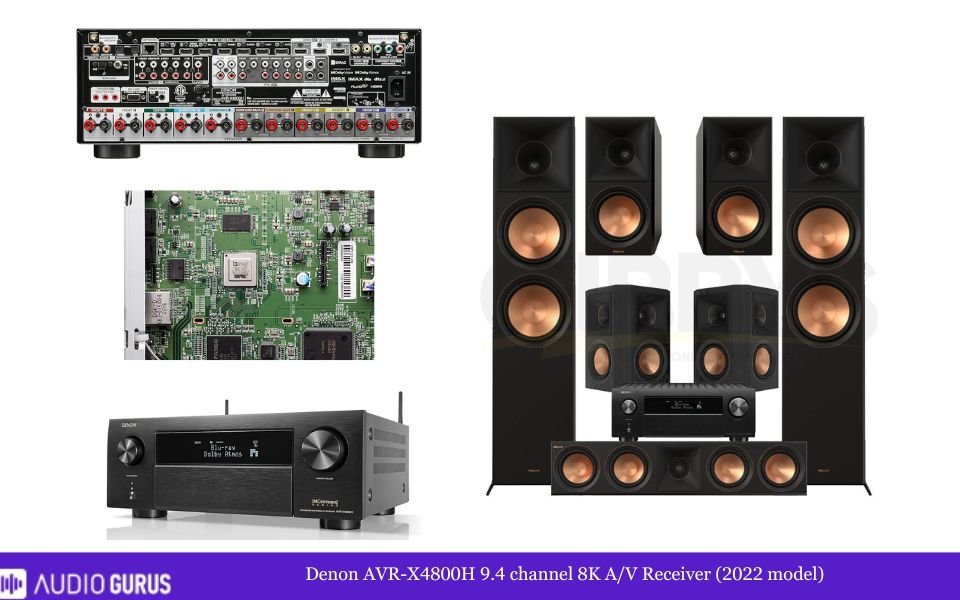
Most of the time, buying into the next generation of home theater can cost a lot of money. This receiver's $1,700 price tag makes this very clear. Denon's AVR-X4700H can do a lot for the things you already own, as well as for things you might buy in the future, like 8K TVs and 8K-compatible devices. When you think about this, it starts to show its long-term value.

The AVR-X4700 isn't a huge change from the AVR-X3700NH, but it does have more power. It has 125 watts per channel instead of the 105 watts its predecessor had. As far as the video goes, the AVR-X4700 still has support for 8K/60Hz, 4K/120Hz, Dolby Vision, and HDR10 (Dynamic HDR, HLG). The 8K upscaling you can do to your 4K Blu-rays and Netflix UHD subscriptions also comes with the new TVs. With 8 HDMI inputs and three HDMI outputs, you won't have to buy a selector for any more devices that you want to connect. We also like how Denon gave current and future-generation gamer features like Variable Refresh Rate (VRR), Quick Frame Transport (QFT), and Auto Low Latency Mode to both current and future-generation gamers (ALLM).

Audio-wise, the X4700 hasn't changed a thing. DTS:X, DTS: Virtual X, and other codecs with a lot of space are what we're talking about. Auro 3D is a three-dimensional audio alternative to Dolby Atmos. 5.2.4 or 7.2.2 traditional Atmos arrangements can be set up, or you can use the Dolby Atmos Height Virtualization feature to make it look like the sound is coming from the ceiling. You can also do the same thing with Auro 3D if that's what you prefer.

Fans of music will be right at home with the X4700's digital music support from services like Spotify, Pandora, Tidal, Soundcloud, and a lot of other things, like Spotify. There's also Denon HEOS support if you have a lot of Denon gear in your house, so you can use it with your home theater. Your phone can control and share all of the music you own. You can also teach the HEOS skill to your Echo speaker so that you can control it with your voice. X3700 also works with Google Assistant, Apple Siri, and Josh.ai, so you can use them as well.

Pros

· the best AV receiver for 8K PROS is this one.

· Ready for new content

· Player-friendly modes

CONS

· Everyone isn't interested in getting ready for 8K yet.
8.02 Mixed Usages
8.4 VIDEO FEATURES:
7.1 CONNECTIVITY OPTIONS:
7.9 AUDIO FEATURES:
8.6 MULTIZONE:
8.2 AMPLIFICATION:
Specification

General

Receiver Type A/V Receiver
Number Of Channel 5.1 , 9.4 Channel
Number Channel Processing 11
Audio Feature Dolby Atmos , DTS:X , Front Wide Ch. , Auro 3D
Video Feature HDR10
Watts Per Channel 125 W
Zones 4
Radio Internet Radio , Pandora , Spotify , Tidal , Deezer , Napster , SiriusXM
Amplifier Class G

Connectivity

Ethernet Yes
Wi-Fi Yes
Bluetooth Yes
USB Yes
RCA LIne Input: Available
RCA LIne Output: Available
RCA Pre-Outs: Available
XLR Line Inputs: Not specified
XLR Pre-Outs: Not specified
Phono Input: Yes
Optical Inputs: Not specified
Optical Output: Not specified
Coaxial Inputs: Not specified
Multi-Channel Input: Available
Headphone Out: Not specified
HDMI Inputs: Not specified
HDMI Outputs: Not specified
8K Inputs: Available
Composite Video Input Available
Composite Video Output: Available
Component Video Input: Available
Component Video Output: Available
Front A/V Inputs: Available
Speaker A/B: Not specified

AUDIO FEATURES:

Maximum Channel Processing 9.4 channels
Dolby Atmos True
Dolby Atmos Height Virtualization Yes
Dolby Atmos Music Yes
Dolby TrueHD Yes
Dolby Digital Plus Yes
Dolby Surround Upmixer Yes
Dolby Pro Logic Yes
Dolby Digital EX Yes
Surround EX Yes
DTS:X Yes
DTS Neural:X Yes
DTS Virtual:X Yes
DTS Neo Yes
DTS-HD Master Audio Yes
DTS-HD High Resolution Audio Yes
DTS 96/24
DTS Express Yes
DTS-ES Yes
IMAX Enhanced Yes
PCM Yes
Music Playback via USB Yes
High Resolution Music Playback via USB and/or Network Yes
High Resolution Audio Formats via USB Yes
Gapless Playback Yes
DSD via HDMI Yes
DSD via USB Yes
DSD to PCM Converter Yes
USB DAC Yes
Jitter Reduction Yes
DTS Dialog Control Yes
Dialog Enhancement Yes
Dialog Level Adjustment Yes
Dialog Normalization Yes
Dialogue Lift Yes
Compressed Music Enhancer Yes
High-resolution Music Enhancer Yes
Audyssey Dynamic EQ Yes
Audyssey Dynamic Volume Yes
Audyssey LFC Yes
Audyssey Sub EQ HT Yes
Audyssey DSX Yes
Direct Mode Yes
Pure Direct Mode Yes
Independent Subwoofer Outputs Yes
Auto Speaker Calibration System with Mic. YPAO
Audyssey App Support Yes
Bass Sync Yes
Optimized Bass Redirection Yes

VIDEO FEATURES:

HDMI Version HDMI v.1.4
Enhanced ARC Yes
HDCP Version Not specified
HDR10+ Yes
Dynamic HDR Yes
Dolby Vision Yes
HLG (Hybrid Log Gamma) Yes
QMS (Quick Media Switching) Yes
3-D Ready N/A
Video Signal Passthrough Yes
Video Signal Upscaling Yes
Analog To HDMI Upconversion Yes
Component Video Upscaling N/A
isf Certified Calibration Control N/A

Amplifiers

Channels 9.4 channels.
Front Wide Channel Support Yes
Current Feedback Topology Yes
Discrete Amplification Yes
HDAM Yes
THX™ Certification N/A
Continuous 6 Ω Rated N/A
Certified 4 Ω Performance N/A
Bi-amp Capability Not Specified

Gaming Features

Auto Low Latency Mode (ALLM) Yes
Variable Refresh Rate (VRR) Yes
Quick Frame Transport (QFT) Yes

Zones

Zones 4
Powered Zones Yes
Zone 2 Outs Available
Zone 3 Outs Available
RS-232C Interface Yes
+12V Trigger Output Yes

Radio

Analog Tuner Yes
Digital Radio Yes
Internet Radio Yes
Pandora Yes
Spotify Yes
Tidal Yes
Deezer Yes
SiriusXM Internet Radio Yes
Napster Yes

Additional Features

On-Screen Display Available
GUI Languages Multiple language options
Web Browser Control Yes
IP Control for CI Yes
Control4 SDDP Yes
PreAmp Mode Yes
Display Yes
Remote Controller RC-1252
Remote Control In/Out 1/1
LCD Display Yes
Detachable Power Cord N/A
Setup Assistant N/A

Power

Power Output (6 Ω, 1 kHz, 2 125W
Rated Power Output (6 Ω, 1 kHz, 1 channel driven, IEC) No
Dynamic Power per Channel (3 Ω, Front) No
Dynamic Power per Channel (4 Ω, Front) No
Dynamic Power per Channel (8 Ω, Front) No
Power Output (8 Ω, 20 Hz - 20 kHz, 2 No
Maximum Effective Power Output (6 Ω, 1 kHz, 1 channel driven, JEITA) No
Power Supply AC 120 V, 60 Hz
Toroidal Transformer Yes
Power Consumption 70 W
No Sound Power Yes
Standby Power Yes

Rating System

AUDIO FEATURES: 7.85
VIDEO FEATURES: 8.38
CONNECTIVITY OPTIONS: 7.11
MULTIZONE: 8.57
AMPLIFICATION: 8.21

Build

Dimensions (W x H x D) 435 mm x 173 mm x 435 mm
Weight 13.2 KG
Chassis Yes
Front Panel Yes
Speaker Terminals Yes
Large Speaker Terminals Yes
Color-Coded Speaker Terminals Yes
Transparent High-Grade Speaker Terminals Yes
High Grade Audio Components Yes
ECO Mode / Hybrid Standby Function Yes
Auto Power off Yes
Warranty 3 Years

Specifications

THD digital 0.01% at +20 dBu,
Analog Distortion Not Specified
Phono Distortion Not Specified
Input Sensitivity and Impedance (Line) 200 mV
Input Sensitivity and Impedance (Phono MM) Not Specified
Rated Lineout Level and Impedance 0.09 ohms
Rated Output digital Not Specified
S/N Ratio (Line, IHF-A) 74 dB (IHF-A)
S/N Ratio (Phono MM, IHF-A) 92 dB
S/N Ratio (digital) 118 dB
Phono RIAA Deviation ±1 dB (20 Hz to 20 kHz
Frequency Response (Analog In) 20Hz–20kHz
DSD Sampling Rates via HDMI 2.8MHz, 5.6MHz, and 11.2MHz
DSD Sampling Rates via USB 2.8MHz and 5.6MHz
Video Input Sensitivity/Output Level and Impedance 1 Vp-p, 75 Ω/ohm
Video Frequency Response 2 Hz to 100 MHz
Ethernet Standard Not Specified
Wi-Fi Standard Not Specified
Wi-Fi Terminal Frequency 2.4 GHz and 5 GHz
Bluetooth Version 5.0
Bluetooth Frequency 2.4 GHz.
USB Terminal 24-bit/192kHz
FM Frequency 87.5 MHz to 108 MHz
FM 50 dB Quiet Sensitivity (IHF, 1 kHz, 100% MOD.) MONO ― 2.8 μV (20.2 dBf)
FM S/N Ratio 112 dB
FM Harmonic Distortion (IHF, 1 kHz) 0.09%.
AM Effective Sensitivity 1.2 μV (12.8 dBf). 18 μV.
AM Frequency 535 to 1705 kHz.

Onkyo TX-NR 6100 Review:

People who want to stay in the middle of the price range but still have access to the most up-to-date features and standards will love this Onkyo TV. It's also a good choice for gamers or people who want to improve their movie experience. Seven-channel receiver: 80 watts per channel into 8 ohms at 0.08 percent THD with two channels used. When you need to keep the noise level down while you're playing games, there's a headphone jack. There are four HDMI 2.1 ports in and two out with HDCP 2.3 support, optical, coaxial, stereo RCA ports, USB ports, and dual subwoofer RCA ports.

There are a lot more supported standards for this Onkyo TV when we look into them. Sonos Port, AirPlay 2, Bluetooth, Chromecast, Alexa and Google Assistant can all be used with this speaker. It can also be used with Dolby Atmos or DTS:X processing. You can use it with ARC/eARC as well as Wi-Fi. Another thing that this receiver can do is optimize for HDR10+ and Dolby Vision, as well as HLG (Hybrid Log-Gamma). This makes it a good choice for a lot of different things.

Variable Refresh Rate (VRR), Auto Low Latency Mode (ALLM), and Quick Frame Transport (QFT) are some of the features that make the Onkyo TX-NR5100 a good choice for gamers. These features can help improve frame rate performance and cut down on issues with lag.

Pros

· The best mid-range A/V model

· A lot of support for the current standards and voice assistants.

· Optimized for gamers

· Good features for a price that isn't too high or too low

CONS

· there is no support for 8K

· Wattage isn't as high as it is with high-end picks.

7.44 Mixed Usages
7 VIDEO FEATURES:
8 CONNECTIVITY OPTIONS:
7.1 AUDIO FEATURES:
6.9 MULTIZONE:
8.2 AMPLIFICATION:
Specification

General

Receiver Type A/V Receiver
Number Of Channel 7.2 Channel
Number Channel Processing 7
Audio Feature Dolby Atmos , DTS:X
Video Feature HDR10 , HDR10+ , Dolby Vision , 8K Passthrough , 4K Upscaling
Watts Per Channel 100 W
Zones 2
Radio Internet Radio , Pandora , Spotify , Tidal , Deezer
Amplifier Class A/B , Non-Phase

Connectivity

Ethernet Yes
Wi-Fi Yes
Bluetooth Yes
USB Yes
RCA LIne Input: 4
RCA LIne Output: No
RCA Pre-Outs: 0.2
XLR Line Inputs: No
XLR Pre-Outs: No
Phono Input: Yes
Optical Inputs: 1
Optical Output: No
Coaxial Inputs: 1
Multi-Channel Input: No
Headphone Out: 6.3 mm (1/4
HDMI Inputs: 6
HDMI Outputs: 2 (1 Main, 1 Sub/Zone2)
8K Inputs: 3
Composite Video Input No
Composite Video Output: No
Component Video Input: No
Component Video Output: No
Front A/V Inputs: USB
Speaker A/B: No

AUDIO FEATURES:

Maximum Channel Processing 7.1
Dolby Atmos Yes
Dolby Atmos Height Virtualization Yes
Dolby Atmos Music N/A
Dolby TrueHD Yes
Dolby Digital Plus Yes
Dolby Surround Upmixer Yes
Dolby Pro Logic N/A
Dolby Digital EX N/A
Surround EX N/A
DTS:X Yes
DTS Neural:X Yes
DTS Virtual:X Yes
DTS Neo N/A
DTS-HD Master Audio Yes
DTS-HD High Resolution Audio Yes
DTS 96/24 Yes
DTS Express Yes
DTS-ES Yes
IMAX Enhanced N/A
PCM PCM
Music Playback via USB 2-ch/Multi-ch Input Music Playback via USB FLAC, WAV, Apple Lossless, WMA, MP3, DSD, AIFF, AAC, Dolby TrueHD
High Resolution Music Playback via USB and/or Network up to 192 kHz
High Resolution Audio Formats via USB FLAC, WAV, Apple Lossless, DSD, AIFF, AAC, Dolby TrueHD
Gapless Playback Yes
DSD via HDMI 2-ch/Multi-ch Input
DSD via USB 2-ch Input
DSD to PCM Converter N/A
USB DAC N/A
Jitter Reduction Yes
DTS Dialog Control Yes
Dialog Enhancement N/A
Dialog Level Adjustment N/A
Dialog Normalization Yes
Dialogue Lift N/A
Compressed Music Enhancer Advanced Music Optimizer
High-resolution Music Enhancer N/A
Audyssey Dynamic EQ N/A
Audyssey Dynamic Volume N/A
Audyssey LFC N/A
Audyssey Sub EQ HT N/A
Audyssey DSX N/A
Direct Mode Yes
Pure Direct Mode Yes
Independent Subwoofer Outputs N/A
Auto Speaker Calibration System with Mic. AccuEQ with subwoofer EQ and AccuReflex™
Audyssey App Support N/A
Bass Sync N/A
Optimized Bass Redirection N/A

VIDEO FEATURES:

HDMI Version 2.1
Enhanced ARC Yes
HDCP Version 2.3
HDR10+ Yes
Dynamic HDR N/A
Dolby Vision Yes
HLG (Hybrid Log Gamma) Yes
QMS (Quick Media Switching) Yes
3-D Ready Yes
Video Signal Passthrough Yes
Video Signal Upscaling Yes
Analog To HDMI Upconversion N/A
Component Video Upscaling N/A
isf Certified Calibration Control N/A

Amplifiers

Channels 7.2
Front Wide Channel Support N/A
Current Feedback Topology Yes
Discrete Amplification Yes
HDAM N/A
THX™ Certification Yes
Continuous 6 Ω Rated Yes
Certified 4 Ω Performance Yes
Bi-amp Capability Yes

Gaming Features

Auto Low Latency Mode (ALLM) Yes
Variable Refresh Rate (VRR) Yes
Quick Frame Transport (QFT) Yes

Zones

Zones 2
Powered Zones 2
Zone 2 Outs RCA Line Out (shared with Zone B)
Zone 3 Outs No
RS-232C Interface N/A
+12V Trigger Output 0

Radio

Analog Tuner FM/AM
Digital Radio N/A
Internet Radio TuneIn
Pandora Yes
Spotify Yes
Tidal Yes
Deezer Yes
SiriusXM Internet Radio N/A
Napster N/A

Additional Features

On-Screen Display No
GUI Languages No
Web Browser Control N/A
IP Control for CI Yes
Control4 SDDP N/A
PreAmp Mode N/A
Display No
Remote Controller No
Remote Control In/Out No
LCD Display N/A
Detachable Power Cord N/A
Setup Assistant N/A

Power

Power Output (6 Ω, 1 kHz, 2 No
Rated Power Output (6 Ω, 1 kHz, 1 channel driven, IEC) No
Dynamic Power per Channel (3 Ω, Front) 240 W
Dynamic Power per Channel (4 Ω, Front) 210 W
Dynamic Power per Channel (8 Ω, Front) 120 W
Power Output (8 Ω, 20 Hz - 20 kHz, 2 100 W (0.08% THD)
Maximum Effective Power Output (6 Ω, 1 kHz, 1 channel driven, JEITA) 210 W (10% THD)
Power Supply AC 120 V, 60 Hz
Toroidal Transformer N/A
Power Consumption 635 W
No Sound Power 65 W
Standby Power 0.1 W

Rating System

AUDIO FEATURES: 7.05
VIDEO FEATURES: 7.04
CONNECTIVITY OPTIONS: 8.01
MULTIZONE: 6.86
AMPLIFICATION: 8.24

Build

Dimensions (W x H x D) 17-1/8
Weight 9.8kg
Chassis No
Front Panel No
Speaker Terminals 9
Large Speaker Terminals 9
Color-Coded Speaker Terminals N/A
Transparent High-Grade Speaker Terminals N/A
High Grade Audio Components N/A
ECO Mode / Hybrid Standby Function Yes
Auto Power off N/A
Warranty 3 years

Specifications

THD digital 0.08% (20 Hz - 20 kHz, Half power)
Analog Distortion No
Phono Distortion No
Input Sensitivity and Impedance (Line) 200 mV/47 kΩ (1 kHz, 100 W/8 Ω)
Input Sensitivity and Impedance (Phono MM) 3.5 mV/47 kΩ
Rated Lineout Level and Impedance 1 V/470 Ω (subwoofer)
Rated Output digital No
S/N Ratio (Line, IHF-A) 106 dB
S/N Ratio (Phono MM, IHF-A) 80 dB
S/N Ratio (digital) No
Phono RIAA Deviation No
Frequency Response (Analog In) 10 Hz - 100 kHz/+1 dB, -3 dB (Direct/Pure Audio)
DSD Sampling Rates via HDMI 2.8 MHz
DSD Sampling Rates via USB 2.8 MHz, 5.6 MHz, 11.2 MHz
Video Input Sensitivity/Output Level and Impedance No
Video Frequency Response No
Ethernet Standard 10BASE-T/100BASE-TX
Wi-Fi Standard IEEE 802.11 a/b/g/n/ac
Wi-Fi Terminal Frequency 5 GHz, 2.4 GHz
Bluetooth Version 4.2
Bluetooth Frequency 2.4 GHz
USB Terminal Front: Ver. 2.0, 5 V, 0.5 A Rear: Ver. 2.0, 5 V, 1 A
FM Frequency 87.5 MHz - 107.9 MHz
FM 50 dB Quiet Sensitivity (IHF, 1 kHz, 100% MOD.) _1.0 µV (11.2 dBf)
FM S/N Ratio No
FM Harmonic Distortion (IHF, 1 kHz) No
AM Effective Sensitivity No
AM Frequency 530 kHz - 1710 kHz

Yamaha RX-A2A Review:

The RX-A2A is part of Yamaha's top-of-the-line Aventage line, and it's been given a new look and new connectivity that will make it last for years to come.

RX-A2A: It has seven full-range channels of power, each with 100W into eight ohms in stereo, and two subwoofer outputs. This means it can run up to 7.1 speaker configurations or, if you use Dolby Atmos or DTS:X decoding, a 5.1.2 set-up, depending on how many speakers you have.

It has a great sound and is very responsive. It has punchy transients, a wide sound field, and a lot of musical drive.

MusicCast is an app made by Yamaha that lets you stream music. It can play high-res and lossless formats like Apple Lossless (ALAC) up to 96kHz, WAV, FLAC or AIFF up to 192kHz, and services like Spotify and Tidal can be played. On top of that, there's also AirPlay 2 and Bluetooth (SBC or AAC) and Google Assistant or Alexa compatibility for voice control. There's also a DAB+ and FM/AM tuner, too.

There are a lot of things that Yamaha plans to do to the RX-A2A in order to make it work properly. It will be able to play back 4K at 120Hz and 8K at 60Hz through three of its seven HDMI inputs in the future.

It will take a series of firmware updates to make these features, as well as other next-generation HDMI updates and HDR10+, available. This Autumn, these features will only be available thanks to these updates. Besides the free hardware upgrade, the Xbox One X and Nvidia RTX30-series graphics cards that can play 4K at 120Hz will also be able to play it.

You might not care about this, though, if you're a real gamer. For movies, the RX-A2A can handle 4K signals at up to 60 frames per second, which no source can do right now, and it can play HDR10 and Dolby Vision video formats.

Pros

· Agility and responsiveness

· Spacious but focused presentation

· Exciting personality

Cons

· May not have enough authority

· HDMI 2.1 features need to be updated

8.84 Mixed Usages
9.9 VIDEO FEATURES:
8.5 CONNECTIVITY OPTIONS:
8.9 AUDIO FEATURES:
8 MULTIZONE:
8.9 AMPLIFICATION:
Specification

General

Receiver Type A/V Receiver
Number Of Channel 7.2 Channel
Number Channel Processing 7
Audio Feature Dolby Atmos , DTS:X
Video Feature HDR10 , HDR10+ , Dolby Vision , 8K Passthrough , 4K Upscaling
Watts Per Channel 100
Zones 2
Radio Internet Radio , Pandora , Spotify , Tidal , Deezer , Napster , SiriusXM
Amplifier

Connectivity

Ethernet Yes
Wi-Fi Yes
Bluetooth Yes
USB Yes
RCA LIne Input: 3
RCA LIne Output: N/A
RCA Pre-Outs: 2.2
XLR Line Inputs: N/A
XLR Pre-Outs: N/A
Phono Input: Yes
Optical Inputs: 1
Optical Output: N/A
Coaxial Inputs: 1
Multi-Channel Input: N/A
Headphone Out: 6.3 mm (1/4
HDMI Inputs: 7
HDMI Outputs: 1
8K Inputs: 7
Composite Video Input N/A
Composite Video Output: N/A
Component Video Input: N/A
Component Video Output: N/A
Front A/V Inputs: N/A
Speaker A/B: N/A

AUDIO FEATURES:

Maximum Channel Processing 7.1
Dolby Atmos YES
Dolby Atmos Height Virtualization Yes
Dolby Atmos Music N/A
Dolby TrueHD Yes
Dolby Digital Plus Yes
Dolby Surround Upmixer Yes
Dolby Pro Logic N/A
Dolby Digital EX N/A
Surround EX N/A
DTS:X YES
DTS Neural:X Yes
DTS Virtual:X
DTS Neo Yes
DTS-HD Master Audio Yes
DTS-HD High Resolution Audio Yes
DTS 96/24 Yes
DTS Express Yes
DTS-ES YES
IMAX Enhanced N/A
PCM 2-ch/Multi-ch Input
Music Playback via USB MP3, WMA, MPEG-4 AAC, Apple Lossless, WAV, FLAC, AIFF, DSD
High Resolution Music Playback via USB and/or Network Up to 192 kHz/32 Bit
High Resolution Audio Formats via USB Apple Lossless, WAV, FLAC, AIFF, DSD
Gapless Playback Yes
DSD via HDMI 2-ch/Multi-ch Input
DSD via USB 2-ch Input
DSD to PCM Converter N/A
USB DAC N/A
Jitter Reduction N/A
DTS Dialog Control Yes
Dialog Enhancement N/A
Dialog Level Adjustment Yes
Dialog Normalization Yes
Dialogue Lift Yes
Compressed Music Enhancer YES
High-resolution Music Enhancer N/A
Audyssey Dynamic EQ N/A
Audyssey Dynamic Volume N/A
Audyssey LFC N/A
Audyssey Sub EQ HT N/A
Audyssey DSX N/A
Direct Mode
Pure Direct Mode Yes
Independent Subwoofer Outputs N/A
Auto Speaker Calibration System with Mic. YPAO sound optimization with Multipoint Measurement
Audyssey App Support
Bass Sync
Optimized Bass Redirection

VIDEO FEATURES:

HDMI Version 2.1
Enhanced ARC Yes
HDCP Version 2.3
HDR10+ Yes
Dynamic HDR N/A
Dolby Vision Yes
HLG (Hybrid Log Gamma) Yes
QMS (Quick Media Switching) Yes
3-D Ready Yes
Video Signal Passthrough Yes
Video Signal Upscaling Yes
Analog To HDMI Upconversion N/A
Component Video Upscaling N/A
isf Certified Calibration Control N/A

Amplifiers

Channels 7.2
Front Wide Channel Support Yes
Current Feedback Topology
Discrete Amplification
HDAM
THX™ Certification N/A
Continuous 6 Ω Rated Yes
Certified 4 Ω Performance Yes
Bi-amp Capability YES

Gaming Features

Auto Low Latency Mode (ALLM) Yes
Variable Refresh Rate (VRR) Yes
Quick Frame Transport (QFT) Yes

Zones

Zones 2
Powered Zones Zone 2
Zone 2 Outs RCA Preout
Zone 3 Outs N./A
RS-232C Interface N/A
+12V Trigger Output 1

Radio

Analog Tuner FM/AM
Digital Radio N/A
Internet Radio YES
Pandora Yes
Spotify Yes
Tidal Yes
Deezer Yes
SiriusXM Internet Radio Yes
Napster Yes

Additional Features

On-Screen Display Graphical User Interface
GUI Languages YES
Web Browser Control Yes
IP Control for CI
Control4 SDDP
PreAmp Mode N/A
Display LCD
Remote Controller YES
Remote Control In/Out 1/1
LCD Display Yes
Detachable Power Cord Yes
Setup Assistant

Power

Power Output (6 Ω, 1 kHz, 2
Rated Power Output (6 Ω, 1 kHz, 1 channel driven, IEC) 125 W (0.9% THD)
Dynamic Power per Channel (3 Ω, Front)
Dynamic Power per Channel (4 Ω, Front)
Dynamic Power per Channel (8 Ω, Front)
Power Output (8 Ω, 20 Hz - 20 kHz, 2 100 W (0.06% THD)
Maximum Effective Power Output (6 Ω, 1 kHz, 1 channel driven, JEITA) 160 W (10% THD)
Power Supply AC 120 V, 60 Hz
Toroidal Transformer
Power Consumption 360 W
No Sound Power
Standby Power 0.1 W

Rating System

AUDIO FEATURES: 8.9
VIDEO FEATURES: 9.9
CONNECTIVITY OPTIONS: 8.5
MULTIZONE: 8.01
AMPLIFICATION: 8.88

Build

Dimensions (W x H x D) 17-1/8
Weight 10.2 kg (22.5 lbs)
Chassis
Front Panel
Speaker Terminals 9
Large Speaker Terminals 9
Color-Coded Speaker Terminals Yes
Transparent High-Grade Speaker Terminals
High Grade Audio Components
ECO Mode / Hybrid Standby Function Yes
Auto Power off Yes
Warranty 3 Years

Specifications

THD digital 0.04% (AUDIO 3 etc. to Front, Pure Direct, 20 Hz - 20 kHz, 50 W, 8 Ω)
Analog Distortion
Phono Distortion
Input Sensitivity and Impedance (Line) 200 mV/47 kΩ
Input Sensitivity and Impedance (Phono MM) 3.5 mV/47 kΩ
Rated Lineout Level and Impedance
Rated Output digital
S/N Ratio (Line, IHF-A) 110 dB
S/N Ratio (Phono MM, IHF-A) 95 dB
S/N Ratio (digital)
Phono RIAA Deviation 0±0.5 dB (20 Hz - 20 kHz)
Frequency Response (Analog In) +0/-3 dB (AUDIO 3 etc. to Front, Pure Direct, 10 Hz to 100 kHz)
DSD Sampling Rates via HDMI 2.8 MHz
DSD Sampling Rates via USB 11.2 MHz, 5.6 MHz, 2.8 MHz
Video Input Sensitivity/Output Level and Impedance
Video Frequency Response
Ethernet Standard 10BASE-T/100BASE-TX
Wi-Fi Standard IEEE 802.11 a/b/g/n/ac
Wi-Fi Terminal Frequency 2.4 GHz, 5 GHz
Bluetooth Version 4.2
Bluetooth Frequency 2.4 GHz
USB Terminal USB2.0 5 V, 1 A
FM Frequency 87.5 MHz - 107.9 MHz
FM 50 dB Quiet Sensitivity (IHF, 1 kHz, 100% MOD.) Mono: 3 µV (20.8 dBf)
FM S/N Ratio Mono/Stereo: 69 dB/68 dB
FM Harmonic Distortion (IHF, 1 kHz) Mono/Stereo: 0.5%/0.6%
AM Effective Sensitivity
AM Frequency 530 kHz - 1710 kHz

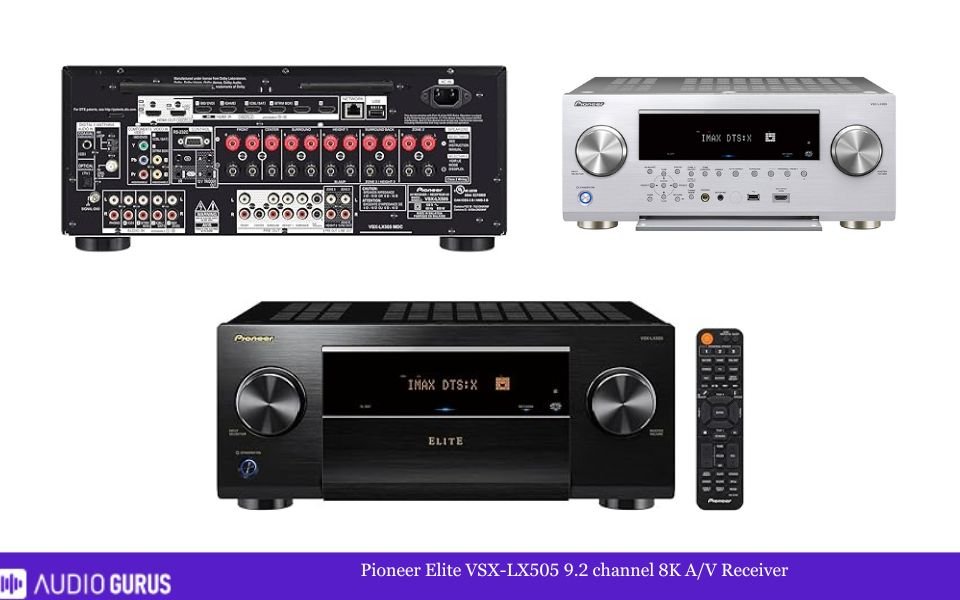
The Pioneer Elite VSX-LX505

This Dolby Atmos AV receiver has nine channels and is suitable for speaker configurations of 5.2.4 or 7.2.2. It is available in black and white. The HDMI configuration includes seven inputs (including one on the front facia) and two outputs. There is Dolby Vision support, but there is no 8K support. There are only two digital audio inputs available: one coaxial and one optical.

Pioneer AVRs have a distinctively crisp delivery that can sound overly analytical at times, but we enjoyed the character of the AVRs we tested throughout our listening tests. Also included is a Reflex Optimizer feature that allows you to fine-tune up-firing Dolby Atmos speakers. Apart from that, this receiver offers built-in Chromecast and Google Assistant support, in addition to Apple Airplay 2 and support for DTS Play-Fidelity technology. In terms of value for money, it's difficult to disagree with this gleaming Pioneer at this pricing.

Pros

· high-end video game console.

· Extremely powerful amplification for the money

· Customizable sound presets

Cons

· There is no 8K/4K 120fps video

· A limited number of digital interfaces are available
7.21 Mixed Usages
7.1 VIDEO FEATURES:
7.1 CONNECTIVITY OPTIONS:
6.5 AUDIO FEATURES:
7.6 MULTIZONE:
7.8 AMPLIFICATION:
Specification

General

Receiver Type A/V Receiver
Number Of Channel 9.2 Channel
Number Channel Processing 9
Audio Feature Dolby Atmos , DTS:X
Video Feature HDR10 , HDR10+ , Dolby Vision , 8K Passthrough , 8K Upscaling
Watts Per Channel 120 W
Zones 3
Radio Internet Radio , Pandora , Spotify , Tidal , Deezer
Amplifier Class A/B

Connectivity

Ethernet Yes
Wi-Fi Yes
Bluetooth Yes
USB Yes
RCA LIne Input: 7
RCA LIne Output: 2
RCA Pre-Outs: 11.2 (barter to Zone 3 out)
XLR Line Inputs: No
XLR Pre-Outs: No
Phono Input: Yes
Optical Inputs: 1
Optical Output: No
Coaxial Inputs: 1
Multi-Channel Input: No
Headphone Out: 6.3 mm (1/4")
HDMI Inputs: 7 (1 front)
HDMI Outputs: 2 (1 MAIN, 1 SUB/ZONE 2)
8K Inputs: 6
Composite Video Input 2
Composite Video Output: No
Component Video Input: 1
Component Video Output: No
Front A/V Inputs: HDMI, USB
Speaker A/B: No

AUDIO FEATURES:

Maximum Channel Processing 9.2
Dolby Atmos Yes
Dolby Atmos Height Virtualization Yes
Dolby Atmos Music N/A
Dolby TrueHD Yes
Dolby Digital Plus Yes
Dolby Surround Upmixer Yes
Dolby Pro Logic N/A
Dolby Digital EX N/A
Surround EX N/A
DTS:X Yes
DTS Neural:X Yes
DTS Virtual:X N/A
DTS Neo N/A
DTS-HD Master Audio N/A
DTS-HD High Resolution Audio Yes
DTS 96/24 Yes
DTS Express Yes
DTS-ES Discrete 6.1, Matrix 6.1
IMAX Enhanced Yes
PCM 2-ch/Multi-ch Input
Music Playback via USB MP3, WMA, AAC, Apple Lossless, WAV, FLAC, LPCM, AIFF, DSD
High Resolution Music Playback via USB and/or Network up to 192 kHz/24 bit
High Resolution Audio Formats via USB Apple Lossless, WAV, FLAC, AIFF, AAC, DSD
Gapless Playback Yes
DSD via HDMI 2-ch/Multi-ch Input
DSD via USB 2-ch Input
DSD to PCM Converter N/A
USB DAC N/A
Jitter Reduction N/A
DTS Dialog Control Yes
Dialog Enhancement Yes
Dialog Level Adjustment N/A
Dialog Normalization N/A
Dialogue Lift N/A
Compressed Music Enhancer Advanced Sound Retriever
High-resolution Music Enhancer N/A
Audyssey Dynamic EQ N/A
Audyssey Dynamic Volume N/A
Audyssey LFC N/A
Audyssey Sub EQ HT N/A
Audyssey DSX N/A
Direct Mode Yes
Pure Direct Mode Yes
Independent Subwoofer Outputs Yes
Auto Speaker Calibration System with Mic. Advanced MCACC and Dirac Live™ Room Correction
Audyssey App Support N/A
Bass Sync N/A
Optimized Bass Redirection N/A

VIDEO FEATURES:

HDMI Version 2.1
Enhanced ARC Yes
HDCP Version 2.3
HDR10+ Yes
Dynamic HDR N/A
Dolby Vision Yes
HLG (Hybrid Log Gamma) Yes
QMS (Quick Media Switching) Yes
3-D Ready Yes
Video Signal Passthrough Yes
Video Signal Upscaling Yes
Analog To HDMI Upconversion N/A
Component Video Upscaling N/A
isf Certified Calibration Control N/A

Amplifiers

Channels 9.2
Front Wide Channel Support N/A
Current Feedback Topology N/A
Discrete Amplification N/A
HDAM N/A
THX™ Certification N/A
Continuous 6 Ω Rated Yes
Certified 4 Ω Performance Yes
Bi-amp Capability Yes

Gaming Features

Auto Low Latency Mode (ALLM) Yes
Variable Refresh Rate (VRR) Yes
Quick Frame Transport (QFT) Yes

Zones

Zones 3
Powered Zones 2 and 3
Zone 2 Outs HDMI, RCA Pre/Line Out (shared with Zone B line out)
Zone 3 Outs RCA Pre/Line Out
RS-232C Interface N/A
+12V Trigger Output 2 (A: 100 mA, B: 25 mA)

Radio

Analog Tuner FM/AM
Digital Radio N/A
Internet Radio TuneIn
Pandora Yes
Spotify Yes
Tidal
Deezer Yes
SiriusXM Internet Radio
Napster N/A

Additional Features

On-Screen Display Yes
GUI Languages 7
Web Browser Control Yes
IP Control for CI Yes
Control4 SDDP Yes
PreAmp Mode Yes
Display Yes
Remote Controller RC-974R
Remote Control In/Out 1 / 1
LCD Display Yes
Detachable Power Cord Yes
Setup Assistant N/A

Power

Power Output (6 Ω, 1 kHz, 2 120 W
Rated Power Output (6 Ω, 1 kHz, 1 channel driven, IEC) 215 W
Dynamic Power per Channel (3 Ω, Front) 300 W
Dynamic Power per Channel (4 Ω, Front) 250 W
Dynamic Power per Channel (8 Ω, Front) 150 W
Power Output (8 Ω, 20 Hz - 20 kHz, 2 80 W
Maximum Effective Power Output (6 Ω, 1 kHz, 1 channel driven, JEITA) 230 W
Power Supply AC 120 V, 60 Hz
Toroidal Transformer N/A
Power Consumption 570 W
No Sound Power 65 W
Standby Power 0.15 W

Rating System

AUDIO FEATURES: 6.48
VIDEO FEATURES: 7.1
CONNECTIVITY OPTIONS: 7.12
MULTIZONE: 7.62
AMPLIFICATION: 7.75

Build

Dimensions (W x H x D) 435 x 185 x 441 mm
Weight 13.8 kg
Chassis Steel
Front Panel Aluminum
Speaker Terminals 11
Large Speaker Terminals 11
Color-Coded Speaker Terminals Yes
Transparent High-Grade Speaker Terminals N/A
High Grade Audio Components Yes
ECO Mode / Hybrid Standby Function Yes
Auto Power off Yes
Warranty 2 Years

Specifications

THD digital 0.08% (20 Hz - 20 kHz, Half Power)
Analog Distortion 0.08% (20 Hz - 20 kHz, Half Power)
Phono Distortion 0.08% (20 Hz - 20 kHz, Half Power)
Input Sensitivity and Impedance (Line) 200 mV/47 kΩ
Input Sensitivity and Impedance (Phono MM) 3.5 mV/47 kΩ
Rated Lineout Level and Impedance 1 V/2.2 kΩ
Rated Output digital 0.5 Vp-p/75 Ω
S/N Ratio (Line, IHF-A) 106 dB
S/N Ratio (Phono MM, IHF-A) 80 dB
S/N Ratio (digital) 103 dB
Phono RIAA Deviation 20 Hz - 20 kHz, ±0.5 dB
Frequency Response (Analog In) 10 Hz - 100 kHz, +1 dB/-3 dB
DSD Sampling Rates via HDMI 2.8 MHz, 5.6 MHz
DSD Sampling Rates via USB 2.8 MHz, 5.6 MHz, 11.2 MHz
Video Input Sensitivity/Output Level and Impedance 1 Vp-p/75 Ω
Video Frequency Response 5 Hz - 10 MHz, +0 dB/-3 dB
Ethernet Standard IEEE802.3 10BASE-T/IEEE802.3u 100BASE-TX
Wi-Fi Standard IEEE802.11 a/b/g/n/ac
Wi-Fi Terminal Frequency 2.4 GHz/5 GHz
Bluetooth Version 4.2
Bluetooth Frequency 2.4 GHz
USB Terminal Type A
FM Frequency 87.5 MHz - 108 MHz
FM 50 dB Quiet Sensitivity (IHF, 1 kHz, 100% MOD.) 1.6 µV (17.3 dBf)
FM S/N Ratio 73 dB (Mono), 70 dB (Stereo)
FM Harmonic Distortion (IHF, 1 kHz) 0.5% (Mono), 0.8% (Stereo)
AM Effective Sensitivity 18 µV
AM Frequency 522 kHz - 1611 kHz

How to Choose the Best Surround Receiver for You

Receiver up to a certain point This is by far the most important factor to take into consideration. If you only intend to use your new receiver for music, you should purchase a stereo receiver. An AV receiver is required if you want to use surround sound in your home theater system. If you're looking for a receiver that can handle both music and home theater, the AV receiver is a great choice.

· Make sure you have enough channels for the present and the future. One speaker equals one channel. Check to see that your new receiver has enough channels to accommodate all of the speakers you currently have, as well as any additional speakers you may want to purchase in the future. There must be at least five channels if you want to enjoy surround sound.

Consider everything and anyone with whom you'll be establishing a connection. Take into account every single source you'll want to connect to, both now and in the future. For example, if you want to use your computer to play vinyl records, you'll need a phono input. If you want to listen to music wirelessly, you'll need to have Wi-Fi onboard, among other things. (In addition to Bluetooth, Airplay, and other similar technologies, so you can play music from your smartphone and tablet however you want.) The more connectivity your new receiver provides, the better, because you'll want to be able to connect any new gadget or device that you purchase in the future.

· The investment in state-of-the-art video switching is worthwhile. Even if you do not have a 4K television, 4K video switching is an absolute must-have feature. Check that you can connect any and all video sources, such as a DVD player or an Apple TV, to your system. It is all about

connecting multiple 4K-capable devices to a single display via an audio-visual receiver when using 4K switching.

· Make sure to purchase a receiver that is compatible with Dolby Atmos technology. Consider this: incredible, 3D-like sound that seems to hover all around you. Also available is Dolby Atmos-like DTS:X, a new surround sound format that is intended to make home theater audio more immersive, similar to Dolby Atmos. The good news is that the majority of new AV receivers are capable of playing both formats.

Frequently Asked Questions
Is it a bad idea to leave a surround receiver turned on all of the time?

Although it is not the best habit, it will not cause significant harm. AV receivers today are designed to be able to go into standby mode while using the least amount of power possible.

Is it necessary to ventilate an A/V receiver?

It is critical to have adequate ventilation in order to prevent the receiver from overheating. In the case of Denon, the manufacturer recommends that you give its receivers at least five inches of space on top and two inches of space on either side. Depending on how hot the amplifier inside gets, it might decide to shut down on its own to protect itself.

What number of channels should an audio/video receiver have?

In light of the fact that receivers are built to last for a long time, it's a good idea to get as many channels as possible so that you have the option of upgrading to more surround sound down the road. Even if you don't currently use that many speakers, we recommend that you invest in at least a 7.1-channel system.

Is it possible to put my receiver in a cabinet?

There are two things you need to think about when you put an AV receiver in a cabinet. AV receivers need air and must be able to move. In the same way as other AV components, AV receivers can be controlled with IR remotes. Many people today have apps that you can use from your phone. All have IR control, though. In this case, you'll need an IR solution (like a receiver extender) that can send the IR commands to your TV's AV receiver without you having to use your phone.

Second, your AV receiver needs to be able to breathe. This is very important. AV receivers can make a lot of noise and heat. A lot of problems can happen if that heat doesn't have a way to get away from the person who's getting it. There is a lot of things you can do, from turning it off to bricking it. If you read the manual for your AV receiver, there will be suggestions about how to ventilate the unit. Then, follow them.

Is it really important what the inputs labels called?

This is what you'll see on the back of your AV receiver: A ton of different ports. Labels like Blu-ray, DVD and so on will be there. They will also have names like Sat and Game. People don't like these labels, and they make them feel stressed out, It takes them a long time to make sure they plug the right thing into the right place. There are many people who are afraid to use the wrong input on their AV receivers.

No, for the most part. They are just labels that the manufacturer put on things. Most of the time, you can change these labels in the receiver's menu to show up on the screen how you want. That one is better for your cable box and another is better for your game system doesn't mean that one is better than the other. The labels on the back of the receiver are just there to help you remember what you plugged in and where on the back.

All other inputs are the same except for HDMI 2.1. At this point, there are many receivers that only have a few HDMI 2.1 ports. All of your next-generation gaming consoles (Xbox Series X/S or PlayStation 5) need HDMI 2.1 inputs, no matter what the name says. If you don't, you won't be able to play games with the new HDMI 2.1 features.

Final Words:

It's clear from our roundup that the AVR market has many choices and a wide range of prices. Think about how much it will cost and what kind of system you would like to build to figure out which is best for you. No, I would not want to move up from 5.1 to 7.1 or Atmos at this point in time. If you want to reach your goal, you might also need to buy a new TV and speakers. People should learn as much as they can about AV receivers before they buy one. Because they do so many things at once, it's important.

It has been a long time since we've shown you a lot of different things and given you a lot of information. A lot of things need to be considered when you buy the best AV receiver on the market. These things include the specifics of your system, the space you're putting it in, and what you want to do with the receiver. Before you can decide which one is the finest, you'll have to consider these factors.

More Articles


Best Upfiring Speakers
Are you looking for a new sound system for your home theater that can be good to go and a bang for your buck? Well, think no more. In this scenario, Dolby atmos upward firing speakers are the easiest option. They can give a perfect sound experience with less than zero hassle to put up. Here we made a list of the Best Upfiring Speakers you can find in today's market.  With its object-based virtual surround sound system that can transport sound flawlessly in 3D space, even above your head, Dolby atmos upward firing speakers is the hottest edition on the block. Up-firing speakers were expensive, which prompted us to spend a lot of time evaluating and comparing them. Yes, a speaker which can play audio from the top is required. While in-ceiling speakers provide richer, higher-quality sound, upfiring systems are preferable if you don't want to make holes in the ceiling. How Uplifting Speakers Work Best atmos upfiring speakers function by projecting high-frequency sounds (rain, airplane overpasses, birds in trees, etc.) from the front speakers against the roof, reflected in the listener's ear. The best atmos speakers ceiling is 12-14 inches, and one of the best methods to install Dolby atmos upward firing speakers placement on a domed roof is to suspend a front-firing unit from the ceiling using wires to tilt it to shoot straight down. This has the advantage of being a closed box device. Best Upfiring Speakers Dolby Atmos and DTS:X have elevated the surround sound experience by allowing consumers to include overhead audio in their home theater installations. Customers can now choose from various speaker types, including in-ceiling speakers installed above the listening position. Speakers with integrated up-firing drivers can bounce sound off a ceiling to simulate audio from above—Add-on modules with up-firing drivers can be placed on top of existing speakers. We've compiled a selection of excellent Dolby Atmos speaker alternatives for every budget with these considerations in mind. Similarly, all of these items should be compatible with DTS:X audio. These are our selections for the finest Dolby Atmos speakers of the year, ranging from low-cost add-on modules to high-end floor-standing units. ELAC Debut 2.0 A4.2 Dolby Atmos Modules Dolby Atmos technology enhances the soundscape, producing a natural 3-D environment that you have to hear to believe. Simply place the ELAC Debut A4.2 on top of your bookshelf or floor standing speakers with Dolby Atmos-enabled AV receivers and processors to create dimensionality that puts you right in the heart of the music and action. A robust woofer with a 4" aramid cone and a 0.5" polymer dome tweeter are included in the Debut BA4.2. Compared to traditional paper or plastic drivers, aramid fiber has a higher strength-to-weight ratio and better damping qualities. As a result of the increased strength, designs with broader bandwidth and smoother responses are possible. Additional Info Brand-new design Few speakers have received as much praise as ELAC's initial Debut Series. They created a new value proposition, with built performance and quality never seen before at such a low cost. Debut "revolutionized," and now the Debut 2.0 Series has altered it again, proving that ELAC can't stop there. These speakers have been completely redesigned and sound even better than those that started the inexpensive high-end sound revolution. Woofer made of woven Aramid fiber  Compared to polypropylene or paper cones, woven aramid fiber has a better stiffness-to-weight ratio and damping. The increased strength gives additional design freedom, allowing for a smooth, prolonged low-frequency response. Certified by Dolby Atmos This speaker is meant to fit on top of a regular floor standing or shelf speaker to give your home cinema system a height dimension without in-ceiling speakers. Personalized Concentric Driver  This concentric driver, designed by Andrew Jones, provides a remarkable audio experience by providing a smoother, more prolonged response and greater directivity control than traditional full-range speakers. Complex Crossover  The designers created a unique crossover with audio-grade components to achieve a seamless transition between drivers. Specs: Crossover frequency: 2,000 Hz Frequency response: 180 to 20,000 Hz Sensitivity: 85 dB at 2.83 v/1m Maximum power input: 80 watts Nominal impedance: 6 ohms Dimensions: 4.92" high, 7.09" wide, 9.21" deep Net weight (each): 5.4 lbs. Reason to buy: Bang for buck Metal body Fantastic sound experience Reason to avoid: Not preferable to some. Sony SSCSE Dolby Atmos Enabled Speakers To replicate a spectacular surround sound experience, add these SS-CSE Dolby Atmos height speakers to your current home theater system and living area. Sony explicitly created the SS-CSE speakers for Dolby Atmos surround sound technology. Although they also perform well with other sophisticated surround formats such as DTS: X.  They provide spectacular 360-degree surround sound that envelops you from every angle, even overhead, giving you an actual theater-like experience. There are no complex speaker configurations required; simply lay the SS-CSE speakers on top of your current speakers for a more immersive surround experience. Every component of these Sony speakers was designed to minimize vibration and distortion. Additional Info: Compact and adaptable These Sony SS-CSE Speakers have a slim design that makes them excellent for hiding under existing speakers and walls. If you're seeking a dramatic Dolby Atmos sound update or just want to expand your current surround sound experience, these adaptable speakers are ideal. Speaker Cones with Mica Reinforcement  Unlike many traditional speakers with paper cones that degrade with time and give distorted sound, the SS-CSE Speakers have mica-reinforced cellular cone woofers that resist distortion more effectively even under high pressure. Acoustic Resonance Within the all-wood speaker cabinet, each of the Sony's SS-CSE Speaker incorporates medium density fiberboard internal joints that readily dampen and absorb undesirable vibrations to provide genuine sound that is well balanced around the space. Design for the CS Series The tiny cabinet of the SS-CSE Speakers complements existing CS series speakers in sound and appearance, blending in effortlessly with your decor. Wall-Mounted Front High You may upgrade to a pre-theater system by hanging these inconspicuous SS-CSE Speakers on your wall at a high front position above your TV for excellent multi-dimensional Dolby Atmos sound. Specs: Full range: 1 x 3.94-inch cone type Rated impedance: 6 ohms Maximum input power: 100 W Sensitivity level: 86 dB (2.83 V, 1 m) Input terminal: Push type speaker terminal Frequency response: 70-32,000 Hz, conforms to Dolby Atmos specifications Dolby Atmos-enabled speakers: 2 Dimensions (W x H x D): Approx. 7-1/8 x 5-3/4 x 7-1/8 inches (178 mm x 145 mm x 180 mm) without speaker terminal/with grill Weight: 6 lb 10 oz (3 kg) Reasons to buy: Great value for money Ideal for small to mid-sized rooms Mica subwoofer It can be set up on walls and ceilings and takes less space. Reasons to avoid: Not ideal for large rooms Noticeable bulgy form factor despite the size No wireless connectivity Klipsch RP Passive 2-Way Speakers The Klipsch Reference Premiere is another excellent ceiling speaker that supports Atmos surround sound. Klipsch is known for its high-quality products, and these speakers do not disappoint. They were also the best Dolby Atmos speakers in 2021. The RP Passive is constructed such that sound travels over the ceiling to provide surround sound, which can improve the movie-going experience. Additional Info: The Klipsch Reference Premiere uses a 1-inch titanium LTS vented tweeter and a 5.25-inch woofer to offer high-quality audio with precise crystal details across the entire frequency range. It comes as a pair, and the best thing is that both speakers work together to provide the impression of a single source of music. In terms of power, it generates 300W and has a peak output of 75W. USING A WALL BRACKET, the RP Passive speaker may be mounted on the wall, on the ceiling, or on the top of your existing tower speakers. The Klipsch Reference Premiere has several flaws, one of which is the speaker's size and design. Because it doesn't mix in well with the ceiling, it might be distracting for some individuals. On the other hand, these bad guys may be effortlessly hooked into your current audio system and give you the impression of a ceiling speaker. Specs: Measurements: 7.4 x 6.8 x 11.2 inches Weight: 7.9 pounds Connection: Wired Output: 75W and 300W peak power Warranty: 5 years manufacturer warranty Reason to buy: 6-inch driver Two speakers Titanium tweeters for high-quality audio across all frequencies Reason to avoid: Costly PSB Imagine XA Dolby Atmos System Pair The PSB Imagine XA is the first speaker to support Dolby Atmos®. The Imagine XA is a Dolby Atmos "elevation" or "height" speaker that generates a magnetic layer of sound above the listener and offers the exhilaration of Dolby Atmos-encoded soundtracks with 3D realism in Dolby Atmos systems from 5.1.2 to 7.1.4 or above. Immerse yourself in Imagine XA's multi-dimensional, auditory environment, and hear the vivid detail of your favorite movies as if you were genuinely there. Additional Info: With a sloping top tilted roughly 30 degrees, the PSB Imagine XA speaker is similar to other Atmos® Enabled speakers. The angled top baffle is buried far behind the cover grill, which is uncommon because it serves as more than just a cosmetic cover for the drivers. The cover is coated with foam, focusing the sound bafflingly. The two drivers complement the Imagine X Series with a 1" Ferrofluid cooled titanium tweeter and a 4" clay-filled polypropylene mid-range driver, the two drivers complement the Imagine X Series. The PSB XA module was created to be installed on the four speakers that surround the seating area, creating a ceiling-reflected route from in front and behind the listening position. With similar black ash finishes, it blends in with the more prominent speaker and appears to be a part of it. PSB provides rubber feet to offer the XA stability while preserving the finish when put on a speaker. Specs: 1" Titanium Dome Tweeter With Ferrofluid And Neodymium Magnet Structure With Heat Sink 4" Woofer With Clay/Ceramic Reinforced Polypropylene Cone Acoustic Suspension (Sealed) Cabinet Design Wall Mountable (Brackets Included) Frequency Response: 100-23,000 Hz (±3db) Nominal Impedance: 8 Ohms (4 Ohms Minimum) Sensitivity: 87 dB Recommended Power: 10-80 Watts Weight: 6.5 Lbs. Each Warranty: 5 Years Reason to buy: Simple, clean styling Easier to set up Wall mounting kit included Classic PSB sound Reasons to avoid: Needs more than 4XA modules. Few color options A better attachment. SVS Prime Elevation Speaker The SVS Prime Elevation is billed as the world's most adaptable home theater speaker, and this claim is accurate. The SVS Prime Elevation was developed primarily as a high-performance height effect speaker, and it's a terrific option if you need one, especially if you can't install in-ceiling height speakers for whatever reason and don't want to utilize Atmos modules. Additional Info: The Prime Elevation speaker is an angled front baffle high-performance speaker. This arrangement strikes a balance here between speakers and height modules. It's far easier to install than in-ceiling speakers, and it provides a far superior audio experience than the height module. It's a fantastic height speaker, especially if you don't want to put holes in your ceiling or aren't permitted to.  It may be mounted high on a side wall (including wall brackets) and directed toward your listening location. The designer didn't limit the frequency range or anything because this is a direct-radiating speaker. They just released a high-performance full-range loudspeaker with convincing height effects. What makes this speaker so remarkable is that it can be used as a regular speaker as well. It may be used as a front, center, or surround speaker because it is a full-range speaker. With 5, 7, 9, or more SVS Elevation Prime speakers, you may create a complete home theater system. All you have to do now is add a subwoofer (or two) to your system. The audio performance of SVS Prime Elevation is pretty impressive. The low-end reproduction was the only element that didn't wow us. The bass is present but not particularly forceful or full-bodied, which is to be anticipated given the speaker's size. Another excellent feature is the affordability. The speaker is not inexpensive, but it is reasonable when compared to other brands such as Klipsch or Sony. You can get a pair of them for $400 (in black ash) or $500 (in walnut) (piano gloss black and piano gloss white). Specs: Width 5.4in Height 9.25in Depth 7.9in Weight : 7.8 pounds Midrange woofers: 4.5-inch polypropylene cone, x1 Tweeters: 1-inch aluminum dome, x1 Type: 2-way crossover Crossover frequency 2.5kHz ENCLOSURE TYPE: Ported, 1-inch rear-firing bass reflex port CONNECTIONS: 5-way binding posts Frequency response: 55Hz to 22kHz Nominal impedance: 8Ω Recommend amp power: 20W to 150W Sensitivity: 87dB Reasons to buy: Simple but elegant design Great versatility/can be used as height, front, center, or surround speaker. Simple installation Excellent price/quality ratio Great midrange and treble reproduction Reasons to Avoid: There are only three colors available, and the price difference between different versions is significant (up to $100)    Klipsch RP-140SA Dolby Atmos Speaker (Pair) Based on its acclaimed Reference Premiere line, Klipsch has unwrapped its first set of Dolby Atmos (and DTS:X) speakers and the RP-280F and RP-140SA. Dolby Atmos is a new home theater standard that includes new height channels and necessitates a suitable new amplifier and ceiling-mounted or "height" speakers. Additional Info: The $500 RP-140SA add-on module, which sits on top of your existing speaker and can also operate as a rear surround, is of particular interest to Klipsch customers. For sound compatibility with the rest of the Reference Premiere range, the RP-140SA uses 4-inch Cerametallic Woofers and Tractrix Horn-loaded LTS tweeters. The speaker is smaller than the towers on which it's supposed to rest, and its appearance is a little odd. Meanwhile, the "grown-up" RP-280FA ($2,400 a pair) incorporates an upfiring 4-inch woofer and tweeter onto the top of the cabinet, giving it a more integrated look. Klipsch is also releasing the RP-450CA ($850) as a companion center speaker. Because this is a center channel, it lacks a distinct height component; in Dolby's consumer system, this is only available for front and back stereo height channels. While the RP-140SA is only available in the RP160Ms' brushed polymer veneer (which is extremely friendly), the other two speakers are available in walnut or black ash veneer. We thought the Reference Premiere surround system to be one of the better alternatives at its price range when we examined it earlier this year, with the $600 RP160M monitors standing out in particular. As a result, we're looking forward to these new additions. While Dolby Atmos and its rival DTS:X are still in their infancy, these speakers appear to be worth investigating if you're trying to go into "object-based surround." Reason to buy: The flexibility of stand or speaker-top use Strongly defined height effects Horn-loaded tweeter Reason to avoid: Potential timbre-matching issues Footprint too large for some speakers Requires flat or nearly flat speaker top POLK Reserve R900 Height Speaker Modules Add Polk Audio's R900 height modules to your home theater. To access an IMAX-enhanced dynamic sound world, The R900's distinctive design allows it to sit atop other Reserve Series speakers or be mounted to the wall, unlocking the Reserve Series' Dolby Atmos and DTS:X capabilities. To create the perfect home theater system, you may mix and match these speakers, which use the same driver components as the Reserve series speakers. Polk Audio recommends using 45W to 100W or more per channel power amplification to get the most quality and performance out of this speaker. Additional Info: The R900 just sounds "better" than similar speakers. We learn what "better" looks like, feels like, tastes like, and even drives like as we become older and more experienced. The Polk Reserve range of loudspeakers inherits best-in-class technology from Polk's flagship Legend series, revealing what "better" sounds like. Reserve isn't going to cost you a fortune. It provides Polk's flagship sound at an affordable price. Polk's Reserve R900 height module is Dolby Atmos-certified and built to DTS:X standards. This height module provides easy versatility by being able to wall mount or position on top of a compatible Reserve speaker. Toggle the switch on the speaker's rear to the appropriate position, and the speaker will adjust to provide the best possible performance. The R900 supports Dolby Atmos, Dolby Atmos height virtualization, DTS, DTS:X, DTS Virtual:X, and IMAX Enhanced soundtracks, and DTS DTS:X, DTS Virtual:X, and IMAX Enhanced soundtracks. Listening to material with Atmos and DTS:X on Reserve Series speakers immerses you in the tale of music every time. When watching IMAX Enhanced movies, television shows, or music, the IMAX Enhanced accreditation ensures an unforgettably significant and dramatic home theater experience. The unusual pointed design of the Pinnacle Ring Radiator Tweeter facilitates the dispersion of high-frequency sounds across a space. This innovation expands the sweet spot, giving you the flexibility to listen to music and watch movies wherever you like. Polk Audio's ground-breaking turbine cone woofer design increases cone stiffness without adding bulk. This advancement allows the woofer to move with greater precision and speed, resulting in improved sound quality and a spectacular detail in your music and movies. The Reserve series is made to last, with a 5-year limited guarantee that is the finest in the industry. Specs: Overall Frequency Response: 50 – 50kHz (when wall mounted) Frequency Response (-3dB limits): 70 – 32kHz (when wall mounted) Recommended Amplifier Power: 45 - 100W Amplifier Output Compatibility: 8Ω / 6Ω / 4Ω Minimum Impedance (ohms): 4.2Ω Sensitivity (2.83V/1m): 85.5dB (when wall mounted) Tweeter/Mid-range Crossover Frequency: 2100 Dimensions W x H x D (including width of feet): 6.5 x 6.2 x 12.6 inches Weight (each): 6.6 lbs. Reasons to buy: Good sound despite the small size Easy to mount Crossover switch for on wall or upfiring Reasons to avoid: The woofer size is a bit small Pioneer SP-T22A-LR Add-on Speaker Module There is no such thing as "too many" speakers for most home theater lovers. We've always been seeking excuses to add more channels to our audio systems, from the early days of mono and stereo to contemporary 5.1 and 7.1 configurations. And now that Dolby Atmos is available, the possibilities are endless. It's the ceiling, to be more precise. Audiophiles may now effortlessly add the above speakers to their existing surround sound systems, delivering a new degree of immersion to the home theater, thanks to the emergence of object-based sound mixing and processing. Pioneer SP-T22A-LR Add-on Speaker Module is another heavy contender in the list of Dolby atmos upward-firing speakers review. Additional Info: The Pioneer SP-PK52FS 5.1 Home Theater Speaker Package contains two Dolby Atmos modules designed by Andrew Jones, each with a primary black vinyl surface and a non-removable grill to fit the Pioneer SP-PK52FS 5.1 Home Theater Speaker Package's utilitarian, no-fuss style. The speakers are 7-1/8" x 4-1/16" x 8-1/16" in size and weigh under 4 pounds.  A 1/2" High-Efficiency Soft Dome Tweeter is positioned in the middle of a 4" Structured Surface Woofer in each 80-watt unit. This upward-firing concentric driver array is positioned to bounce sound off the ceiling of the user. The speakers have a frequency response of 180 Hz to 20 kHz, a nominal impedance of 6 Ohms, and a sensitivity of 85 dB. Each device has a pair of conventional speaker wire binding posts with banana plug support on the rear. The modules are designed to work with Pioneer's SP-BS22-LR small speaker and SP-FS52 floor standing speakers, but you may also use them with any flat-top speakers from any manufacturer as long as there is enough area top for the module's size. The configuration of the speakers is straightforward after they have been unpacked. The modules are stacked on top of existing floor-standing or bookshelf speakers, with all drivers pointing in the same direction. Users will require a ceiling with a horizontal flat hard surface and an 8' to 14' height for the most fantastic Dolby Atmos performance.  Similarly, each module's top-mounted drivers should be positioned at a user's sat ear-level height or higher while staying less than half the room's height. If these specifications aren't reached, the manufacturer suggests using regular ceiling or in-ceiling speakers instead. Specs: Speaker Type: In-Ceiling, Tower Brand: PIONEER Mounting Type: Tabletop Color: Black Item Dimensions LxWxH: 12.4 x 11.8 x 10.2 inches Reasons to buy: Hassle-free set up Bang-for-your-buck pricing Enveloping Dolby Atmos performance Blends seamlessly with Pioneer SP-PK52FS 5.1 Speaker Package Reasons to avoid: Reflected overhead audio isn't always convincing Actual ceiling speakers are still more immersive It might not pair as well with different size/brand speakers Buying Guide for Best Upfiring Speakers: If you are looking for the best Dolby atmos upward firing speakers, we have compiled this list and short-listed all the tough contenders in the best Dolby atmos speakers 2021 and 2022. But to be honest, there are a lot of tough opponents that we missed because of our short time and selective criteria. So, before buying any of the given choices or any other uplifting speaker, think of the following to ensure the best buy.  Aesthetic Appeal The sound quality of the ceiling speakers is something that many people ignore. Yes, it's shocking. This is because many individuals would buy a ceiling speaker without considering how it will add value to the environment in which it will be positioned. There are a few things to keep in mind if you want to create genuinely cinematic music. The Atmos surround sound experience is influenced by the ceiling, space's size, and the speakers' sound output in proportion to your audio system. Connectivity Connecting With your sound system and room setup, you'll want to make sure you have the right connectivity choices. If you don't have a fake ceiling, ceiling speakers with Bluetooth connectivity, for example, would cause minimum disruptions. Choosing the Correct Size Ceiling speakers are available in a variety of designs and sizes. Some speakers mix in artificial ceilings and come in various colors to complement your decor. If you want something more subtle, If you don't mind a conspicuous speaker that provides performances, there are also box ceiling speakers. The size of your space and where the speakers are placed are crucial. You don't want to waste your money on speakers that don't give the Dolby Atmos experience you paid for. Budget Ceiling speakers are a low-cost addition to audio and home theater systems. However, if you want quality, you'll have to fork out some cash. Ceiling speakers can range from a few hundred dollars to several thousand dollars. While high-end speakers will undoubtedly give more outstanding Atmos sound quality, fantastic speakers may also be found on a budget. Audio Setup Your current audio arrangement will determine the ceiling speakers you choose. The ceiling speakers should offer value rather than serve as the focal point in an ideal multi-speaker arrangement. As a result, you'll get the best Atmos sound experience possible, completely immersing you in the contents you're watching and hearing. Having an extensive audio system and getting extra ceiling speakers to enhance the Atmos surround sound experience is good. In a mid-sized room, though, a pair of ceiling speakers might suffice with a basic audio setup or an entry-level home theater system. When purchasing any form of a speaker, durability is a crucial consideration. The issue with ceiling speakers is that many low-cost versions are available, frequently sacrificing durability. The last thing you want to do is take out the speakers and replace them, which is a pain. Loudness Last but not least, there's the speaker volume. Even though ceiling speakers are considered supporting audio add-ons, you need to ensure they are powerful enough to give the Atmos sound experience. As a result, you should get a ceiling speaker that is loud and compatible with your audio system and space. FAQ What is Dolby Atmos? Answer: Atmos is a sound technology that allows a Dolby Atmos-enabled speaker to provide a multi-layered, rich audio experience. Consider it is creating three-dimensional surround sound audio that fills the space and emphasizes everything from guitar riffs in rock songs to helicopters flying over explosions in a movie. Dolby Atmos is used in many movie theaters worldwide to immerse you in the experience of viewing a film entirely. With ceiling speakers for Atmos, you can now enjoy surround sound in your own home. What distinguishes Dolby Atmos from other audio systems? Dolby Atmos, in essence, is a technology rather than a sound system. Computers, unbranded TVs, and cellphones, for example, all have mono audio. Some have numerous channels, while others have stereo audio. Stereo refers to audio from two directions, whereas mono refers to audio from only one direction. Dolby Atmos is a multi-dimensional audio system that generates multi-dimensional sounds for seven channels. What distinguishes Dolby Atmos from other surround sound systems? The user may pick which direction the sound should emanate from with Dolby Atmos. This provides the listener with a far more immersive audio experience and more control over the output audio. Dolby Atmos allows you to hear authentic sounds from various directions and angles, which may be mesmerizing. What is the distinction between Dolby Atmos and IMAX? Both IMAX and Dolby technologies provide excellent audio experiences. One significant distinction is that IMAX can be increased to 5.1, whereas Dolby Atmos can be enhanced to 7.1. How can I add Dolby Atmos speakers to my system? Ensure you have a HiFi/Home Theater amplifier to handle Dolby Atmos. You must also ensure that your source files are Dolby Atmos compatible. Dolby surround sound is available in most Apple Movies and Google Play streaming movies. With a Netflix premium membership, you can view Atmos.  On the rear of your amplifier, you'll find height output speaker connectors to which you'll attach your height speakers. If you have floor-standing Dolby Atmos speakers, the wire plate on the back of the speaker will include extra connections for Atmos speakers. Wrapping Up To fully appreciate Dolby Atmos, you'll need loudspeakers with overhead sound to complete the 3D bubble effect. Most people, in my view, would prefer up-firing speakers because they don't require drilling holes in the wall, going through the installation process, and providing a better overall experience. While in-ceiling speakers are unquestionably superior, the difference isn't significant enough to persuade me to invest in them. We hope this article regarding Best Upfiring Speakers helps you solve your audio needs. We can vouch for two or three other speakers up to the mark. No matter what you buy, always look for relevant reviews. Happy listening!
-Read More
Why Can't I Download Apps on My Samsung TV
It's very annoying when you can't download new apps on My Samsung TV. If you can't download apps on your Samsung smart TV, there might be a number of different problems. There are many things that could cause this to happen. let's find out Why Can't I Download Apps on My Samsung TV. Users or reviewers of Samsung's Smart TVs don't often tell us about problems with the ones they have now. The company has upgraded its user interface and app platforms multiple times over the previous decade, and as a consequence, everything operate smoothly. But every tech fan knows that there will always be products and services that don't live up to expectations. We've written this article just for Samsung smart TV owners who are having trouble installing applications. Let's get on with the article. Why can’t you download apps on Samsung TV? So, you're probably wondering why you can't get any more apps for your Samsung smart TV. A number of factors might be at play, including outdated software, bad network connectivity, and technical faults or snags. The first step is to determine whether the problem is exclusive to one app or if it affects all of them. But if you can't download an app, it may be a problem for the app's developers. Continue reading to learn how to resolve troubles with downloading any app- Read: 10 Mistakes Hooking Up Home Theater Network Issue If you're having trouble getting online, it's probably because your modem is too far away from your TV, or because your internet connection doesn't seem to be powerful enough. Your network adapter should be placed near your television so that you don't have to deal with connection troubles. Old Firmware Keeping your TV up to date is just as important as keeping your Android mobile up to date. Keeping the applications up-to-date is essential to ensure that they run properly and without interruption. In addition, your TV's settings must match the applications, which implies that the software on the television should match or be capable of handling the apps efficiently, as well. Temporary Issue There are often temporary problems when apps, the network, or perhaps even the TV can't connect or get updates. Such transitory issues may be resolved by restarting the components that may be experiencing issues and resolving them as soon as possible. The most common reason of "temporary difficulties" is a hiccup in the app store or TV program owing to a connection problem or a simple loading problem. Location is set wrong Several times, the app store's location is input incorrectly, which might lead to problems since the app store's service cannot be located. The place where you live should be specified in the location field since the internet service will be from the same area. To make it easier for the app store to connect to your TV, the TV software has a real - time location setup. The issue in streaming plans If you can't download applications on your Samsung smart TV, there must be an issue with the streaming plan that prevents you from doing so. If you're having trouble downloading applications, it might be because your streaming plan has a limit on the number of apps you could download, or because your recharge hasn't been recognized. There might be a number of problems that need to be addressed, so keep reading. Read: 10 Things To Improve Home Theater How can you fix the downloading issue on Samsung Smart TV? The first step is to reinstall the AppStore to check whether it was just an error that occurred when troubleshooting. Reopen App Store If you're having trouble with your Samsung smart TV, the first thing you should do is open the app store again. If you couldn't get to the app store, you could easily fix the problem by reopening the app. So make sure that this is the first thing you try to fix. If you're in a hurry and the Samsung TV app listing you want is taking a long time to load, you should try reopening and refreshing the app. This way, you won't have to waste several minutes reloading a list of apps that you don't use. Read: Over-Ear vs In-Ear vs On-Ear Headphones: Explain with Example Restart Your TV Unplugging and re-plugging in your TV is a good first step for many problems. This might be the solution you're searching for, whether you're trying to repair a faulty remote or upgrade the software. You can power cycle your TV if it won't respond to a button press, the remote control, or any other signal. The process will use up power from your TV as well as force it to start over from scratch the very next time you switch it on. If your device isn't working right, having to turn it off and on again can often fix the problem. Here's how to turn the TV off and on again: Press the power button to turn off the TV. Pull the power cord out of the wall socket. Wait a minute. Connect the power cord to the outlet again. Press the TV's power button. Now, check your Samsung Smart TV to see if you can install the apps. Read: How to Turn on Sony Soundbar without Remote Logout and Login To App Store Again Samsung's App Store could be at blame if you're having trouble downloading apps from the TV. The best thing you can do to fix this is to log out of the App Store and then log back in again. On your Samsung Smart TV, open the Samsung App Store. Click the button on your remote that says "Settings." It shows the Settings Menu. On the Settings Menu, click Sign Out. There will be a confirmation window. Click "OK" to move on. You will be logged out of the Samsung Smart TV App Store. Wait a few minutes after logging out of the app before logging back in. When you are ready to move on, press OK on your remote to confirm. Downloading applications should work again after logging out and back in to the Samsung TV App store. Check Network Connection Issue Like Google Play and iTunes, Samsung TVs have an app store. You can get these apps on your TV as long as it is connected to Wi-Fi or mobile data. TV apps won't work right if there's a problem with the internet or if you're in an area with poor service. On the home screen, look for a blue "Wi-Fi" emblem to see whether your TV is internet-connected. For those who have problems connecting to their home Wi-Fi, there are several things you can try. Make sure you're connecting to the right network and that the signal is strong. To get a good signal on your TV, place it near your modem or router. If your router is less than 5 feet away, you may want to use an Ethernet cable. This will be the quickest way to get your devices connected to the internet. Make sure you are using the most recent Wi-Fi password if you are using Wi-Fi. Also, if you can, put your router up high. It will make the signal and speeds stronger. Sometimes Wi-Fi just needs a reboot. And if restarting your router doesn't help, you can try moving it closer to your TV. You can also use an Ethernet cable, which can work. A website's loading speed could be an issue, just as it would be for a user. Still, speed isn't the only issue when it comes to network problems. When doing online speed tests, you need to watch out for things like high ping, or latency, rates, low bandwidth, and blocked ports. If you have a fast Internet connection, your ping rates will be very low (under 100 ms). Contacting your internet provider is always a good first step when there's a problem. They can help you figure out what's wrong or make sure everything is set up right. Check Location Settings Before you can use your smart TV, you need to make sure the location settings are correct. Your TV needs to be set up for the right country in order to access the internet. For example, if your geolocation settings are incorrect, your smart TV will simply stop connecting to the internet. This is a rather typical occurrence, particularly for people who purchase their TVs in another country and then bring them back to their own country. When you're using a Samsung TV, where do you go to change your location? Changes to your device's location are simple. Once under "Network/Location Settings," you'll want to modify your device's location. By selecting "Region," you may adjust your device's location by selecting multiple nations or adding a single country to display. It's time to complete a power cycle: turn everything off for around 15 seconds, including the TV, its connections, and the router.  Then turn them back on, first the router, then the TV and its cables; finally check your internet connection again. Read: How To Use Hisense Tv Without Remote Update TV Firmware It is likely that checking for software updates on your TV is the single most critical thing you can do for it. Here are the most important things to do. Press the HOME button on the remote to get to your TV's Control Panel. Choose Settings. Select System Information. Choose to update the software. The dashboard has a list of changes. Depending on the type of TV you have, you might or might not need to restart it. Have patience and let the update happen. But if you keep having problems, there is also another way to solve this issue. Do a Factory Reset People sometimes want to start over. If a Samsung TV isn't working right, there are several steps that can be taken to get it back to how it was when it was first bought. First, you'll need to reset your Samsung TV to factory settings. This will delete all settings, so make sure to back up any settings you might want to use again in the future. A picture of the current setup is also a good idea in case something goes wrong. Here's how to reset a Samsung TV to factory settings: Press the Settings button on your remote or the menu bar. Pick General. Click on Reset. Depending on what kind of TV you have, this may be called something different, but the general idea will be the same. Enter your PIN. The PIN for most Samsung TVs is 0000. After you do a reset, your TV will start up again. When it starts up again, make sure that the input device is set to the right one. First, you'll have to make sure your TV is connected to the internet. Then you'll have to run the first setup and wait for it to finish. Once your Smart TV is ready, you'll be able to add apps and games to it. Conclusion Samsung's app store is known for having bugs that prevent your TV from downloading any apps. Even if it might sound complicated, the solution to this problem is pretty simple: turn off and on the TV, update its firmware, as well as change its location settings. If none of those things work, you can check the connection to the internet or do a factory reset to fix the problem. FAQs This faq is here to solve some of the most asked question from internet regarding this matter. How do I upgrade my Samsung TV? Using the remote for your TV, go to Settings and then choose Support. Choose Software Update, then choose Update Now. Your TV will get new updates that will be downloaded and put on it. Most updates take a few minutes, so please don't turn off the TV until it's done. How do I find out what model Samsung TV I have? For older models, look on the back of the TV for the model code and serial number. You can find the model and serial number for a much newer Smart TV by going to Menu > Support > Contact Samsung. The following is what you will find.
-Read More
Best preamp for Audio Technica Lp120
By adding a phono preamp, also called a phono stage, to your turntable, you can make it work with modern amplifiers. Aside from that, it also has standard equalization. So then, why do you need one? There is a chance that your turntable doesn't have one. If it doesn't, you won't be able to play records that have one. Or maybe you just want to make the sound better than what the device's built-in preamp can do. Like many other types of products, phono stages can be bought at a wide range of prices. But whether you want to save money or spend a lot, we have a phono preamp that will meet your needs. We've used our extensive review archive to pick the best phono preamps on the market right now, so you can be sure that the product you buy is of high quality. Here are the best preamps for Audio Technica Lp120. Rega Fono MM MK2  Pros  Detailed and spacious performance from the   Excellent management of the timing and dynamics  Updated  sleeker design  Cons  Nothing to mention   To say that there were high expectations for the successor of the Rega Fono MM MK2 would be somewhat of an understatement. The Rega Fono MM MK2 was widely regarded as one of the finest phono stages that could be purchased. Thankfully, it not only meets them but exceeds them as well. The design has been refined to within an inch of its life, which has resulted in a product that is significantly more streamlined while preserving the winning simplicity of its forerunner. The sound of the MK2, which won an award for its quality, now has a greater dynamic range and greater clarity, making an already excellent performance even more impressive. The phono preamp that offers the best sound quality for its price.  Cambridge Duo MC/MM Pros  Full-bodied and warm presentation from the   Times well, good dynamics  Beautiful to look at and a joy to put to use  Cons  Not nearly as powerful as it could be  This one is a real winner. It's clear that a lot of thought went into making this device because it has an offset volume dial, a simple design, and labels on the back that are easy to read even when you're looking over the top of it. Also, the audio quality has not been in the least bit ignored. Overall, the presentation is excellent. It has qualities like space and unity, as well as dynamic sound and perfect timing. Even though it can't quite compete with the Rega Fono MM MK2, it does a good job of keeping up with itself, which shows that it deserves to be taken seriously. Edwards Audio Apprentice MM  Pros  A satisfactory amount of specifics  Timing and dynamic range are both important.  Music that is skillfully knit together.  Cons  Nothing at all considering the cost.  It's as rare as hen's teeth to find phono stages that aren't too expensive but still sound great, so we're very excited to see a new competitor in this space. Even though it is small and doesn't look like much, a lot of work has gone into how it works on the inside. They give a song's vocals enough weight without drowning them out with bass. In addition to this, it has a great sense of timing. One of the best phono preamps you can buy for the money. Rega Fono Mini A2D   Pros  Musically excellent  At this price, you get a lot of space and detail.  Ability to rip vinyl  Cons  There is not much to see here.  After more than half a decade since its introduction, this phono preamp continues to be one of the best that can be purchased for less than £100 or $100. The tracks are served up with heaping helpings of zeal and enthusiasm, with an additional helping of musicality and dynamics on the side. Additionally, given that it comes equipped with a USB port, you can use it to digitize your record collection.  Moon 110LP v2  Pros  Presentation that is polished and unbroken  Imaging in stereo that is very spacious  Outstanding construction and end result  Cons  With moving coil cartridges, the argument is less compelling.  Even though it doesn't have the most catchy name, the 110LP v2 does an excellent job of enhancing the sound quality of your vinyl records. The tidy aluminum box is finished to the high standards set by Moon, and it is switchable, which means it is capable of handling both moving coil and moving magnet cartridges. Moon's high standards were met in the production of this box.  This phono stage will be suitable in terms of its quietness and lack of hum provided you keep it at a safe distance from other products that are powered by the mains and power cables. Even though the features aren't particularly advanced, it's obvious that the Moon put more of their attention into the sound quality.  Because of this, the Moon 110LP v2 is thought to be one of the best phono preamps you can get for this price. It makes a sound that is smooth, fluid, and refined but still has a satisfying punch, and it works especially well with moving magnet cartridges. It is highly recommended that you give this little box a try if you are looking for a phono stage that is both high in quality and affordable.  Graham Slee Gram Amp 2 Communicator  Pros  Class-leading specification  Absolutely impeccable timing  Sound that conveys meaning  Cons  When it comes to weight or punch, it’s not the best  Another tried-and-true favorite that continues to deliver, the Gram Amp 2 is as relevant today as it was when it was first introduced to the market six years ago. You can see why this is the case; simplicity is the name of the game here, and it is an approach that holds up exceptionally well over time. It is a moving-magnet phono stage that only has one output and one set of inputs; there are no additional features or bells and whistles. The sound quality is of the highest caliber; it is incredibly detailed, with the upper register being especially impressive. Additionally, there is a PSU1 that can be chosen.  Linear audio upgrade consisting of a 24V DC brick that evens out the variations in voltage that come from a standard household power supply. It will set you back a little more money, but if you want to take this already fantastic low-cost model to the next level, then it is absolutely worth it.  Musical Fidelity LX2-LPS   Pros  Presentation that is open and full-bodied  Fluid dynamics  Ace vocal performances  Cons  It could use some more punch and drive.  It's rare to find a turntable at this price that works with both moving magnet and moving coil cartridges, and it's even rarer to find one that does so with such ease. This phono stage has a lot of features, some of which may not be necessary, but it still performs very well. It sounds very good because it has a lot of space and body, and it has a good amount of bass. Even though it's not the best in this price range, it's definitely among the best. iFi Zen Phono   Pros  Delivers a performance that is clean and detailed  A perfect equilibrium  A multitude of capabilities  Cons  Not the best timing in the class  When you use the iFi Zen Phono, our records will have a simple sound. This is a great addition to the list of good entry-level phono stages. In fact, you will have a hard time finding anything else at this price that is clearer. The iFi Zen Phono is well made, which is what you would expect from a company with such a good name in this field. It plays moving magnet cartridges the best, but it can also play moving coil cartridges. It is also important to note that the balanced circuit design reduces noise and crosstalk, which is a feature that is less common in this market segment. The best thing about this place is how it sounds. Even though it is clean, it doesn't feel at all like a hospital. If the goal of the game is to recreate each note and maybe make it better in some way, Zen Phono is definitely the better choice. The balance is also really good. This product does not provide the same level of enthusiasm and dynamism as a few of the options listed above, but we still can't help but fall in love with its genuine sonic personality. Because of this, I believe that it would be beneficial to try out for the role.  Chord Hui   Pros  Clear and unruffled Sound   Outstanding construction  Neat design  Cons  It could use a little more dynamism.  It is easy to get distracted by the high-quality DACs that Chord manufactures, but we must not forget that the company also produces analogue amplifiers. This phono preamp has a balanced XLR output in addition to the single-ended stereo RCA connections that are used for input and output. It looks and feels like the real deal. Because the process of setting it up can be a little finicky and because there is a wide variety of adjustments to become familiar with, we strongly advise to keep the user manual close at hand.  As long as you use the Huei with a turntable that has adequate capabilities, you will be pleased with the results. The sound as a whole has a pleasant level of overall balance, a respectable level of insight, and an open, stable, and inviting stereo image. Although it is not quite as dynamically expressive as the top performers at the money, it is still a solid performer that ought to be taken seriously.  Rega Aria  Pros  Outstanding perceptiveness  Strong in all respects  MC loading adjustments  Cons  Nothing of significance at all  However, despite its high quality construction, this model is more on the tough than the stylish side. It can work with both moving magnet and moving coil cartridges, which gives it more uses than many similar products. The sound is responsive and quick, which is what you would expect for the price, but what really sets it apart from other, less capable units is its sense of calm. A strong all-arounder that should be paired with a turntable that can do what it needs to do. Musical Fidelity MX-VYNL  Pros  Transparency, that is truly remarkable    Articulate and agile presentation  Outstanding construction and end result  Cons  Absolutely nothing on this level  This device's controls are very easy to use, which makes it a very useful and useful piece of equipment. It's a good thing that's not even close to the only good thing about it. The sound is very clear and detailed, which makes it easy to find low-level instrumental threads and sonic textures. It has a smoothness that makes its competitors seem more mechanical. It doesn't hold back when it comes to biting and attacking, either. A remarkable balance between being smart and being bold. Rega Aura  Pros  Presentation that is both engaging and exciting.  Impressive detail resolution  Excellent construction  Cons  A lack of available options for curves of equalization Incompatible with those that have a moving magnetic field.  When Rega decides to go big, the results are typically spectacular, as the Aura phono stage demonstrates. Rega as a brand typically focuses on the more affordable end of the high-fi market because it caters to a wider range of customers. This is not a Swiss Army knife type of device, as it is solely focused on extracting maximum performance from moving coil cartridges. Those who have moving magnets will need to look in a different location.  When taking into consideration that the vast majority of cartridges that are likely to be used in conjunction with the Aura will be of the suitable type, this is not as much of an issue as it may initially appear to be. After the cartridge has been optimized with the appropriate electrical loading, you will discover that the Aura makes it possible for your record player to sing by delivering a sound that is full of excitement and drive. An entertainer of such high caliber is extremely uncommon in our experience. The Rega Aura is not inexpensive, but when used in a system with the appropriate amount of talent, it is worth every penny and then some.  Cyrus Phono Signature/PSX-R2 phonograph  Pros   A sound that is both balanced and insightful.  Expressive dynamics  rhythmically stable on the feet  Cons  inaccessible and poorly marked  The contrast of the display suffers off axis.  Front panel buttons feel vague  Using a remote control makes adjusting the sound just as simple as switching the channel on the television. Or at the very least, it ought to; despite being an improvement that is much appreciated, the remote control could benefit from having its functions more obviously labeled, as the phono preamp is controlled by only a select few buttons. Alternately, Cyrus could have produced an entirely distinct remote control for this device. However, there are many inputs. The sound is extremely talented, and it is packed to the brim with a variety of textures and insights. Strongly suggested as an option.  Vertere Acoustics Phono-1 MkII  Pros  Performer who is both dynamic and entertaining  Impressive resolution  consistency in meter and rhythm  A wide variety of possible modifications  Simple appearance  Cons  Lacks bling value  The Vertere Acoustics Phono-1 MkII doesn't look like much, but if you're looking for a phono amplifier that costs more than a thousand dollars or pounds, you have to give it a listen. It works well for the price, and it has a lot of helpful features and settings that should help you get the most out of any cartridge. It is full of details and musicality, which makes it a pleasure to hear. Pathos In The Groove   Pros  Refined acoustic production  Modifications to the loading of the cartridge  Excellent construction and finishing  Cons  Nothing to mention   Given that Pathos is renowned for its eye-catching designs, we were somewhat dissatisfied to see its latest collection, In The Groove. A bit conservative, no? Nevertheless, you can't deny that it has the feel of a high-end piece of equipment. It not only looks good but sounds great as well; the presentation has a touch of sweetness, and the harmony is fluid and full-bodied. When you add it all up, you get a flexible phono preamp that will perform admirably with a wide variety of different systems.  Aesthetix Io Eclipse  A sound that is both natural and informative  Exquisite design and build  Use with caution is required.  Cons  Inflexible in its approach  Utilizes a significant amount of shelf space  17 thousand dollars for a phono preamp? Even though it's an insane amount of money, this apartment is absolutely incredible. The sound is truly otherworldly, provided, of course, that you use it in conjunction with some respectable turntables. The ability to convey low-level changes in dynamic range is truly mesmerizing, as is the midrange's beautiful layering, the treble's wealth of insight, and the ability to do so. This is the item for you if you are looking for one of the very best.  Burmester Phono preamplifier 100   Pros  Sound that is fluid, dynamic, and informative  Modular nature  Superb build  Cons  a lack of available options for curves of equalization  On this, switching between moving magnet and moving coil cartridges is as simple as flicking a switch, which is a welcome feature given that expensive equipment isn't always as user friendly as this one. It has almost all the features that were on our wish list, including a test record that comes with it so that you can fine-tune the equilibrium. What about the noise? The warmth that we have come to associate with Burmester is maintained despite the fact that it packs a considerable amount of punch. It's every bit as good as you'd hope for something with such an expensive price tag, which is saying a lot.  Frequently Asked Questions  Why do you need to use a preamp?  The signal level that is outputted by a turntable cartridge is insufficient to be fed into a conventional audio signal input on an amplifier/receiver or powered speakers because it is too low. The frequency response of the signal coming from the cartridge of the turntable is non-linear as well.  A phono preamp, which provides the necessary gain in addition to frequency response correction, is used to rectify this issue (RIAA equalization).  If you attempt to play vinyl records on a stereo that does not have a phono preamp, the music level will be very low, and there will be no bass at all in the music that is produced.  Does a more expensive phono preamp result in higher sound quality?  When it comes to the majority of home audio equipment, a higher price tag almost always indicates a higher quality product. When it comes to phono preamps, the price range of approximately $200 seems to be an excellent compromise between price and quality.  It is possible to construct a phono preamp for that price with components of adequate quality because a phono preamp is essentially just a very simple electronic circuit. If the rest of the equipment in your home audio is not of very good quality, it does not make much sense, in my opinion, to spend more than $200 on a phono preamp before upgrading those other pieces. With the exception of tube phono preamps, where the cost of quality comes at a higher price than it does for solid-state phono preamps, all other things being equal.  What exactly is the main distinction between MM and MC Phono Preamps?  Turntables can utilize one of two primary varieties of phono cartridges for playing records. Both the Moving Magnet (MM) and the Moving Coil are in Motion (MC).  When compared to the signal that is produced by an MM cartridge, the output signal that is produced by an MC cartridge is significantly lower. Therefore, a phono preamp that is MC compatible offers a higher gain than a phono preamp that is MM compatible.  Final Thoughts  The preamps listed above are some of the best on the market, so it would be wise to investigate them. Once you have narrowed down the candidates, you may like to schedule an audition to see their performance.   You can then determine which of the preamps delivers the sound quality you want. You can also use this list as a reference to compare it other amp models or brands not included on this list. We recommend auditioning at least one or two of the preamps on the list to obtain a more realistic comparison. 
-Read More
Best HEOS Compatible Speakers: Review and Guide
Although HEOS makes it easier to work with multiroom audio, the sound could be improved further with dynamics. You can choose HEOS wireless speakers based on your room size and setup scenario. There are several options to arrange a setup. You can pair two HEOS 1 or 3 for stereo and then connect multiple HEOS 5 in different rooms for seamless sound throughout the house. It always not necessary to pick HEOS compatible speaker. HEOS Link will work with any receiver or amplifier which you can use to set speakers in different rooms. in most cases, HEOS 1, 3, 5 or 7 speakers will result in easier setup and seamless audio playback. Although user experience may tell you about interruptions, this is mostly due to weak Wi-Fi signal. Denon and Marantz also have receivers with built-in HEOS. With that you can create multiroom sound based on the number of zones. HEOS and Alexa works together that makes controlling speakers quite easy. If you want a soundbar for TV, you can also do this with HEOS. Once you setup the soundbar, use HEOS to connect surround or rear speakers. What is HEOS and How does it work? HEOS stands for Home Entertainment Operating System. This is a system that allows multi-room speaker setup wirelessly and is a platform made by Denon. Along with Denon, Marantz receivers also support HEOS feature. Denon has several wireless speakers, soundbars and receivers with HEOS compatibility. You will need internet connection as HEOS will work via Wi-Fi. Working over Wi-Fi allows transmission of uncompressed audio files. This is a better option than streaming with Bluetooth. It supports MP3, AAC, Apple, DSD, FLAC, wav, wma. Along with streaming from internet or Bluetooth, you can play songs from CD/turntable in HEOS compatible wireless speakers via HEOS amplifiers. Create stereo or surround sound with HEOS. Make sure to pair speakers of same model or brand for stereo like two HEOS 5 speakers. You can also use HEOS for rear speakers. In case you want HEOS surround, make sure the receiver supports this. If you don’t have a HEOS receiver, then you can also use the HEOS Link. This is a preamplifier via which you can connect non-HEOS receiver or soundbar. Control Option: Download the HEOS app in iOS or Android. Install it and you are good to go for installation. The following devices will work with HEOS app: iPhone, iPad, or iPod running iOS 7 or higher, Android Smartphone or Tablet running Android 2.3 or higher and Kindle Mobile device.  Best HEOS Compatible Speakers: HEOS wireless speakers are available for different use cases. Based on your room size you can choose the wireless HEOS speaker, or you can also pick a soundbar. HEOS system is quite versatile as you have the option to go for a complete home theater system. Denon Home 350 Wireless Speaker Review and Guide To Use: [ds]-797-[/ds] Specs: Supports ALAC, FLAC and WAV files up to 192kHz/24-bit 6 class D amp USB and Aux in Dimension: 380 x 225 x 180 mm Supports Hi-res audio Denon Home 350 is a one of the HEOS built in speakers that supports both Bluetooth and Wi-Fi. It works with voice assistants. It consists of 2 0.75” tweeters, 2 2” mid-bass drivers and 2 6/5” woofers. Wi-Fi makes it easy to stream from Amazon Music, Deezer, TuneIn, etc. This speaker with Denon HEOS and Alexa makes it easier to control different options with Alexa. Built-in microphone helps in this case to pick you voice even in noisy environments. It has a glass top and mesh like grille. Build quality is decent. If you are an Apple user, use Aiplay 2 or simply pair with other Aiplay supported speakers. Precise tuning of the speaker ensures balanced audio profile. Although the bass is decent, it is futureproof as it supports sub with built-in HEOS like the Denon DSW-H1. If you are using the DHT-S716H soundbar, you can use this speaker as surround. You can also use two of these 350 Home speakers as HEOS rear surround speakers. This 350 Home speaker has an average soundstage, and it can get quite loud. If you want a small speaker, then check the Denon Home 150 [amazon box="B0837K4WXB" title= " "] [/amazon] It has two Class D amplifiers and a total of 4 drivers. If you want to broaden the sound, place it nearby walls. You can pair two of these but, if you use Airplay mostly, you won’t get stereo. What can you do with HEOS? With the HEOS app you can tweak bass and treble settings. While using the app, make sure to update it to the latest firmware in order to use Amazon Alexa. With HEOS you can connect two of the speakers or can create You can also pair two speakers together to create a multi-room audio by connecting several speakers in different rooms. For adding several speakers in a group, use the Room option of the app. Then give the group a name so that it’s easier to understand. The app gives you group volume control or individual volume sliders as well. While setting up speaker using HEOS app, go to the back side and check for a Connect button. A step-by-step instruction is given below as well. Denon Home 250 Wireless Speaker Review and Guide To Use: [ds]-973-[/ds] Specs: 4 class D amps Has proximity sensor 3 quick preset buttons Dimension: 295 x 216 x 120 mm What if Denon Home 350 is too large and Home 150 is too small for you? Well, Denon has got your back. You can see this Denon Home 250 wireless speaker which falls between 350 and 150 in terms of size and sound. Inside the speaker there are two 0.75” tweeter, two 4” mid-bass driver and a 5.25” passive radiator. It has crystal clear treble and precise midrange. Similar to Denon 350, it works with Alexa and supports streaming through Bluetooth or Wi-Fi. The performance is adequate if placed in mid-sized rooms. You can use it to play music and it can get quite loud. It is better to use it as front speaker near walls rather than rear. Before you feel too much disappointed, understand that these are mono speakers. Pairing two of them might improve the sound. Speaker placement plays a huge role in the audio quality. Denon HEOS speaker manual suggests placing it 3 to 12” from the wall and around 12” from TV or PC. Make sure to place it nearby your listening position and within Wi-Fi range for stable connection. In case you want to play music from PC or NAS, use the app, go to Music option and select Music Server. Denon Home 250 Bluetooth compatibility allows you to stream files from Bluetooth enabled devices. You can also stream content from iPhone, iPad or iPod if it is upgraded to iOS 10.0.2 or later versions. What can you do with HEOS? HEOS app and system works in the same way as in Home 350 speakers. The app is user-friendly and is easy to use. Creating multiroom is simply a press away. You will experience True multiroom audio with HEOS. You can the same song in all rooms or different songs in each room. Connect additional wired speakers with Ethernet cable and the speaker’s name will appear on the app. If you want to add wireless speakers, go to Settings in the app and click on Add device. With HEOS, this Denon Home 250 speaker can connect to 100000 internet radio through TuneIn. For changing the speaker performance, go to the EQ settings in the app to adjust bass or treble. Denon HEOS 5 Review and Guide To Use: [amazon box="B00KJJW39I" title= " "] [/amazon] Specs: 4 Class D amp Picture formats: PG, PNG, BMP and GIF Audio formats: WMA, AAC, MP3, WAV, ALAC and FLAC Dual band Wi-Fi Dimensions: 209 x 294 x 166 mm  Denon HEOS 5 has a neutral audio profile. It delivers sound with optimum clarity. It has two tweeters, two woofers and a passive radiator. It is best for medium sized spaces in living room, bedroom or offices. If you prefer stereo sound or have a large space to cover, it is best to use HEOS to connect two of these HEOS 5 speakers. Acoustical processing algorithms enhance the audio quality. Use Alexa to control audio playback with your voice. Go to Alexa app and press on Skills options. Add and enable the HEOS Home Entertainment. In the Smart Home option of Alexa app, find out your speaker. You can use Alexa to control other HEOS compatible speakers as well. You can also use Google Assistant with HEOS. With the help of Google Home, app or device with built-in Google Assistant to use and control options with voice. HEOS speakers have very easy setup and installation procedure. They excel in producing sound from these compact speakers due to intelligent engineering. The speaker size is different from others and although it isn’t a battery powered portable speaker, it comes with a handle. We presume its because you can hold it to carry it from one place or room to another. On the rear side you will see the following ports: USB port, 3.5mm audio jack and Ethernet. HEOS 5 speaker is powerful than the HEOS 3 but HEOS 7 is much better than the 5. What can you do with HEOS? With HEOS app, you can stream content from Spotify, TuneIn, SoundCloud, TIDAL, Deezer, Napster, etc. You can also play files from USB, NAS, smartphone or tab. It supports multiroom and Hi-res audio. Once the setup is complete, the speakers will become available in different music streaming apps like Spotify, TuneIn or others. HEOS app integrates quite well with those music services. If you face any connection interruption with HEOS, or feel discouraged by reading other user feedback, understand that each user has a different setup. If the Wi-Fi network faces a barrier by travelling through walls or too many devices are connected that makes it congested, playback might be interrupted. So, make sure your internet has strong signal and is stable. Denon DHT-S716H Home Theater Soundbar Review and Guide: [amazon box="B07XPF1BNM" title= " "] [/amazon] Specs: 6 Class D amp Supports WMA, AAC and MP3, FLAC, WAV and ALAC JPG, PNG, BMP and GIF 72 x 1100 x 148 mm Denon DHT-S716H is a 3.0 soundbar that has a total of 9 drivers. There are three tweeters and six mid-range cones.  This Denon HEOS soundbar delivers rich and deep audio. Its warm sound profile ensures movies are engaging. Just because it is a standalone soundbar doesn’t mean it is poor sounding. It is futureproof so if you want you can add wireless sub and surround sound. With a length of 43.3”, you can easily place it under 55 or 65” smart TVs. If you aren’t satisfied with single soundbars, you can always check Denon HEOS 5.1 home theater system. For smaller setup, a 3.1 home theater system is also available. It supports the following surround sound formats: Dolby TrueHD, DTS-HD Master, Dolby Digital, Dolby Digital Plus, DTS Decoding. However, you won’t find Atmos of DTS: X. if you want 3D sound with Dolby Atmos and DTS:X, you can check the Denon Home 550 compact soundbar Review [ds]-409-[/ds] It has 4K HDMI Input and HDMI Output so connection with TV is much easier. Four HDMI input is much better than one or two and will be an advantage for people with several devices to connect. You will also find analog line in, USB, optical (Toslink) and RCA digital audio in.Controlling this Denon HEOS soundbar is easier with knobs on the bar itself, or the remote. Remote isn’t backlit but with few buttons, it is user friendly. The remote has few buttons that includes 6 presets. You can save customized inputs with different sound mode and volume level. Similar to other Denon HEOS speakers, this soundbar doesn’t support Airplay. What can you do with HEOS? Similar to other Denon speakers, this soundbar supports HEOS multiroom audio. So you can play music files or TV audio to other HEOS compatible speakers. With HEOS expand this 3.0 system to 3.1 or 5.1 home theater system. Connect HEOS built-in speakers like HEOS 3 speakers along with a HEOS subwoofer like the DSW-11 model. HEOS outdoor speakers: [amazon box="B01CTUJQL2" title= " "] [/amazon] HEOS 1 is a Denon wireless outdoor speaker that you can use in indoor as well. It is humidity resistant to suit well in outside environment. Splashguard protection ensures that it remains protected against water splashes. This compact speaker can deliver a punch and you can enjoy music by streaming through Wi-Fi or Bluetooth. it has a good battery life of around 6 hours. Heos compatible Devices for Speakers: Multiple speakers throughout the house need a media to connect each other. For this, HEOS amplifier and receivers will help.  The Drive HS2 is a HEOS multi zone amp with which you can create a 4-zone multi-room speaker system. If you have wired speakers and want a multiroom setup with Bluetooth, you will need a HEOS Amp HS2. Denon HEOS LINK Wireless Pre-amplifier User Exprience: [ds]-976-[/ds] Specs: Frequency response: 10 Hz to 100 kHz: +1, -3dB Dual band Wi-Fi S/N ratio: 100 dB 74 x 155 x 150 mm With Denon HEOS Link preamplifier, you can connect any receiver, amplifier or home audio and create multiroom wireless system. On the front panel there is a status LED and on the top section you will find volume and mute button. The rear panel is flooded with ports: IR out, Trigger out, Coax out, optical out, optical in, USB, aux in, analog pre out, subwoofer connector, etc. It also has two buttons: Bluetooth and Connect. Place the preamp close to the device through which you will connect speakers to create multiroom. It could be a receiver or amp. Also, make sure to be within strong Wi-Fi range. It supports the following files: WMA (192kbps), AAC and MP3 (320kbps), WAV, ALAC and FLAC: (24-bit/192kHz) and DSD (2.8MHz, 5.6MHz). Looking into consumer feedback, we didn’t encounter any app bugs. Use the free app, create an account and go through any available firmware update. When connected to a good quality device, the sound is pleasing and impressive. It can transfer high-res digital file to external DAC or vintage stereo receiver. Whether you are connecting an old school receiver or speakers, the audio is glorious and noteworthy. Connect the receiver or amp through preout, coax out or optical out. To achieve a HEOS multiroom system you can connect wired or wireless speakers. For wired speakers you need Ethernet cable. You can stream content from external device and play it through the network to multiple speakers. Use the EQ settings to adjust bass and treble. For changing the sound, you can select either Normal or High. Denon HEOS Link allows streaming from music services, via Bluetooth, or connecting other devices. This HEOS preamplifier will work with both Denon and Marantz receivers but make sure they are sold after 2010. Denon (AVRS540BT) 5.2 Receiver User Experience and Review: [amazon box="B07C49F2LD" title= " "] [/amazon] Spec: Stereo RMS power: 70W Discrete power amp Supports HEOS Link Built in Bluetooth Dimension: 17.2x6x13.4” While we talk about Denon or Marantz receivers, Audyssey room calibration software is something that we look into. Denon AVRS540BT doesn’t support Audyssey or AirPlay. It supports DTS HD Master, Dolby TrueHD. For wireless multiroom audio, you need to connect it to Denon HEOS Link. The front panel is made of metal and quality of construction is very good. It has 5 HDMI In, I HDMI out, composite in, analog in, optical in, sub out, etc. It can smoothly drive high quality speakers. Audio quality is rich and detailed with excellent dynamics. It supports 4k @60Hz input and output. If you connect it to a 4k Ultra HD TV, you can enjoy high resolution images. With HDR 10, HLG, DV and BT.2020, you will view vibrant colors. As it supports 3D video passthrough, you can connect it to 3D-compatible Blu-ray, games and broadcast devices to 3D-compatible HDTVs. Multiple HDMI inputs allow you to connect different devices like Blu-ray Disc players, game consoles and etc. Go wireless with Bluetooth connection and stream through smartphone or tab. GUI and setup assistant make the installation easier. The remote control has several buttons and you can use it to adjust channel level button, select sound mode and etc. You can create a 5.1 home theater system and also connect additional sub with sub out. Multiple subwoofers are better than a single one. Two or four subwoofers deliver broader sweet spot in terms of lower frequencies. This receiver is packed with several settings and adjustment option. You can select room EQ or set Surr. Parameter. For Auto setup use the Sound Calibration microphone and place it on listening position. Use the Manual setup option if you want to set each option like crossover, distance, bass, levels, manually. Marantz Receptor AV 8K Ultra HD SR5015 User Exprience: [amazon box="B08F9ZHQTF" title= " "] [/amazon] Specs: Supports voice assistants 4k and 8k signal passthrough Multiple HDMI ports Power output: 100 W (8-ohm, 20 Hz - 20 kHz, 0.08% 2ch Drive) Unlike Denon, this is a Marantz receiver with built-in HEOS. It also has several basic features that are missed out in Denon. It supports Wi-Fi, AirPlay and Dolby Atmos. This Marantz NR1510 Slim 5.2 Channels supports Amazon Alexa, Google Assistant and Apple Homepod.For multichannel surround, it supports DTS HD Master, DTS:X, DTS Neutral:X, DTS Virtual:X, Dolby Atmos Height Virtualization. All these means you will receive an engulfing, room filling audio with overhead effects when connected to speakers or soundbar. This means movies will be immersive, realistic with enveloping sound. It uses Audyssey MultEQ XT room calibration software and supports Dynamic EQ and Dynamic Volume. Aydyssey is one of the most reliable software for room calibration. It is one of the best HEOS multizone receiver that is suitable for any type of content. With this 7.2 channel HEOS receiver, you can create a 5.1.2 home theater. Dedicated Atmos speakers will produce powerful sound. If you want to create multiroom audio, you can create a 5.1 system and use two channels to play audio in another room. HEOS multiroom integrated feature allows two zones. In terms of connectivity, it has 6 HDMI In and 2 out, there are other basic ports like composite in, analog in, optical, coax, 2 sub out, USB, etc. With built-in phono in, you can also connect turntable. Support for HDR, HLG, Dolby Vision, HDR10+, Dynamic HDR makes images clearer and richer. Picture adjust and noise reduction improves picture even more. The receiver wins in terms of dynamic range and excellent clarity. choose any one of the audio enhancements as per the content: DRC, Cinema EQ, etc. HDMI 2.1 with the support for VRR, ALLM and QFT makes it the best HEOS built-in receiver for gaming. Lower lag and faster response time make the gaming scenes clear. How to setup HEOS? Follow these steps to establish HEOS connection. The image will give you an idea of on screen prompts: Plug in the speaker to the power outlet and place it in desired position. Take you smartphone, go to HEOS app Use the audio cable to insert into Aux in of the speaker and headphone out of the smartphone Tap on next and check LED light on the speaker to see if its yellow. Then press on the Connect button on the speaker See whether the light glows green continuously On the app, select Next. The light will be solid green Then select ‘light is solid green’ Connect the speaker to the Wi-Fi Since you have multiple speakers, give a name for the speaker and the room HEOS vs Sonos: [amazon bestseller="Sonos multiroom speakers" template="bestseller_table" items="5"] Comparing Sonos and HEOS, the HEOS supports 5GHz band of Wi-Fi which isn’t available in Sonos. Sonos supports multiroom as well where you can connect speakers in different rooms over Wi-Fi. Some of the best Sonos multiroom speakers are Sonos Play 1, Play 3, etc. Denon HEOS is comparatively pricier than Sonos systems. Bluetooth function is available in all Denon HEOS compatible speakers or receivers. With Sonos, this isn’t the case. It’s rare to find a speaker with Bluetooth, Sonos Move is one of them. Sonos app is simple and easy compared to HEOS app. Consumers sometimes complain about lag or bug issues of HEOS app. For others HEOS app worked smoothly. HEOS app has more function, features and options. If you get to know them you won’t find it harder to use. Setup or installation is easy for both but with Sonos it might be easier. Parting words: Are you looking for a HEOS compatible speaker? Some of the best HEOS compatible speakers are HEOS 5 and Home 350. If you want a HEOS compatible outdoor speaker, you can use HEOS 1. Denon HEOS gives you the freedom to spread audio throughout your house in the easiest way possible. Streaming via music services and Bluetooth is the best way to listen to music. Denon HEOS is a versatile multiroom platform with unlimited possibilities. Consumers also use Sonos for audio in multiroom and it is a competitor of Denon. Denon is best for home theaters. This is because they excel in making the best receiver or amplifiers. If you want a home theater and multiroom audio, this is possible with Denon receiver with HEOS built-in. HEOS app works well but some may experience few issues as well. Grouping different speakers for different rooms and naming them makes it easy for you to understand. User manual will help you understand each option and how to use the HEOS app. Most HEOS compatible speakers work support Airplay or you can connect smartphone with 3.5mm port.  What is HEOS Link? Instead of selecting a HEOS compatible speaker, you can choose HEOS Link. This preamplifier with HEOS will work with receivers or amplifiers that doesn’t support multiroom audio. Which HEOS speaker is right for me? HEOS 5 and 7 wireless speakers are best for large spaces, HEOS 3 speaker is best for medium sized rooms. In space limitations, use the HEOS 1.
-Read More
RCA Universal Remote Codes For Vizio TV
Let's say you've lost your Vizio TV remote and now have to rely on a universal remote to control your TV. It could also be that you want to use a single remote to control a lot of different things in your home theater at once. If you want to know what the best way to set up a Universal remote on a Vizio TV is, read this. As a bonus, it also gives you all the RCA Universal Remote Codes for Vizio TV. Different models of Vizio TV have different RCA Universal Remote codes. There are two-digit, three-digit, four-digit, and five-digit codes for each of these models. This means that if you have a universal remote, you can set it up to work with your Vizio TV and other home theater devices. A Universal remote makes it easier to watch TV and movies. There are three ways to make your Universal remote work with your Vizio TV. Let's learn all of these methods first, and then we can go to the list of codes. RCA Universal remote codes for Vizio TV You can set up your RCA universal remote to work with any Vizio TV. There are a lot of different models of the Vizio TVs and the codes that are used to program them, so this could change. There is a number on the back of your TV that tells you the model of it. This will help you figure out which codes to use. Most of the time, two-digit and three-digit codes work, but if they don't, you can add a 0 at the end to make them four-digit codes. 2 Digit Codes 19 3 Digit Codes 502 627 004 113 505 011 4 Digit codes 1758 0178 1756 0128 0117 1017 1078 0030 0056 0205 1292 1004 5 Digit codes 10178 10117 11756 01377 10885 10864 10120 How Do I Program an RCA Universal Remote? The process of setting up your RCA universal remote isn't very hard. There are three ways to get your RCA Universal Remote to work with your Vizio TV. But, before you start the process, you need to think about some important things. Make sure that your TV is plugged into a functional power outlet and turned on. In your universal remote, make sure that the batteries are in good shape. If they want to be working and fresh, they should be. Read: Why is My Vizio TV So Slow Auto-Programming Method When setting up an RCA universal remote, auto-programming is the best way to do it. Turn on your Vizio TV by pressing the power button on the remote control. Hold down the "TV" button for about five seconds on your RCA Universal remote to turn on the TV in your room. You may release the button if the remote's LED light blinks twice and then stays on for a few seconds before going out. Soon after you get your Vizio TV, type in the programming code. Codes must be tried to find the right one. There is an LED light that lights up two times and then goes out when you give the right code. In this case, move your RCA Universal remote around and point it at your Vizio TV. Then, press "Power." If your TV agrees to the command as well as turns itself off, the setup is done. You can also tell your TV to do something else to make sure. However, if the code is wrong, the TV won't be able to follow your commands. So, you need to do it again with different codes. Read: Why Is There No Sound Coming From My TV Direct Code Programming The auto-programming feature isn't always going to work. In case that method didn't work for you, your RCA universal remote came with a codebook. The codebook has a lot of codes from almost all of TV companies. So, you won't have to enter all the different codes. Only one relevant code will work. Use these steps to set up your TV and remote control on your own. The codebook that comes with the RCA Universal Remote has a section about TVs. Find the code for your TV brand in the book. Circle the possible codes. You can press the TV button to turn on the power. Keep holding the TV button while you use the numeric buttons on the RCA Universal Remote to enter the code marked with a dot. An example of a code is 11423 for an LG TV, for example. If the power light stays on, you have managed to enter the code correctly. As soon as the light flashes four times, you'll need to try out a different code. It's time to let go of the TV button when the correct code has been typed in. Test all of the features, such as the volume, menu, and so on. Read: How To Connect Samsung TV to WiFi Without Remote Code search method There is a "Code search method" that you can use to connect your remote to your TV. There aren't very many RCA Universal Remotes that can be programmed through auto code search, though. Do this by the following method: Turn your Vizio TV on. In order to set things up on your remote control, press and hold the button that says "Setup." The number keys just on remote can be used to enter the code "9-9-1," so do that. Press and hold the "Power" button on your Universal remote. At the same time, press and hold the "Channel up" button on the same time, too. Let go of the button when your TV turns off. You can use the remote to turn it back on, or you can do it by yourself. It shows that your device has been set up. There are two buttons on the RCA Universal Remote that can help you find the codes you need. To search for codes if you are using the auto-programming method, you will use the Play Button and the Reverse Button to look for them. Vizio Universal Remote The Vizio Universal remote is also available for purchase in the retail market. Whether or whether it comes with the television, it is available for purchase separately. If you have a Vizio TV, it's possible that your remote is the Universal Remote. You may verify this by looking at the buttons. As long as the buttons are labeled with the device's name, such as "TV," "DVD," or "VCR," you've got a universal remote. Vizio TV, cable box, DVD player, or speaker may be used to program it. All of your gadgets may be controlled with a single remote. But if you have a universal TV remote, you may buy one from Amazon or a local vendor. How Do I Set up My Universal Remote to My TV? Batteries for the RCA universal remote control must be fitted before use. If you haven't already done so, follow these instructions to connect your RCA Universal Remote to your television. Two approaches exist: the auto-programmed and the codebook approaches. It's possible that you'll need to use both techniques to get the remote to work, depending on how old your television is. Final Thoughts Hopefully, you have found it interesting. There are a lot more interesting and useful posts on our blog that you can check out. Besides, you can also ask for help with your TVs as well as other devices. This guide has told you how to connect a Universal Remote to your Vizio TV in three different ways. It also has the RCA Universal Remote Codes for Vizio TVs. Keep in touch with everyone and stay up to date. FAQs This FAQ is going to solve some of your problems regarding this matter. let's find out more! How do I program an RCA Universal Remote to a DVD player without codes? Press and hold the DVD button on the remote to start your DVD player. The light on the remote will blink once, then stay on. Press the power button on the remote until its lights go off and on again. Release the buttons. When you do this, the power button will stay lit, which means it's in "pairing" mode, and you can use it. Using the power button, you may scan through all of the possible codes until you find the proper one. How do I program an RCA Universal Remote to a Vizio TV? Turn on your Vizio TV by itself. Then, press the TV button on the remote for a few seconds until the LED light on the remote starts to flash. The number buttons on the remote can be used to enter the programming code for your Vizio TV. Then, point the remote at the Vizio TV to control it. Visit Vizio's remote codes page if you don't know how to set up your Vizio TV. How do I get the best RCA universal remote? This isn't the best remote, but if you want to save money, it's a good choice. How do I know the model of my Vizio TV? If you have a Vizio TV, it comes in different sizes and models. You need to check the model number of your TV to get the right code for programming.
-Read More
RPX vs IMAX: Feature Analysis
RPX vs IMAX, which is better? While both these movie formats are better than conventional ones, RPX has several advantages over IMAX. On the other hand, IMAX is quite good for slightly lower cost than RPX. If you understand the differences clearly, you can choose the one for better viewing experience. Although IMAX initially focused on documentary, later its area of interest became entertainment as well. IMAX delivers brighter and close to reality images in theaters. While the ticket prices of these theaters are quite high compared to standard ticket price, they also deliver superior movie experience. In case you are using laser IMAX, then the IMAX digital will improve the performance of images. It is far better than Xenon projectors. RPX use good projectors, has decent audio with a ‘punch’ on seats. The seats are upgraded with leather material and cushioned for comfort.  What is IMAX? IMAX stands for Image Minimum. It uses two 2k projectors. It uses high-resolution cameras, film formats, projectors, and theaters to deliver optimum viewing experience. The images are superimposed with a half-pixel offset. Deployment of super-resolution imaging enhances the resolution to 2.9K. IMAX uses two independent cameras to achieve the illusion of depth. These cameras are for left and right eye and are placed 2.5” apart. This is how you can visualize a 3D film on 2D screen. What is RPX? RPX means Regal Premium Experience. There are several differences between RPM and IMAX. It is also a theater technology that is ahead of IMAX. RPX is the latest and huge screen launched by the Regal Cinema. It uses dual 30,000 lumen digital projectors, Dolby Atmos sound system or an 11.1 channel. Auro 11.1 sound system has 273 loudspeaker components plus eight 21-inch subwoofers. Table: RPX vs IMAX Comparison   IMAX RPM Screen size 52 feet by 70 feet 40 feet by 60 feet Can play 2D and 3D 2D and 3D Seat comfortability better best Speaker system 12.1 7.1 In-seat speaker no Yes Cost  High Higher Screen size: Comparing RPS vs IMAX screen size, IMAX has larger screens or in other words, taller. One of the largest IMAX screen sizes in 144.3 ft × 75.4 ft. IMAX movie screen size in auditorium are limited to 1.89:1 aspect ratio. Regal premium experience vs IMAX, their screen size differs in terms of aspect ratio. IMAX movie theaters have a dome shape in a large gigantic screen. Comparing IMAX vs traditional movie theaters, IMAX screens are 6 times larger. They measure by 52 feet by 70 feet. The dome shape creates immersive visual experience rather than flat screens. There is other type of screen as well that shapes as a square. Normally, RPX screens measure 40 feet by 60 feet. The size of RPX screens will vary based on your location and in most cases, they have a flat shape. Although RPX screens might be a bit shorter, it is still quite large than conventional ones. Seat comfortability Comfortability matters a lot when you want to relax and enjoy the cinema. Comparing IMAX vs RPX theaters both excel in this case. IMAX builds attractive seating arrangement. The seats have extra padding that makes it very cozy and comfortable to sit for longer period of time. However, RPX wins by taking the comfortability up by another level. The RPX theater seats are soft and padded along with they are made from leather. This gives user a premium feel. They have wide reclining seats that are cushioned. Even with fully reclining of seats there is adequate space in front of them. While some rows of the theater have two armrests for each seat, others may have only one that you have to share. This can be an issue. While choosing your seat, you can select the upper seats above the center row. In that way you don’t have to move you head around to view the large screen. Technology IMAX propriety technology DMR (Digital Media Remastering) can convert non-IMAX films into IMAX format. In 2020, IMAX announced the use of ‘Filmed In IMAX’ that uses high-quality digital cameras for making IMAX-format films. As a projection technique, IMAX theatres have high-powered laser light engine. Comparing these to standard xenon lamps, IMAX lasers use two 4K proprietary digital projectors. When this is ‘shed’ on giant screens, it results in super bright and clear images. IMAX is popular of using high-quality filmmaking tools. RPX owns premium quality technologies with the use of Digital projectors. Image Quality RPX uses bigger and high-quality digital projectors.  This means the display is much better than IMAX. It will be pleasant on your eyes to watch for long time but the images will be slightly less bright than IMAX. IMAX has consistent performance. Optimum clarity, higher brightness and superior details will result in the original version of the movie. To achieve producer’s version of the movie, it uses DMR and takes each frame and works on them with precision. It uses two projectors at the same time seeking sharpness in images. The IMAX movie theaters are planned and designed so that consumers get the best experience. Standard film formats have size of 35 mm or 70 mm. On the other hand, IMAX film sizes are available in 15/70 mm. Comparing this to conventional 32mm film, the IMAX film size is around 10 times larger. This is another reason to achieve optimum clarity. Comparing RPX vs IMAX image quality, RPX movie theaters ensure good experience while watching 3D movies as it will be easy on your eyes. While the brightness isn’t excellent, it is decent and adequate. Apart from watching 3D movies, in most cases, IMAX and RPX will deliver similar experience. IMAX might be the winner for 2D contents as it designs the users to sit closer. Sound Quality: Comparing RPX vs IMAX audio quality, IMAX becomes a better choice. IMAX theater sound system has excellent tuning and accuracy. There is sweet spot for each seat. It uses patented 12.1 channel 15,000-watt digital speaker that has broader frequency response. It incorporated well trained audio engineers who excel in building high-fidelity sound systems. The sound is crystal clear, room filling and delivers movie effects with impact. Along with sound engineers, IMAX movie theater geometry allows the audio to flow in every corner of the room. RPX has a 7.1 channel surround system. Unlike IMAX, it embeds low-frequency transducers into the chairs. In-seat sound is actually for feeling each scene you watch on the screen. While some users might like the extra sensory impact from the vibrations, others find this distracting. RPX movie sound can get quite loud and at some point, it might hurt your ears. It is best for people with hearing issues. IMAX sound system is best for audiophiles but some may prefer RPX as well. There are some IMAX cinemas that support Dolby Atmos. It ensures you experience and listen whispers, hustling of leaves and low-end effects of the cinema. Although you will prefer one from IMAX and RPX, they both deliver powerful sound with details on soundtrack. Type of Content: While both these types of theaters are suitable for watching movies, IMAX theaters are best for documentaries in institutions, museums, etc. Different type of movies, animated series can be watched in IMAX screens. RPX is best for all movie types. It excels in with dialogue-oriented movies. Cinemark XD vs IMAX: What Is The Real Difference Parting Words: IMAX vs RPX comparison shows they are suitable for different contents. Whether you choose IMAX or RPX, both will deliver outstanding imagery and larger-than-average screen sizes. Auditorium design and screen size makes these theaters a better choice over traditional ones. IMAX movies with 70mm film prints will deliver the best image quality. RPX images are a bit less bright than IMAX but that is needed for watching 3D movies. If you like to feel vibrations of in-seat audio and you are watching dialogue heavy content, then you can choose the RPX. RPX can play IMAX films as well. Along with choosing the best theater system, you need to find the ideal seat. The best seating position for IMAX theaters is to choose a seat within 50%-70% distance from the screen. With RPX, try avoiding the front seats as you have to move you head and eyes too much to view the screen. IMAX is preferred by many as it has outstanding picture quality and superior sound. It has high-resolution images that are close to perfection.  FAQ: RPX vs IMAX Is IMAX superior then Dolby? Although IMAX and Dolby are some of the best movie formats, Dolby has better image quality. Dolby images have 500 times more contrast ratio and four times higher resolution than IMAX.  This ensures the images are accurate and vivid. IMAX screen sizes are 46% larger. It also than 26% taller aspect ratio than Dolby Cinema. Does Dolby have better audio than IMAX? Dolby uses 64 audio channels as compared to 12 of IMAX. But not only this, Dolby is the master of the audio industry. It uses Dolby Atmos and has transducers built-in in chairs like the RPX. Is IMAX 8K? IMAX doesn’t have 8k. IMAX Digital has 2K projection (2,048 x 1,080) and Laser IMAX has 4K projection (4,096 x 2,160).
-Read More

ADVANCE COMPARE ENGINE

Select Two Audio / Video System for Detailed Comparison

ADVANCE SEARCH ENGINE

Find Your Sound System by Any Desire Specification