Bookshelf speakers are an important addition to home theater. They can be either powered or passive. Klipsch is one of the most trustworthy brands that manufactures home theater equipment at different price point. Most of the models fall within the affordable price range. They differ in size as well so in case of space limitations, pick one of the Klipsch small bookshelf speakers.
They are well known of horn loaded technology and Cerametallic woofers. They manufacture the drivers to better efficiency, control, accuracy, and dynamics. They always design in such a way to reduce turbulence, distortion, or any coloration. Klipsch targets to get sonic accuracy and with controlled directivity.
Passive speakers are ready to be connected in a theater system. Whether it is an active or powered speakers, they support addition of a subwoofer and strongly suggests having one. Subwoofers will bring out the missing ‘magic’ in the sound. This is the ultimate guide to find the best Klipsch bookshelf speaker for different use case.
Best Klipsch Bookshelf speaker review:
The following will give you the ultimate guide of choosing the best bookshelf speaker based on different criterion.
Best wireless Klipsch bookshelf speaker
In small or congested rooms, wireless Klipsch bookshelf speaker will be an ideal choice.
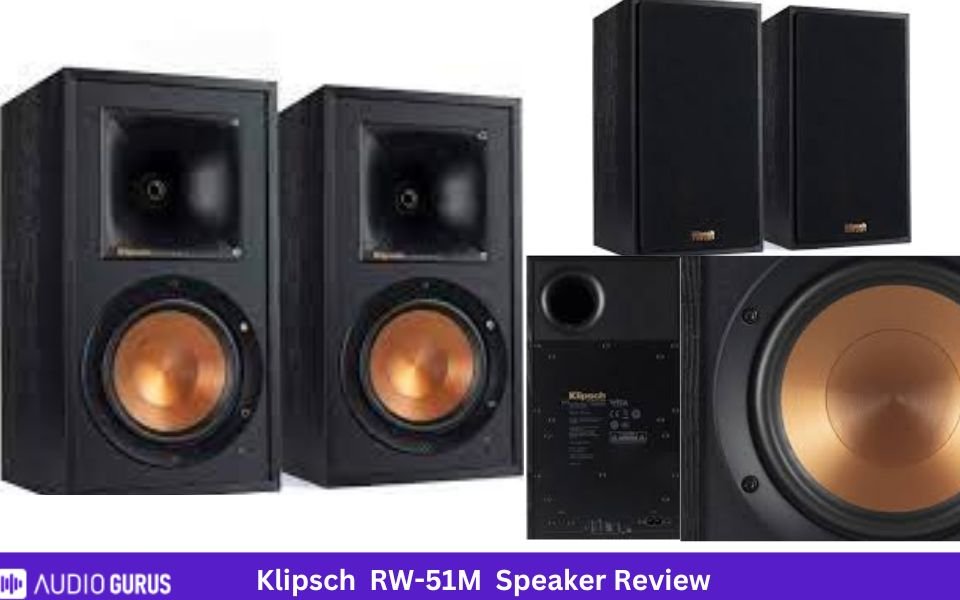
Klipsch RW-51M
This Klipsch bookshelf review is about the RW-51M model. It is a wireless powered speaker that has 1” tweeter and 5.25” woofer. It has built-in WISA receiver and Class D amplifier. WISA allows you to connect multiple home theaters. It can transmit up to 24 bits at 48kHz/96kHz. The speaker can get as low as 62Hz and extends up to 21kHz. It is a complete package that is futureproof.
You can include RW-34C center channel, two more RW-51M as rear speaker and RW-100SW as the wireless sub. It will be the best wireless Klipsch home theater for use. Sound will be synced through all speakers. Once installation is complete, it can automatically detect 2.0 to 7.1 setups. To improve the sound performance simply convert from 2.0 to 2.1 with a sub.
Audio quality is engaging with impressive clarity and dynamics. Watch movies or shows and enjoy stereo sound. Since they are wireless speakers, setup and installation is much easier. The speaker measures 13.3x7x8.5” and placement is much easier as you can easily move it around.
3.6 Mixed Usages
3.3
Dialogue & Vocal Accuracy:
4
Treble Accuracy:
3.8
Bass Accuracy:
3.6
Imaging & Soundstage:
3.3
Dynamic Range:
Klipsch Reference Wireless RW-51M is a pair of WiSA compatible powered speakers. Music and movies are clear and enjoyable, thanks to the Tractrix Horn technology. The performance is impressive and satisfying. Vocals and instrumental sounds are clear and precise. These speakers have wide soundstage and can deliver room filling sound in compact spaces.
Our Verdict
Klipsch Reference Wireless RW-51M bookshelf speakers show powerful and room filling performance. It has precise highs that do not sound very harsh. They sound lively and can produce impactful sound. For bassheads, an additional subwoofer would be a better option. It is easy to add more speakers to create a wireless system. If you think passive speakers are a hassle, then the RW-51M is best for you.
1 pair of powered speaker, Grilles , self-adhesive rubber feet, User Manual, Warranty, Safety Instructions
User manual:
Yes
Check Prices
Loading...
Klipsch 140-WM
Klipsch 140-WM speaker has 1” tweeter and 4.5” woofer. Similar to RW-51M, it uses WISA wireless technology. The use of Tractrix Horn delivers good imaging and produces the ‘real’ sound. This compact speaker comes with removable grille. it measures 13.1x7.2x11”.
Best powered Klipsch bookshelf speaker
We already mentioned the benefits of powered speakers. Along with saving some bucks, you can save space (of a receiver) and have a cleaner look with less wires. It would be ‘silly’ to predict powered speakers with built-in amps are weaker and the reviews below will tell you why.
Klipsch The Sixes
Klipsch The Sixes is an active bookshelf speaker or powered monitor. It is custom engineered to produce maximum output. Ultra-low noise amplifier ensures maximum system performance. With 1” tweeter and 6.5” woofer, it can fill up mid-sized spaces. Use the handy remote control which you can use to turn volume up/down or select inputs.
The following connection ports are available: Bluetooth, 3.5mm, Phono pre-amp / RCA Analog, USB Type B, optical inputs, and a sub out. So, in case you seek more bass, just include a subwoofer. It is one of the best Klipsch bookshelf speaker that is versatile. You can simply so wireless via Bluetooth thus decluttering wires. Since it has built-in phono preamp, enjoy your vinyl records by connecting the turntable. It supports 96kHz / 24-bit decoding, so files from PC will be produced with good resolution.
Sound quality is excellent, and users often select this to replace other speakers like from Edifier. It has a smooth midrange and natural bass. The speaker produces well-balanced, crisp, and clear sound. It can handle all type of music easily. It can get quite loud to produce room-filling audio. With real wood veneer and copper spun knobs, Klipsch The Sixes have a retro look which you want to show off.
4.29 Mixed Usages
4.3
Dialogue & Vocal Accuracy:
4.4
Treble Accuracy:
4.3
Bass Accuracy:
4.3
Imaging & Soundstage:
4.3
Dynamic Range:
Specification
GENERAL:
Speaker Type
Bookshelf Speaker
Number Of Channels
2.0 way speaker
Amplification Type
Passive Speaker (External Amp)
Power Source
AC Powered
DRIVERS
Drive Unit
2x2
Tweeter Type
Titanium Tweeter
Tweeter Size (inches)
1
Midrange Size (inches)
N/A
Midrange Type
N/A
Woofer Size (inches)
6.5
Woofer Type
long-throw woofer
Other
Specs
Power Range
100W rms
Sensitivity
N/A
Impedance
N/A
Frequency Range
40Hz ~20kHz @ -3dB
Crossover Frequencies
N/A
CONNECTIVITY:
Speaker Wire Input:
N/A
Speaker Level Input
N/A
Line Level Input
N/A
Digital Input (Optical)
Yes
Digital Input (Coaxial)
N/A
RCA Input
Yes
3.5mm Stereo Analog Input
Yes
Aux Input
N/A
Bi-amp Input:
N/A
HDMI Input
N/A
USB Port
Yes
Subwoofer Output
Yes
Wireless Features
Bluetooth
Yes
Wi-Fi
N/A
Other
Connector:
Connector Type
N/A
Compatible Connector Types
N/A
Speaker Wire Compatibility
N/A
Audio Quality ( Tested )
Bass Accuracy:
Deep and tight bass
Dialogue & Vocal Accuracy:
Clear and loud vocals
Treble Accuracy
Good highs
Imaging & Soundstage:
Great imaging and soundstage
Dynamic Range:
Good dynamic range
Power Handling:
Moderately powered
Frequency Response:
Wide frequency response
Transient Response:
Fast transient response
Build Material
Enclosure
Ported
Finish
MDF
Color
Walnut
Size & Weight
Height (inches)
16.75
Width (inches)
8.6875
Depth (inches)
12.875
Weight (pounds)
Right speaker: 17.74 lbs, Left speaker: 16.00 lbs
Recommended Stand Height (inches)
22-24
Control
Handheld Remote
Yes
Control by app
N/A
Amazon Alexa
N/A
Google Assistant
N/A
Rating System
Bass Accuracy:
4.3
Dialogue & Vocal Accuracy:
4.25
Treble Accuracy:
4.36
Imaging & Soundstage:
4.28
Dynamic Range:
4.25
IN THE BOX
Accessories:
1 pair of Powered speakers, Grilles, Remote control, Owner's Manual, Important Safety Instructions, Warranty Information
User manual:
Yes
Check Prices
Loading...
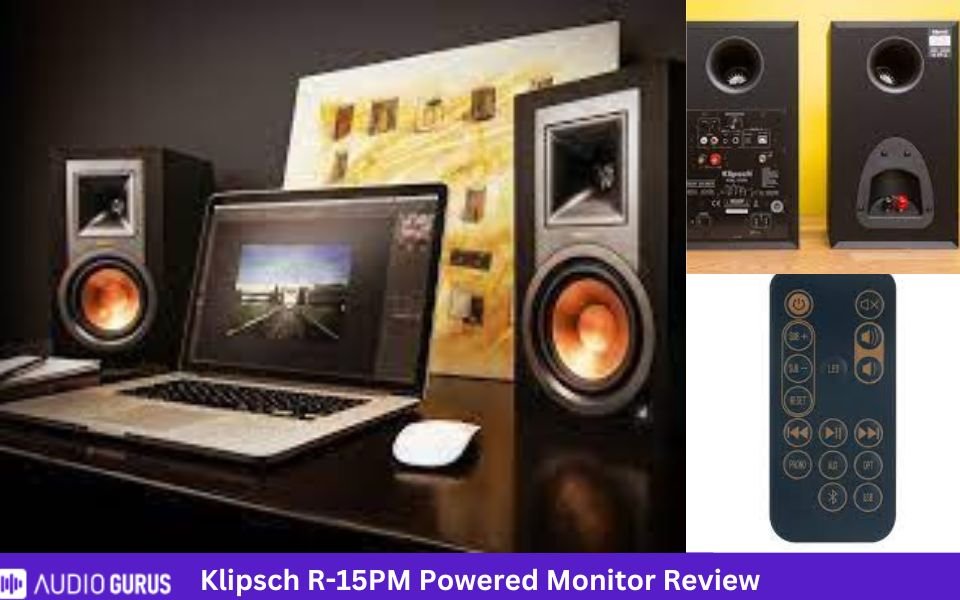
Klipsch R-15PM
Have a look at the Klipsch R-15PM review to know why it is best. It has smaller driver than the The Sixes. With 5.25” woofer and frequency response of 62Hz to 24kHz, low-ends are clean and decent. The built-in amp gives out 50W per channel. Measuring around 12.5x7x8.11”, it will not take up much space. You can choose wired or wireless connectivity with multiple options.
Along with phono preamp, it has Bluetooth, digital optical, analog RCA and USB inputs. This makes it one of the best versatile powered monitors at affordable price. The amp is highly efficient and produces low noise so you can rely on it. This cuts down the hassle of looking for an AV receiver. Connection options indicate it is designed for desktop PCs along with others.
It shows good performance if you turn up the volume. The sound quality is rich and detailed with excellent dynamics. Connecting a sub to the speaker will bring out the magic. This Klipsch powered monitor is TV-ready and has the easiest setup and newbies will prefer this model over others. Like other Klipsch speakers, it is made of MDF and has good build quality. An IR remote is included so you can sit on the couch and control the speaker.
4.6 Mixed Usages
4.6
Dialogue & Vocal Accuracy:
4.7
Treble Accuracy:
4.6
Bass Accuracy:
4.6
Imaging & Soundstage:
4.6
Dynamic Range:
Specification
GENERAL:
Speaker Type
Bookshelf Speaker
Number Of Channels
2.0 way speaker
Amplification Type
Active Speaker (Built-in Amp)
Power Source
AC Powered
DRIVERS
Drive Unit
2x2
Tweeter Type
Aluminum
Tweeter Size (inches)
1
Midrange Size (inches)
N/A
Midrange Type
N/A
Woofer Size (inches)
5.25
Woofer Type
IMG woofer
Other
Specs
Power Range
50 wpc
Sensitivity
N/A
Impedance
N/A
Frequency Range
62Hz - 24kHz +/- 3dB
Crossover Frequencies
1800 Hz
CONNECTIVITY:
Speaker Wire Input:
N/A
Speaker Level Input
N/A
Line Level Input
Digital Input (Optical)
Digital Input (Coaxial)
Yes
RCA Input
Yes
3.5mm Stereo Analog Input
Yes
Aux Input
Bi-amp Input:
N/A
HDMI Input
N/A
USB Port
Yes
Subwoofer Output
Yes
Wireless Features
Bluetooth
Yes
Wi-Fi
N/A
Other
Connector:
Connector Type
N/A
Compatible Connector Types
N/A
Speaker Wire Compatibility
N/A
Audio Quality ( Tested )
Bass Accuracy:
Full and tight bass but not very deep.
Dialogue & Vocal Accuracy:
Clean and intelligible vocals
Treble Accuracy
Rich and detailed highs
Imaging & Soundstage:
Precise imaging and soundstage
Dynamic Range:
Decent dynamic range
Power Handling:
Adequate amount of power
Frequency Response:
Broad frequency response
Transient Response:
Quick transient response
Build Material
Enclosure
Ported
Finish
MDF
Color
Ebony
Size & Weight
Height (inches)
12.1
Width (inches)
7
Depth (inches)
8.11
Weight (pounds)
10.3
Recommended Stand Height (inches)
24-36
Control
Handheld Remote
Yes
Control by app
N/A
Amazon Alexa
N/A
Google Assistant
N/A
Rating System
Bass Accuracy:
4.6
Dialogue & Vocal Accuracy:
4.57
Treble Accuracy:
4.65
Imaging & Soundstage:
4.61
Dynamic Range:
4.57
IN THE BOX
Accessories:
1 pair of bookshelf speaker, Remote control, USB cable, RCA cable, Optical digital cable, rubber feet, Instruction, Warranty Information, Safety Instructions
User manual:
Yes
Check Prices
Loading...
Best sounding Klipsch bookshelf speaker
Reference Premiere 600M
Should you buy it? Klipsch RP-600M review will help you decide. It has 6.25” woofer and, the tweeter size is the same as other speakers. LTS is used in tweeter diagram similar to other Reference speaker lineup. It can low as low as 45Hz and with the Horn shaped bass-reflex port, low ends are punchier and tighter. Treble region excels in clarity with reduced distortion. Klipsch gives full attention to this speaker and ‘eagle-eye’ focus on details is the proof.
Copper anodized trim rings, cast aluminum feet are some of the examples. Klipsch RP-600M specs show that it has power handling of 100W (continuous) and a sensitivity of 96dB. With high sensitivity, it can work smoothly with low power amps. Make sure to match the power and impedance (8 ohms). It delivers ‘sweet spot’ throughout a broader region and with minimized reflections, the sound holds its dynamics and remain crystal clear.
Place them on speaker stand, tabletop or shelves. It can rubber feet so it will remain stable with a firm grip. Make sure the tweeters are at ear level and the L and R speaker create an equilateral triangle with the user. Keep a distance of 6-15’ between the speakers and don’t forget to toe-in. You can use it as stereo speaker for front or rear or create a home theater with it. The speaker supports inclusion of a powered sub for better low-end representation.
4.45 Mixed Usages
4.4
Dialogue & Vocal Accuracy:
4.5
Treble Accuracy:
4.5
Bass Accuracy:
4.4
Imaging & Soundstage:
4.4
Dynamic Range:
Specification
GENERAL:
Speaker Type
Bookshelf Speaker
Number Of Channels
2.0 way speaker
Amplification Type
Passive Speaker (External Amp)
Power Source
AC Powered
DRIVERS
Drive Unit
2x2
Tweeter Type
Titanium LTS Vented Tweeter
Tweeter Size (inches)
1
Midrange Size (inches)
N/A
Midrange Type
N/A
Woofer Size (inches)
6.5
Woofer Type
Cerametallic Cone Woofer
Other
Specs
Power Range
100W/400W
Sensitivity
96 dB
Impedance
8 ohms
Frequency Range
45-25kHz +/- 3dB
Crossover Frequencies
1500Hz
CONNECTIVITY:
Speaker Wire Input:
Yes
Speaker Level Input
N/A
Line Level Input
N/A
Digital Input (Optical)
N/A
Digital Input (Coaxial)
N/A
RCA Input
N/A
3.5mm Stereo Analog Input
N/A
Aux Input
N/A
Bi-amp Input:
N/A
HDMI Input
N/A
USB Port
N/A
Subwoofer Output
N/A
Wireless Features
Bluetooth
N/A
Wi-Fi
N/A
Other
Connector:
Connector Type
Dual binding posts
Compatible Connector Types
banana plugs, pin-connectors, spade-lugs and bare wire
Speaker Wire Compatibility
standard speaker wire
Audio Quality ( Tested )
Bass Accuracy:
Solid bass but not room shaking
Dialogue & Vocal Accuracy:
Clear and intelligible vocals
Treble Accuracy
Undistorted highs that are dispersed through a broader area
Imaging & Soundstage:
Great imaging and powerful soundstage
Dynamic Range:
Great dynamic range
Power Handling:
Easy to drive
Frequency Response:
Wide frequency range
Transient Response:
Fast transient response
Build Material
Enclosure
Ported
Finish
MDF
Color
Ebony, Walnut, Piano Black
Size & Weight
Height (inches)
15.69
Width (inches)
7.95
Depth (inches)
11.85
Weight (pounds)
16 lbs
Recommended Stand Height (inches)
none
Control
Handheld Remote
N/A
Control by app
N/A
Amazon Alexa
N/A
Google Assistant
N/A
Rating System
Bass Accuracy:
4.49
Dialogue & Vocal Accuracy:
4.4
Treble Accuracy:
4.54
Imaging & Soundstage:
4.42
Dynamic Range:
4.4
IN THE BOX
Accessories:
1 pair of Bookshelf speakers, 2 Grilles, Self-adhesive rubber feet, User Manual, Important Safety Instructions, Warranty Information
User manual:
Yes
Check Prices
Loading...
RP-500M ii
Read along the Klipsch RP-500M II review to find out more. It has 5.25” woofer and a frequency response of 50Hz to 25kHz. The Cerametallic woofers are designed to eliminate distortion while improving efficiency. They are designed to have better accuracy and higher speed. Klipsch RP-500M II specs reveal it has a sensitivity of 92dB and a power handling of 75W (continuous).
Like several other Klipsch speakers, it has bass-reflex Tractrix port. Aluminum binding posts and high-end wires will attract music enthusiast. Instead of rubber bumpers, it uses cork pads for better grip. It has a balanced profile and has better value for money. The sound is crisp and clear with powerful soundstage. With a dimension of 13.56x6.81x10.65”, it won’t take up much space. Use them as front speakers for stereo sound or install them as surround speaker in home theater setup.
When using them as surround speakers, place them 2’ above listening position. You can pair it with RP-5000F II, center RP-404C, surround RP-502S II, and Atmos speakers RP-500SA II. This is an example and there are several other models you can choose from. The treble region is smooth but not fatiguing. This speaker pair has improved imaging and broader sweet spot.
It produces clean and loud vocals and shines in the mid-range section. Guitar tunes in audio have a ‘forward’ nature. Along with music, the speakers are good for movies. Compared to their size, the sound is much bigger and more powerful. You can place it on table or mount it on wall with wall brackets (not included).
4.38 Mixed Usages
4.4
Dialogue & Vocal Accuracy:
4.4
Treble Accuracy:
4.4
Bass Accuracy:
4.4
Imaging & Soundstage:
4.4
Dynamic Range:
Specification
GENERAL:
Speaker Type
Bookshelf Speaker
Number Of Channels
2.0 way speaker
Amplification Type
Passive Speaker (External Amp)
Power Source
AC Powered
DRIVERS
Drive Unit
2x2
Tweeter Type
Titanium LTS Vented Tweeter
Tweeter Size (inches)
1
Midrange Size (inches)
N/A
Midrange Type
N/A
Woofer Size (inches)
5.25
Woofer Type
Cerametallic Cone Woofer
Other
Specs
Power Range
75W/300W (cont/peak)
Sensitivity
92dB @ 2.83V / 1m*
Impedance
8 ohms
Frequency Range
50-25kHz +/- 3dB
Crossover Frequencies
1530Hz
CONNECTIVITY:
Speaker Wire Input:
Yes
Speaker Level Input
N/A
Line Level Input
N/A
Digital Input (Optical)
N/A
Digital Input (Coaxial)
N/A
RCA Input
N/A
3.5mm Stereo Analog Input
N/A
Aux Input
N/A
Bi-amp Input:
N/A
HDMI Input
N/A
USB Port
N/A
Subwoofer Output
N/A
Wireless Features
Bluetooth
N/A
Wi-Fi
N/A
Other
Connector:
Connector Type
Single aluminum binding posts
Compatible Connector Types
banana plugs (single only), pin-connectors, spade-lugs and bare wire
Speaker Wire Compatibility
12-16 AWG
Audio Quality ( Tested )
Bass Accuracy:
Clean and impactful bass
Dialogue & Vocal Accuracy:
Clear and loud voices
Treble Accuracy
Detailed and pure highs
Imaging & Soundstage:
Great imaging and good soundfield
Dynamic Range:
Good dynamic range
Power Handling:
Decent power handling
Frequency Response:
Broad frequency response
Transient Response:
It has quick transient response.
Build Material
Enclosure
Ported
Finish
MDF
Color
Ebony, Walnut
Size & Weight
Height (inches)
13.56
Width (inches)
6.81
Depth (inches)
10.65
Weight (pounds)
13.1lbs
Recommended Stand Height (inches)
24-28
Control
Handheld Remote
N/A
Control by app
N/A
Amazon Alexa
N/A
Google Assistant
N/A
Rating System
Bass Accuracy:
4.41
Dialogue & Vocal Accuracy:
4.38
Treble Accuracy:
4.39
Imaging & Soundstage:
4.35
Dynamic Range:
4.35
IN THE BOX
Accessories:
A pair of Bookshelf speakers, 2 Grilles, User Manual, Important Safety Instructions, Warranty Information
User manual:
Yes
Check Prices
Loading...
Best budget Klipsch bookshelf speaker
Audio enthusiasts often have a budget barrier that stops them of purchasing their desired speakers. Well, you don’t have to spend thousands to get a quality speaker and Klipsch promises some of the best budget bookshelf speaker. The sound will simply ‘blow’ you away.
Klipsch R-41M
Let’s have a look at the Klipsch R-41M review. It measures 11.3x5.75x7.9” and is made of MDF that ensures sonic accuracy. It is scratch resistant so it will stay as new for long time. The speaker has a frequency response of 68Hz - 21kHz +/- 3dB and a woofer of 4”. It can produce excellent midrange and has good bass response. With average bass, you can always add a subwoofer.
Along with stereo use, you can include this speaker in a home theater. This passive Klipsch speaker will need an AV receiver and you can also use R-51M, R-34C, R-14S, R-610F, and R-10SW. Also, you can use them as front or rear speakers. The speaker sounds larger than its size and since it has a sensitivity of 90dB, it doesn’t require much power to get loud.
Klipsch R-41M specs indicates that it uses Kapton aluminum used in the tweeter will enhance resolution and details. It works well with music and movies. If high volume, is your requirement, this Klipsch speaker is best for you. This small and compact speaker can handle 50W of continuous power. It is one of the best budget Klipsch bookshelf speaker that produces crisp and clear sound with excellent dynamics.
The sound exceeds the cost and size. You can fit them in tight spaces, and it will produce outstanding audio quality.
4.16 Mixed Usages
4.1
Dialogue & Vocal Accuracy:
4.2
Treble Accuracy:
4
Bass Accuracy:
4.2
Imaging & Soundstage:
4.2
Dynamic Range:
Specification
GENERAL:
Speaker Type
Bookshelf Speaker
Number Of Channels
2.0 way speaker
Amplification Type
Passive Speaker (External Amp)
Power Source
AC Powered
DRIVERS
Drive Unit
2x2
Tweeter Type
Aluminum LTS tweeter
Tweeter Size (inches)
1
Midrange Size (inches)
N/A
Midrange Type
N/A
Woofer Size (inches)
4
Woofer Type
spun-copper IMG woofer
Other
Specs
Power Range
50W/200W (cont/peak)
Sensitivity
90 dB @ 2.83V/1M
Impedance
8 ohms
Frequency Range
68Hz - 21kHz +/- 3dB
Crossover Frequencies
1,730 Hz
CONNECTIVITY:
Speaker Wire Input:
Yes
Speaker Level Input
N/A
Line Level Input
N/A
Digital Input (Optical)
N/A
Digital Input (Coaxial)
N/A
RCA Input
N/A
3.5mm Stereo Analog Input
N/A
Aux Input
N/A
Bi-amp Input:
N/A
HDMI Input
N/A
USB Port
N/A
Subwoofer Output
N/A
Wireless Features
Bluetooth
N/A
Wi-Fi
N/A
Other
Connector:
Connector Type
Single Gold Plated Binding Posts
Compatible Connector Types
banana plugs (single or dual), pin-connectors, spade-lugs and bare wire
Speaker Wire Compatibility
16-12 gauge
Audio Quality ( Tested )
Bass Accuracy:
Lows are clean, decent and not muddy
Dialogue & Vocal Accuracy:
Good voices
Treble Accuracy
The highs are detailed and airy
Imaging & Soundstage:
Great imaging and soundstage
Dynamic Range:
Decent dynamic range
Power Handling:
Power handling shows it is easy to drive
Frequency Response:
Wide frequency response
Transient Response:
Good transient response
Build Material
Enclosure
Bass-reflex
Finish
MDF
Color
Black
Size & Weight
Height (inches)
11.3
Width (inches)
5.75
Depth (inches)
7.9
Weight (pounds)
7lb
Recommended Stand Height (inches)
26-31
Control
Handheld Remote
N/A
Control by app
N/A
Amazon Alexa
N/A
Google Assistant
N/A
Rating System
Bass Accuracy:
4.03
Dialogue & Vocal Accuracy:
4.14
Treble Accuracy:
4.23
Imaging & Soundstage:
4.17
Dynamic Range:
4.23
IN THE BOX
Accessories:
Bookshelf loudspeakers, 2 Grilles, 8 Self-adhesive rubber feet, Quick Setup Guide, Important Safety Instructions, Warranty Information
User manual:
Yes
Check Prices
Loading...
Klipsch R-14M
RP-14M is one of the best affordable Klipsch speaker under $100. It has 4” woofer and low frequency can get as low as 64Hz. It is best for small to mid-sized rooms. While a $100 speaker wont produce high-end audio, it still packs a punch. Choose an ideal amplifier or receiver for the speaker and allow them to shine. Use them as movie speaker or listen to music. The speaker measures 9.75x5.88x7.5”.
It has 90dB sensitivity and will seamlessly work in a home theater. We recommend including a subwoofer if you have the space. Although in lower volume levels, the speaker might not represent all details, it works well for average volume. You can use this speaker during nighttime as well. Since the LTS tweeter is designed to lower any distortion, it can excel when you play loud music.
Create a theater system as follows, R-15M, R-25C, R-14S, R-24F/R-26F/R-28F and R-10SW/R-12SW. if you purchase this model, you will surely receive big sound in small package. It will fit easily so if you have space issues, this model will help you. Connect the speakers to the PC, TV and play any type of content you want.
4.45 Mixed Usages
4.4
Dialogue & Vocal Accuracy:
4.5
Treble Accuracy:
4.5
Bass Accuracy:
4.4
Imaging & Soundstage:
4.4
Dynamic Range:
Specification
GENERAL:
Speaker Type
Bookshelf Speaker
Number Of Channels
2.0 way speaker
Amplification Type
Passive Speaker (External Amp)
Power Source
AC Powered
DRIVERS
Drive Unit
2x2
Tweeter Type
Aluminum LTS tweeter
Tweeter Size (inches)
1
Midrange Size (inches)
N/A
Midrange Type
N/A
Woofer Size (inches)
4
Woofer Type
IMG woofer
Other
Specs
Power Range
50W/200W
Sensitivity
90 dB
Impedance
8 ohms
Frequency Range
64Hz - 24kHz +/- 3dB
Crossover Frequencies
2250 Hz
CONNECTIVITY:
Speaker Wire Input:
Yes
Speaker Level Input
N/A
Line Level Input
N/A
Digital Input (Optical)
N/A
Digital Input (Coaxial)
N/A
RCA Input
N/A
3.5mm Stereo Analog Input
N/A
Aux Input
N/A
Bi-amp Input:
N/A
HDMI Input
N/A
USB Port
N/A
Subwoofer Output
N/A
Wireless Features
Bluetooth
N/A
Wi-Fi
N/A
Other
Connector:
Connector Type
single binding posts
Compatible Connector Types
banana plugs, pin-connectors, spade-lugs and bare wire
Speaker Wire Compatibility
standard speaker wire
Audio Quality ( Tested )
Bass Accuracy:
Tight lows that is moderately good for compact spaces
Dialogue & Vocal Accuracy:
Clear voices
Treble Accuracy
Detailed highs
Imaging & Soundstage:
Expansive soundstage and good imaging
Dynamic Range:
Moderate dynamic range
Power Handling:
Easy to drive
Frequency Response:
Broad frequency response
Transient Response:
Good transient response
Build Material
Enclosure
Ported
Finish
MDF
Color
black
Size & Weight
Height (inches)
9.75
Width (inches)
5.88
Depth (inches)
7.5
Weight (pounds)
7.13
Recommended Stand Height (inches)
none
Control
Handheld Remote
N/A
Control by app
N/A
Amazon Alexa
N/A
Google Assistant
N/A
Rating System
Bass Accuracy:
4.48
Dialogue & Vocal Accuracy:
4.4
Treble Accuracy:
4.53
Imaging & Soundstage:
4.42
Dynamic Range:
4.4
IN THE BOX
Accessories:
1 pair of Bookshelf speakers, 2 Grilles, Self-adhesive rubber feet, User Manual, Warranty sheet, Safety Instructions
User manual:
Yes
Check Prices
Loading...
Best high-end Klipsch bookshelf speaker
Klipsch RP-600m ii
The Klispch RP-600M II costs higher than the RP-600M model. While several things are same, like the woofer size or dual input terminals, there are differences as well. It has a 6.5” woofer and a frequency response of 44Hz to 25kHz. When paired with a sub, the speaker produces ‘exciting’ sound making movies and music enjoyable. Klipsch RP-600M II specs shows it has a sensitivity of 94dB and continuous power handling of 100W.
Like other Klipsch bookshelf speakers, this model has furniture grade and scratch-resistant finish resulting in sturdy build quality. In case you want to create a theater system with it, have a look at the speaker position diagram below. The treble and mid region is detailed and shows accurate representation. Tractrix Horn ensure accurate soundstage and directivity of the speaker. They are an improvement and worth spending after.
The authoritative sound from these speakers makes it one of the best high-end Klipsch bookshelf speaker. This redesigned RP-600M II has Cerametallic woofer is known to have better control and accuracy. No matter the type of content you play, it produces lively and impressive sound with depth.
4.36 Mixed Usages
4.4
Dialogue & Vocal Accuracy:
4.4
Treble Accuracy:
4.4
Bass Accuracy:
4.4
Imaging & Soundstage:
4.4
Dynamic Range:
Specification
GENERAL:
Speaker Type
Bookshelf Speaker
Number Of Channels
2.0 way speaker
Amplification Type
Passive Speaker (External Amp)
Power Source
AC Powered
DRIVERS
Drive Unit
2x2
Tweeter Type
Titanium LTS Vented Tweeter
Tweeter Size (inches)
1
Midrange Size (inches)
N/A
Midrange Type
N/A
Woofer Size (inches)
6.5
Woofer Type
Cerametallic Cone with Faraday Rings
Other
Specs
Power Range
100W/400W
Sensitivity
94.5dB @ 2.83V / 1m
Impedance
8 ohms
Frequency Range
44-25kHz +/- 3dB
Crossover Frequencies
1500Hz
CONNECTIVITY:
Speaker Wire Input:
Yes
Speaker Level Input
N/A
Line Level Input
N/A
Digital Input (Optical)
N/A
Digital Input (Coaxial)
N/A
RCA Input
N/A
3.5mm Stereo Analog Input
N/A
Aux Input
N/A
Bi-amp Input:
Yes
HDMI Input
N/A
USB Port
N/A
Subwoofer Output
N/A
Wireless Features
Bluetooth
N/A
Wi-Fi
N/A
Other
Connector:
Connector Type
Binding post
Compatible Connector Types
banana plugs (single only), pin-connectors, spade-lugs and bare wire
Speaker Wire Compatibility
16-12 gauge
Audio Quality ( Tested )
Bass Accuracy:
clean, even and adequate bass
Dialogue & Vocal Accuracy:
clear voices
Treble Accuracy
detailed and rich highs
Imaging & Soundstage:
precise imaging and wide soundstage
Dynamic Range:
Good dynamic range
Power Handling:
Decent power handling
Frequency Response:
Broad frequency response
Transient Response:
It has quick transient response.
Build Material
Enclosure
Ported
Finish
MDF
Color
Black, Walnut
Size & Weight
Height (inches)
15.75
Width (inches)
7.95
Depth (inches)
13
Weight (pounds)
18.1lbs
Recommended Stand Height (inches)
22-26
Control
Handheld Remote
N/A
Control by app
N/A
Amazon Alexa
N/A
Google Assistant
N/A
Rating System
Bass Accuracy:
4.36
Dialogue & Vocal Accuracy:
4.36
Treble Accuracy:
4.4
Imaging & Soundstage:
4.35
Dynamic Range:
4.35
IN THE BOX
Accessories:
A pair of Bookshelf speakers, 2 Grilles, 4 Terminal jumpers, User Manual, Important Safety Instructions, Warranty Information
User manual:
Yes
Check Prices
Loading...
Klipsch RB-81 II
Klipsch RB-81 II is one of the best bookshelf speakers for large rooms. This is ideal for places where you can’t fit a floorstanding but still want room-filling sound. An 8” woofer and frequency range of 44 Hz to 24kHz results in deep and tighter bass. Unlike other models, this one has a front-firing port which means it is less placement sensitive.
Klipsch RB-81 II specs shows it has power handling of 150RMS and sensitivity of 97dB. With high sensitivity, it can go louder without distortion. The redesigned and improved horn shape ensure to achieve better dynamics and efficiency. The drivers are designed not to sound too bright or fatiguing after long listening hours. The front-firing port effectively minimize any turbulence noise. Use them as front or surround speakers.
This redesigned model sounds big and better. Even without a subwoofer, the performance is powerful, immersive, and satisfying. Klipsch RB-81 II delivers audiophile grade audio quality. Users with hearing issues will enjoy these as well. Clear, rich, and detailed sound remain consistent throughout the listening period. This ‘powerhouse’ bookshelf speaker brings a smile to anyone who has it.
4.46 Mixed Usages
4.4
Dialogue & Vocal Accuracy:
4.6
Treble Accuracy:
4.5
Bass Accuracy:
4.4
Imaging & Soundstage:
4.4
Dynamic Range:
Specification
GENERAL:
Speaker Type
Bookshelf Speaker
Number Of Channels
2.0 way speaker
Amplification Type
Passive Speaker (External Amp)
Power Source
AC Powered
DRIVERS
Drive Unit
2x2
Tweeter Type
Tractrix Horn
Tweeter Size (inches)
1
Midrange Size (inches)
N/A
Midrange Type
N/A
Woofer Size (inches)
8
Woofer Type
Cerametallic Cone Woofer
Other
Specs
Power Range
150W RMS / 600W Peak
Sensitivity
97 dB
Impedance
8 ohms
Frequency Range
44Hz-24KHz ± 3dB
Crossover Frequencies
1400Hz
CONNECTIVITY:
Speaker Wire Input:
Yes
Speaker Level Input
N/A
Line Level Input
N/A
Digital Input (Optical)
N/A
Digital Input (Coaxial)
N/A
RCA Input
N/A
3.5mm Stereo Analog Input
N/A
Aux Input
N/A
Bi-amp Input:
Yes
HDMI Input
N/A
USB Port
N/A
Subwoofer Output
N/A
Wireless Features
Bluetooth
N/A
Wi-Fi
N/A
Other
Connector:
Connector Type
Dual binding posts
Compatible Connector Types
banana plugs, pin-connectors, spade-connectors, and bare wire.
Speaker Wire Compatibility
standard speaker wire
Audio Quality ( Tested )
Bass Accuracy:
deep and impactful bass
Dialogue & Vocal Accuracy:
Clear and intelligible vocals
Treble Accuracy
great highs that does not sound harsh
Imaging & Soundstage:
great imaging and broad soundstage
Dynamic Range:
Decent dynamic range
Power Handling:
Easy to drive
Frequency Response:
Broad frequency response
Transient Response:
Fast transient response
Build Material
Enclosure
Bass Reflex
Finish
Woodgrain vinyl
Color
Finish Black Ash & Cherry woodgrain vinyl
Size & Weight
Height (inches)
19
Width (inches)
9.3
Depth (inches)
12.3
Weight (pounds)
27.5 lbs
Recommended Stand Height (inches)
18-24
Control
Handheld Remote
N/A
Control by app
N/A
Amazon Alexa
N/A
Google Assistant
N/A
Rating System
Bass Accuracy:
4.5
Dialogue & Vocal Accuracy:
4.4
Treble Accuracy:
4.56
Imaging & Soundstage:
4.43
Dynamic Range:
4.4
IN THE BOX
Accessories:
1 pair of bookshelf speaker, magnetic grille, Self-adhesive rubber feet, Owner's Manual
User manual:
Yes
Check Prices
Loading...
Best futureproof Klipsch bookshelf speaker
Futureproof speakers leave open doors so that you don’t get stuck in future. This means the speaker will allow you to include a subwoofer or other speakers like center channel or rear speakers. So that, you can create a home theater system if you want.
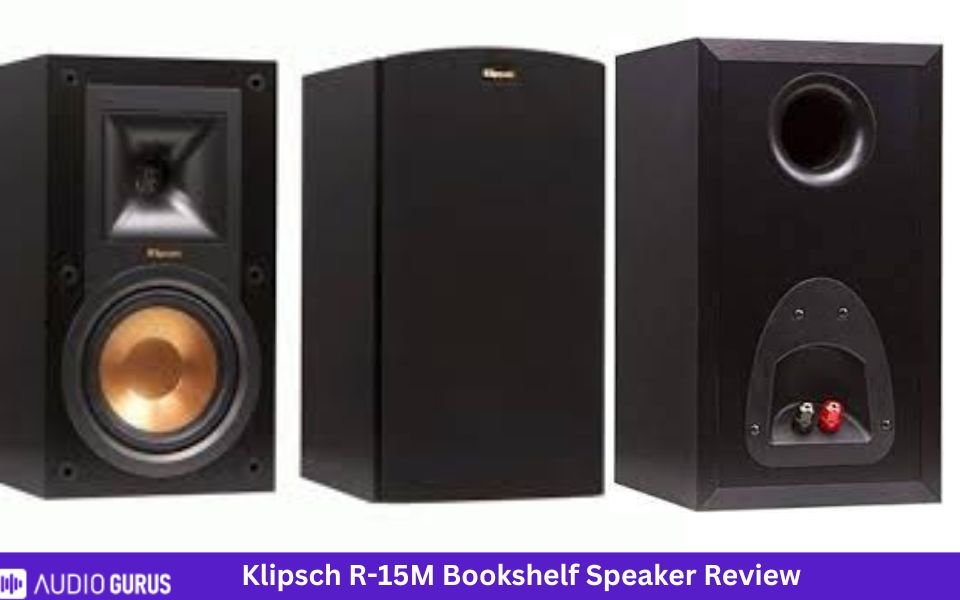
Klipsch R-15M
Klipsch R-15M review will shed light on details to explain why it is one of the best speakers for small to medium sized rooms. It has 1” tweeter and 5.25” woofer along with a frequency response of 62Hs-24kHz. The R-15M Klipsch specs say that the low-ends will be decent. It has a rear firing port to minimize turbulence.
Klipsch R-15M price is much lower and affordable compared to powered monitors like the The Sixes. This pair produces lively and engaging sound. It can produce low ends without cone distortion. It is one of the best futureproof speakers and if you want, you can include a subwoofer with it. Along with adding powered subwoofer, you can pair it with Klipsch R-14M, R-25C, R-14S and R-24F speakers to build a complete theater system.
Match an amp or receiver with it to bring out the powerful sound. It has power handling of 84W and impedance of 8 ohms. This ‘exciting’ speaker will be ideal for listening to music or movies. The treble and mids are clean and it has excellent dynamics. They are popular due to performance vs price comparison.
4.46 Mixed Usages
4.5
Dialogue & Vocal Accuracy:
4.5
Treble Accuracy:
4.5
Bass Accuracy:
4.4
Imaging & Soundstage:
4.4
Dynamic Range:
Specification
GENERAL:
Speaker Type
Bookshelf Speaker
Number Of Channels
2.0 way speaker
Amplification Type
Passive Speaker (External Amp)
Power Source
AC Powered
DRIVERS
Drive Unit
2x2
Tweeter Type
Aluminum LTS tweeter
Tweeter Size (inches)
1
Midrange Size (inches)
N/A
Midrange Type
N/A
Woofer Size (inches)
5.25
Woofer Type
IMG woofer
Other
Specs
Power Range
85W/340W
Sensitivity
94 dB
Impedance
8 ohms
Frequency Range
62Hz - 24kHz +/- 3dB
Crossover Frequencies
1800Hz
CONNECTIVITY:
Speaker Wire Input:
Yes
Speaker Level Input
N/A
Line Level Input
N/A
Digital Input (Optical)
N/A
Digital Input (Coaxial)
N/A
RCA Input
N/A
3.5mm Stereo Analog Input
N/A
Aux Input
N/A
Bi-amp Input:
N/A
HDMI Input
N/A
USB Port
N/A
Subwoofer Output
N/A
Wireless Features
Bluetooth
N/A
Wi-Fi
N/A
Other
Connector:
Connector Type
Single binding posts
Compatible Connector Types
banana plugs, pin-connectors, spade-lugs and bare wire
Speaker Wire Compatibility
standard speaker wire
Audio Quality ( Tested )
Bass Accuracy:
Deep bass that shows its presence
Dialogue & Vocal Accuracy:
Clear and loud voices
Treble Accuracy
Detailed and responsive highs
Imaging & Soundstage:
Decent imaging and broad soundstage
Dynamic Range:
Good dynamic range
Power Handling:
Easy to drive
Frequency Response:
Broad frequency response
Transient Response:
Quick transient response
Build Material
Enclosure
Bass Reflex
Finish
MDF
Color
Black, Ebony
Size & Weight
Height (inches)
12.1
Width (inches)
7
Depth (inches)
8.11
Weight (pounds)
10.3 lbs
Recommended Stand Height (inches)
28-31
Control
Handheld Remote
N/A
Control by app
N/A
Amazon Alexa
N/A
Google Assistant
N/A
Rating System
Bass Accuracy:
4.49
Dialogue & Vocal Accuracy:
4.45
Treble Accuracy:
4.53
Imaging & Soundstage:
4.42
Dynamic Range:
4.4
IN THE BOX
Accessories:
1 pair of Bookshelf speakers, Grilles, Self-adhesive rubber feet, User Manual, Warranty sheet, Important Safety Instructions
User manual:
Yes
Check Prices
Loading...
RP-150M
Klipsch RP-150M review says that it is another futureproof speaker. It will work with R-110SW sub. Or you can create a home theater system by adding RP-250C and RP-240S. The speaker has 5.25” woofer and the lower frequency reaches 48Hz. Klipsch RP-150M specs show it has a power handling of 75W (continuous). Sensitivity is high as well, 93 dB.
This high sensitivity means it can get loud and can work with low power amps. Use an amp or tube amp with these speakers. Measuring around 14.57” x 7.67” x 10.67", these speakers produce clearer sound and make music come back to life. The treble region is well-represented which isn’t too bright. If you want to know list of Klipsch best bookshelf speakers, then RP-150M will be one of them. Soundstage is impressive and so is imaging.
Pair it with a center channel and sub to have ultimate movie theater experience with clearer vocals. You can place it on tabletop where the rubber feet will make the speakers stable. Or you can mount it on the wall. The speakers excel in balance and clarity. At low volume, the sound is clear and intelligible. At this price point, the performance is more that you can ask for.
Best stylish Klipsch bookshelf speaker
Klipsch Signature woofer and tweeter allow a user to identify that it is a ‘Klipsch’ product from distance. MDF enclosure ensures there is no coloration in the sound and focuses on producing purer form of it.
Klipsch Synergy B-100
Synergy B-100 is one of the stylish Klipsch bookshelf speaker. Klipsch iconic woofers will be acknowledge by your friends from a long distance. With 90dB sensitivity, the speakers can get louder. It has 0.75” tweeter and 4” woofer. The audio quality is satisfactory, and you can listen to it for long period of time without any ear issues. You can use them as rear speaker in home theaters to boost the overall sound.
Klipsch Synergy B-100 specs tells us it has a frequency response of 64Hz-23kHz. With a smaller woofer size compared to other models, this speaker packs a punch. It delivers clean and deep bass. However, as always, we suggest inclusion of a subwoofer. Intelligent driver design gives us wide soundstage, clearer and lifelike sound. Once you choose a sub, you can connect subwoofer and speaker of your choice.
This speaker will give you a vintage look and blend into any décor. This is true for other Klipsch models as well. The speakers sound rich and powerful for something that costs under $150. If you have small rooms, you can use them as stereo speakers. Otherwise include them in your home theater.
KlipschRP-160M
Read along the Klipsch RP-160M review to know more about it. We know it by now that all Klipsch model is made of MDF. RP-160M build quality is very good. It has brushed polymer veneer finish. Spun copper Cerametallic woofer gives the signature look of Klipsch. The speaker produces crisp and clear sound with a natural tone. They excel in maximizing efficiency and minimizing distortion.
It has a 6.5” woofer and a frequency response of 45Hz to 25kHz. The low ends are deeper and tighter. It has a sensitivity of 96dB and as the speaker gets louder, it remains clear. if you have the budget, include the RP-160M and create a home theater. Or at least include a sub with the stereo speakers if you are picky about the low ends.
Make sure to match an appropriate AV receiver. If you have space on your table, you can also use it as PC speaker. Although they are big in size, they will not need much power to shine. Audio quality is clear but never ‘harsh’. Sound separation is impressive as well. The cost is legit based on performance and quality.
4.36 Mixed Usages
4.4
Dialogue & Vocal Accuracy:
4.4
Treble Accuracy:
4.4
Bass Accuracy:
4.3
Imaging & Soundstage:
4.4
Dynamic Range:
Specification
GENERAL:
Speaker Type
Bookshelf Speaker
Number Of Channels
2.0 way speaker
Amplification Type
Passive Speaker (External Amp)
Power Source
AC Powered
DRIVERS
Drive Unit
2x2
Tweeter Type
Titanium LTS Tweeter with Hybrid Tractrix Horn
Tweeter Size (inches)
1
Midrange Size (inches)
N/A
Midrange Type
N/A
Woofer Size (inches)
6.5
Woofer Type
Cerametallic Cone Woofer
Other
Specs
Power Range
100W/400W (cont/peak)
Sensitivity
96dB @ 2.83V / 1m
Impedance
8 ohms
Frequency Range
45-25kHz +/- 3dB
Crossover Frequencies
1500Hz
CONNECTIVITY:
Speaker Wire Input:
Yes
Speaker Level Input
N/A
Line Level Input
N/A
Digital Input (Optical)
N/A
Digital Input (Coaxial)
N/A
RCA Input
N/A
3.5mm Stereo Analog Input
N/A
Aux Input
N/A
Bi-amp Input:
Yes
HDMI Input
N/A
USB Port
N/A
Subwoofer Output
N/A
Wireless Features
Bluetooth
N/A
Wi-Fi
N/A
Other
Connector:
Connector Type
Dual binding posts
Compatible Connector Types
banana plugs (single only), pin-connectors, spade-connectors, and bare wire.
Speaker Wire Compatibility
12-16 AWG
Audio Quality ( Tested )
Bass Accuracy:
Clear and deep bass
Dialogue & Vocal Accuracy:
Intelligible and clear vocals
Treble Accuracy
Clearer and accurate highs
Imaging & Soundstage:
Outstanding imaging and powerful soundstage
Dynamic Range:
Great dynamic range
Power Handling:
impressive power handling
Frequency Response:
Wide frequency response that can get as low as 45Hz
Transient Response:
Quite good transient response
Build Material
Enclosure
Ported
Finish
MDF
Color
Ebony, Cherry, Walnut
Size & Weight
Height (inches)
16.67
Width (inches)
8.81
Depth (inches)
12.86
Weight (pounds)
19.9lbs
Recommended Stand Height (inches)
24-28
Control
Handheld Remote
N/A
Control by app
N/A
Amazon Alexa
N/A
Google Assistant
N/A
Rating System
Bass Accuracy:
4.39
Dialogue & Vocal Accuracy:
4.35
Treble Accuracy:
4.38
Imaging & Soundstage:
4.34
Dynamic Range:
4.35
IN THE BOX
Accessories:
2 Bookshelf speakers, 2 Detachable magnetic grilles, User Manual, Warranty Information, Important Safety Instructions
User manual:
Yes
Check Prices
Loading...
Best value Klipsch bookshelf speaker
There are some speakers that excel in terms of performance even though they aren’t very expensive. Klipsch ensures users with different budgets can receive quality sound.
Klipsch Synergy B-200
Klipsch Synergy B-200 has 0.75” tweeter and 5.25” woofer. It measures 12.5x 7x 8”. The speaker has 85W continuous power and an impedance of 8 ohms. While choosing the amp, make sure it can handle the speaker well. It can get as low as 62Hz, so the bass is tight but average. As always, use a sub to enhance the low ends.
The speakers have a sensitivity of 92dB. It doesn’t come with speaker wires so you should purchase 16-gauge wire. Along with front, you can use them as rear speakers. Bass response is good along with clearer treble. Mids are well represented. Once connected to the AV receiver, you can connect sub or build a home theater.
They are bright but in a good way and will not cause any ear fatigue. It produces high-fidelity sound without any distortion. It has wide frequency response and produces highly efficient ‘Klipsch’ sound. This model is suitable for all type of audio content. Movie and music lovers consider it to have best value for money.
Klipsch R-14M
Klipsch R-14M review will give detailed information so that you can make a clear decision. This model has a 4” woofer and can get as low as 64Hz. Sensitivity is lower than other Klipsch models, but it is still under high range. It has a dimension of 9.75x5.88x7.5” and Klipsch R-14M specs doesn’t hide anything at all. Low ends are powerful but only for its size. You can expect room shaking bass from this speaker. Simply connect a sub and enjoy movies and music.
It sounds best at average volume levels but at low volume, it can lose details which isn’t major in any way. Like other passive models, you can include this into a home theater creating powerful and room-filling sound. It is one of the best Klipsch speaker under $100. The performance and quality exceed the cost.
Parting words
Some of the best Klipsch bookshelf speaker are RP-600M II, The Sixes, RW-51M, etc. Klipsch bookshelf speakers allow you to choose from active or passive speaker. Although Klipsch was accused of being bright, they improved their mistake, and you won’t find this situation again. All the speakers reviewed here supports an additional subwoofer.
If you include a receiver, you can easily complete a theater system and choose from the Klipsch speakers. Most of the Klipsch speakers have high sensitivity which means you can drive them with low power amps. Make sure to match the power and impedance of the speaker with the amp. Also, follow the speaker placement guidelines for best results.
Most of the bookshelf speakers can be used as both front or rear/surround speakers. Even if you cant afford a 5.1 home theater system, we suggest to go for a 2.1 system.
4.45 Mixed Usages
4.4
Dialogue & Vocal Accuracy:
4.5
Treble Accuracy:
4.5
Bass Accuracy:
4.4
Imaging & Soundstage:
4.4
Dynamic Range:
Specification
GENERAL:
Speaker Type
Bookshelf Speaker
Number Of Channels
2.0 way speaker
Amplification Type
Passive Speaker (External Amp)
Power Source
AC Powered
DRIVERS
Drive Unit
2x2
Tweeter Type
Aluminum LTS tweeter
Tweeter Size (inches)
1
Midrange Size (inches)
N/A
Midrange Type
N/A
Woofer Size (inches)
4
Woofer Type
IMG woofer
Other
Specs
Power Range
50W/200W
Sensitivity
90 dB
Impedance
8 ohms
Frequency Range
64Hz - 24kHz +/- 3dB
Crossover Frequencies
2250 Hz
CONNECTIVITY:
Speaker Wire Input:
Yes
Speaker Level Input
N/A
Line Level Input
N/A
Digital Input (Optical)
N/A
Digital Input (Coaxial)
N/A
RCA Input
N/A
3.5mm Stereo Analog Input
N/A
Aux Input
N/A
Bi-amp Input:
N/A
HDMI Input
N/A
USB Port
N/A
Subwoofer Output
N/A
Wireless Features
Bluetooth
N/A
Wi-Fi
N/A
Other
Connector:
Connector Type
single binding posts
Compatible Connector Types
banana plugs, pin-connectors, spade-lugs and bare wire
Speaker Wire Compatibility
standard speaker wire
Audio Quality ( Tested )
Bass Accuracy:
Tight lows that is moderately good for compact spaces
Dialogue & Vocal Accuracy:
Clear voices
Treble Accuracy
Detailed highs
Imaging & Soundstage:
Expansive soundstage and good imaging
Dynamic Range:
Moderate dynamic range
Power Handling:
Easy to drive
Frequency Response:
Broad frequency response
Transient Response:
Good transient response
Build Material
Enclosure
Ported
Finish
MDF
Color
black
Size & Weight
Height (inches)
9.75
Width (inches)
5.88
Depth (inches)
7.5
Weight (pounds)
7.13
Recommended Stand Height (inches)
none
Control
Handheld Remote
N/A
Control by app
N/A
Amazon Alexa
N/A
Google Assistant
N/A
Rating System
Bass Accuracy:
4.48
Dialogue & Vocal Accuracy:
4.4
Treble Accuracy:
4.53
Imaging & Soundstage:
4.42
Dynamic Range:
4.4
IN THE BOX
Accessories:
1 pair of Bookshelf speakers, 2 Grilles, Self-adhesive rubber feet, User Manual, Warranty sheet, Safety Instructions
User manual:
Yes
Check Prices
Loading...
FAQ
Is subwoofer a must have?
Klipsch bookshelf speakers will produce clean and deep bass. The bass will increase if the woofer size is larger. If you don’t want to scrutinize the low ends, you won’t need a subwoofer.
Is Klipsch a good brand?
Klipsch manufactures speakers that have best value for money. At reasonable and cheap price, you can purchase speakers that shows decent performance if not ‘high-end’
There is no sound coming from the TV speakers or soundbars that are connected to the TV with an optical cable. To see if this is the case, check out our guide.
The built-in speakers on your TV aren't very good at making good sound. So, we need to connect the speakers we want to use to get the best sound.
Optical cable is one of the best ways to transfer audio because it sends high-quality audio, but you need to do it right.
A lot of things need to be changed on the television when you connect it to other speakers or a soundbar through an optical cable.
First, you should check to see if everything is working right. Whether you did something wrong or not, don't worry. We will show you how to do it right today.
What Can You Do If You Are Facing a Similar Problem?
If there is no sound, how can you enjoy the music? When you use an optical cable to connect your Samsung TV to an external audio system, many people overlook the fact that you must change a setting in order to hear the sound.
There are a few things you may do if your Samsung TV's optical out no sound is an issue that you're having. In that case, don't worry; keep reading.
Steps to Follow to Fix the Samsung TV Optical Out No Sound Issue
Here are some steps that will help you get sound back from your Samsung TV when you connect it to external speakers through optical out.
Step 1: Change the way the audio comes out.
There is a menu page on your Samsung TV. In the first step, you have to go to this page. There is a sound setting in the menu settings. You have to choose the sound output as "Audio Out."
If you set the sound output on your TV-to-TV speakers, you won't be able to hear the sound coming from the external speaker that is connected with an optical cable.
Step 2: Go to the "Expert Settings" tab.
Then, go back to the sound settings and choose "Advanced Settings." An expert setting has HDMI input audio and a digital audio format that can be used to send and receive audio. If you want to use PCM files, you have to change both of them.
Step 3: Change the audio and sound settings.
After you've changed the export setting on your Samsung TV, go to the sound setting and change the sound level. When you click on the drop-down list, you will see options like HDMI and TV speakers, but you have to choose optically out of them all.
When you choose optically, a new drop-down list will show up. You have to choose a digital out sound if you want to connect your Samsung TV to another audio system.
Step 4: It's now time to check out the sound.
To do this, you have to change all the settings that are needed for this process. The last thing you will do is listen to the sound. Any time you play a song on your Samsung TV, check to see if the sound comes from a speaker that you have connected with an optical cable.
A problem with your speaker might be to blame for you not being able to listen to the sound coming from your external audio system. The settings you made in Samsung TV seem to be fine.
Why Is still There No Sound Coming from My Samsung TV?
It's possible that other problems with your speakers or Samsung TV could be to blame if you still don't hear any sound even after you've changed the settings for your speakers to make sound. The following are some suggestions that might help you get the problem solved once and for all:
Run A Cable Check on Your Optical Cable
You might have a bad optical cable, so check to see if that's the case. A different way to check is to try plugging in a new optical cable to the TV and see if that works, too.
Check out the Ports
If there is a problem with the ports on your external speakers or your Samsung TV, all of your work might not be worth it at the end. Make sure they are in their best shape.
Power Cycle Your Samsung TV
If the ports work, temporal errors could be to blame for the problem. To fix them, you should:
Turn the TV off.
Remove the device from the wall.
If there is still a charge in the TV's memory or capacitors, wait about 5 minutes to let it go.
Plug the Samsung TV set back in, and then turn it on.
Turn on the TV again.
If you've done all the steps and your optical cable is working fine, you can factory reset the TV. Check your TV's user's manual for instructions that are specific to your model.
How Do You Test An Optical Cable?
If you use the VFL (Very Low Frequency) method, you can quickly check the optical cable on your Samsung TV.
There is a problem with the cable if there is a lot of red light. That's the same if you look at the ferrule from the other side and see it glowing from all sides. You, on the other hand, have the right cable if the light comes only from the fiber.
You can find out if your optical cable is good by replacing it with a fresh one and seeing how it works. If the cable looks bad, you don't need to test it. Replace.
Wrapping Up
There you have it. We really hope that the techniques and solutions we have discussed in this post will help you fix your Samsung TV's optical cable not generating sound problem.
For the TV and speaker to be able to talk to each other, you need to make the right settings on your Samsung TV and make sure the optical cable you use for the connection is in good shape.
In this case, there might be a hardware problem that you can show in the service center. After you have done everything, you still don't hear any sound coming from the external speaker.
FAQs
Why does my Samsung TV have picture but no sound?
Navigate to Settings > Support > Self Diagnosis. Then, click Start Sound Test to start a sound test. If the test shows that there is a problem, go to Settings > Sound > Advanced Settings, and then choose Reset Sound. Note: If you still have a problem even after you reset the sound, go to our Support Center and ask for help. This way, we can help you.
How do I turn the optical output on my Samsung TV?
In and out connections for audio on a smart TV (Optical)
Please click on Audio to go to the next page.
Choose the Speaker setting.
Select the speaker you want.
When you choose External speaker, you will hear the sound.
The TV should have a digital audio out port (optical). Find it.
It is best to connect the digital audio cable to a digital audio output on the TV.
Why does my Samsung TV say audio out optical?
When you use the Samsung TV remote, go to the setting menu on your TV. From the settings, move your mouse to the sound area. This is what you want to do in the sound section. Make sure the sound output is set to Audio out/Optical and not TV speakers.
Sometimes, the sound on your television could go off or become distorted for no apparent reason. There might be something wrong with the Vizio Sound Bar, which is your TV's sound system. If you connect the Vizio Sound Bar to your TV through the HDMI ARC input, you might find that the two devices don't work well together. Before you connect your Vizio Soundbar to your TV, make sure that your TV's HDMI ARC port is set to CEC.
There may be some other problems. So here, I'll show you why the HDMI port on your Vizio sound bar isn't working right and how to fix it. Listen to what I say, because I'll tell you how to solve the problem in the best way!
Causes of Vizio Soundbar No Sound HDMI ARC
The HDMI ARC port on the Vizio soundbar doesn't have an optical digital audio out, but it does have a digital optical output. From what I've learned, one of the most common problems with the Vizio Soundbar HDMI ARC is that it doesn't work when it's connected to an HDTV. Here are some of the most common reasons why this happens.
Vizio Soundbar wasn't set up or put in place correctly.
Some strange things plug into the TV's ARC HDMI port.
Make it harder for the Soundbar and TV to connect.
The Soundbar doesn't have enough HDMI ports.
The Techniques for Resolving Vizio Soundbar HDMI ARC Problems:
If you have ever had a problem with your Vizio soundbar where none of the HDMI devices work when you turn it on. Don't be afraid! There are some simple things you can do to help, and they might even fix your Vizio arc problems.
Read: How to Reset Vizio TV Without Remote
Check the Soundbar's plug and power
If your Vizio sound bar unexpectedly stops working after you set it up, test to see if this is plugged in properly. And that the power cord to the sound bar is in good shape.
In this scenario, let's assume your sound bar isn't experiencing any issues with power supply. See if the device is turned on. To do just that, you have to press the sound bar's POWER button. If the device has a blinking light in the center or even on the left side, it is on. After pressing the POWER button, wait a few seconds for your device to switch on before using it.
Read: Using different speaker-
Make sure you're plugging in to the right port
If you're using the Vizio sound bar for the first time, actually pay attention to the information below. This is something that most first-time users don't consider. If any of the following applies to your sound bar's HDMI ARC, it won't work:
You might have plugged the cable into the port that wasn't made for HDMI ARC. You can't use HDMI ARC with your smart TV since it doesn't support it. Check to determine whether your television has an HDMI ARC connector before connecting your soundbar to it.
When it comes to HDMI ports, HDMI ARC is usually the first. There is a label that reads "HDMI 1 (ARC)" or "1 (ARC). A green line may be seen surrounding the port on occasion. To make it stand out from the crowd.
The other end of the HDMI cable should be plugged into your sound bar's HDMI ARC connection in the same manner. On the device's rear, you'll see a label that looks somewhat like this.
What if your TV doesn't have an HDMI ARC port? In that case you won't be able to connect your Vizio sound bar to it over HDMI ARC. If this is the case, you may connect to a compatible smart TV. Alternately, you may choose from a variety of sound outputs.
Read: Best Cable Amplifier
Use a Different HDMI cable
You could connect the cable to both of the HDMI ARC ports. The sound bar still doesn't work. If so, your HDMI cable might be damaged. Or that the cable doesn't fit the connection.
Some clear signs that an HDMI cable is broken are:
The wires have been bent.
Burned-in plugs
There are bite marks all over the place.
Plugs that have lost their effectiveness.
Wires exposed.
Let's say you can't see any damage to your HDMI cable. How to check if it's broken:
Investing in a second HDMI cable is your best bet.
Use the HDMI ARC ports on your sound bar and TV to connect this device together.
After that, mount your sound bar.
The original HDMI cable may no longer be working if the sound bar is working. That's why, you'll need to buy a new one ASAP. If you have an HDMI 2.0 cable, I highly recommend that you use it.
Set TV and sound bar audio to HDMI ARC
After using HDMI ARC to connect your sound bar to your TV, users should start changing the audio inlet and outlet settings. And that goes for both your smart TV and your sound bar. Here are the steps you need to take. The steps may be different depending on the brand of your TV and sound bar.
To change how a smart TV plays sound:
Use the remote to press the MENU button.
Click on settings.
Click on "Audio."
Click "Output Sound."
After that, choose HDMI ARC.
And thus to change where the sound bar gets its sound:
Get the remote for the sound bar.
Press the button for input. There is a box with an arrow on the input button.
After that, choose "HDMI ARC."
Turn on the TV's CEC
Consumer Electronics Control, or CEC, is a control setting that most smart TVs have. This means you can control all of your HDMI devices with just one remote.
Even though this doesn't have a direct effect on your Vizio sound bar's HDMI ARC connection. If you turn it on, your sound bar will turn on when you turn on your TV. This makes it less likely that your sound bar won't work. The steps may be a little different depending on the type of TV you have. So, check the manual for your product for detailed instructions.
To make your TV's CEC work:
Use your TV remote to select MENU.
Click on settings.
Continue on to "System."
Choose "CEC."
Then, click "Enable" or "ON."
Unplug the HDMI cables
If it doesn't work, try unplugging and re-plugging every HDMI device on your TV. Sometimes, when HDMI devices are connected, they interfere with each other. If that's what's wrong with your HDMI ARC on your sound bar. The best thing to do is to turn off everything.
Here's the right way to do it:
Unplug everything that uses HDMI on your smart TV.
Hold on for about a minute.
Plug your sound bar's wire back into the HDMI ARC port.
Put your sound bar in place next to your TV.
You can then proceed to connect the remaining HDMI devices one at a time.
When you plug your TV back in, the sound bar must be the first thing you plug back in. So, do what the steps say to do.
Turn off Eco mode on the sound bar
You could also try turning off the Eco Mode on the sound bar of your Vizio.
When Eco Mode is on, your sound bar turns off after a certain amount of time. The majority of the time, between 5 and 10 minutes after the last sound was heard. If you haven't used your sound bar in a while, it might stop making sounds all of a sudden.
To stop the Vizio sound bar's Eco mode:
Press and keep holding the device's VOLUME DOWN buttons.
Then, press and keep holding down the POWER button.
Hold on to them for another 5 seconds. Or until you hear two beeps with a low tone.
On a few models, the Eco Mode turns off when the sound bar's LED lights go out.
Upgrade the sound bar's firmware
If the problem wasn't fixed by the fixes above, check to see if your sound bar's firmware needs to be updated. If it has, make sure to install the update as soon as you can.
Here's what you need to do:
Fist click VIZIO.com.
Type in the serial number of your sound bar.
Click "Update Firmware."
The file for updating the firmware is on the right side of the screen.
Put it on a USB memory stick.
Put the sound bar to work.
Pull the power cord out.
Connect the USB stick to the sound bar.
Plug the power cord back in.
Wait until the update is done. The process of updating is done when the LED lights stop shining.
Upgrade the TV’s software
Make sure your TV software is up to date if you've previously upgraded your sound bar.If your TV's software isn't up-to-date, this might not be able to send and receive connection signals. And that could be why your sound bar's HDMI ARC doesn't work.
So, update your TV to fix any problems your smart TV might be having with its connections. The steps depend on the brand and model of your TV.
But here's how it usually works:
Press MENU on the TV remote.
Click on settings.
Choose "Help."
Click on "Update Software."
Tap "Update Now" after that.
Check the box next to "Update automatically" if you want to do this. You don't have to do it by hand every time.
Unless you see a "Update Now" button on the screen, the TV is current. As a result, the solutions suggested below may help you resolve the issue.
Power cycle the TV and sound bar
Power cycling, or "rebooting," is a way to restart your device's operating system. And this helps in the elimination of software faults and defects. That could well be preventing us from connecting.
Important information and settings that you've made yourself will remain intact. That means that you don't need to create a duplicate of your data. Try turning off and turning on your TV and sound bar again if none of the previously mentioned remedies worked. No matter what device you want to restart, the steps are the same.
Here's what you need to do:
Make sure the device is switched on.
Pull the device's plug out of the power outlet.
Wait around ten minutes.
Plug the device back in.
Then, check to see if the problem has been fixed.
If this didn't work, try leaving it unplugged for another 30 minutes.
Hard reset the sound bar
If nothing else works, you can do a hard reset on your Vizio sound bar. All of your data will be deleted and the device will be restored to factory settings if you do a hard reset instead. So, this is your only choice left.
To correct faults and malfunctions, a complete wipe is necessary since it removes everything. So your sound bar works better because of this. And easily connect with the other smart devices. Depending on the type of device you have, the buttons you just had to press may be different. Also, make sure to read the manual for your product.
Here's how to reset a Vizio sound bar to factory settings:
Press the device's BLUETOOTH button and the VOLUME DOWN button.
For about 5 seconds, press and hold the buttons. Or until three of the 12 LED lights flash.
After you hard reset your sound bar, you'll have to set it up again with your smart TV.
Connecting to another TV
You may use a different TV to connect the Vizio soundbar if the first one isn't working properly. Your TV may be faulty if the soundbar works on other TVs. For HDMI ARC to work, either the port is broken or some settings need to be changed. In this situation, you can look in the TV's manual for help.
Also you can check the soundbar and TV for the latest versions and updates. Other TV brands use older firmware that doesn't work with ARC compatible connections. To allow ARC only CEC connection, it is best to update your TV's software to the most recent version. To accomplish this, connect the Vizio TV to the web and then navigate to the settings page. Click on firmware update.
People who had the same problem with their Vizio sound bar HDMI ARC not working fixed it by updating the firmware. Turn both of them on and see if the sound bar can now play sound.
Wrapping Up
If your Vizio sound bar's HDMI arc isn't working, hopefully this post has given you some ideas about what to do. You should be able to use your Vizio sound bar with an HDMI ARC-enabled smart TV now that you've followed the instructions above.
If none of these things work and your Vizio sound bar's HDMI ARC still doesn't work, you can connect using a different method or contact Vizio support. They will figure out what's wrong and, if they can, replace the soundbar.
FAQs
How do I turn on the HDMI Arc on Vizio?
To make a Vizio sound bar work with HDMI ARC, change its input signal to "HDMI ARC." To do this, press the "Input" button on the remote for the sound bar and set the audio to "HDMI ARC."
Also, don't forget to switch your TV's audio output. Just click Settings > Audio > Audio Output > HDMI ARC.
How do I connect my Vizio soundbar to HDMI Arc?
To use HDMI ARC with your Vizio sound bar, plug one stop of the HDMI cable into the HDMI ARC port on the sound bar. The other end goes into the HDMI ARC port on the TV.
When you connect your devices with the HDMI cable, make sure that the:
There is an HDMI ARC port on a smart TV.
An HDMI ARC connection may be made using this cable.
The cable is not broken and has no damage that can be seen.
Why isn't my Vizio sound bar connecting to my TV?
Rebooting your Vizio sound bar and TV is the quickest and most straightforward solution. Users can use the power switch or the remote, but make sure to unplug it and wait at least 10 seconds prior to actually plugging it back in.
Is it better to use HDMI ARC or optical?
The better choice is HDMI ARC. It can handle up to 7.1 channels of uncompressed audio and Dolby Digital Plus and Dolby Atmos. Digital Optical can only handle Dolby Digital and up to 5.1 channels of uncompressed audio.
While choosing the best portable speaker for dance class, look for a one that shows undistorted sound at loud volume and has longer battery life. If you want a microphone in your portable speaker, check Bose S1 Pro or JBL PartyBox 300. They are expensive but have powerful performance with loud sound. If you want a portable speaker with high battery life you can check the ION Pathfinder 280.
This portable speaker is affordable and produces excellent sound quality. It is versatile as it supports radio, has a bottle opener, etc. You can also consider portable PA speakers if you have larger dance classrooms and tend to move from one place to another.
How to choose the best portable speaker for dance class?
Some of the important criteria to have in mind as you shop for the best portable speaker for dance class are listed below.
Audio quality
Above all, the audio quality matters. Speakers for dance classes should be able to deliver crytal clear and loud sound throughout the room. Search for a speaker based on room size. SPL specs will give you a rough idea of how loud a speaker can be. Auto EQ or adaptiq EQ option in any speaker will analyze the room shape and adjust the sound.
Loudness
As already mentioned above, loudness is important in a portable speaker. Higher SPL indicates louder volume. Along with being loud, make sure the sound remains undistorted, pure and clean. Bose S1 Pro is ideal for large rooms.
Portability
In case you move from one place to another, a small and lightweight speaker is ideal. A built-in handle or carrying strap make it quite easier to carry. If it is a portable PA speaker, chances are that it will be heavy. However, with a handle it will be easy to move.
Battery life
Portable speakers come with good battery life. Some have a high lifetime, others have higher. ION Pathfinder 280 has a battery life of 100 hours. Marshal Emberton II has a battery of 30+ hours.
Best 5 Portable Speakers for Dance Class: Detailed Review
The following reviews top 5 portable speakers for dance class. They vary in terms of price, features and performance.
Bose S1 Pro Review
[ds]-839-[/ds]
Bose S1 Pro is an expensive portable speaker for dance class. Although the speaker weighs around 7kg, it is normal for a PA speaker and is portable with a built-in handle. It is a mid-sized speaker that can produce powerful sound. Made of plastic and steel grille build quality is good. Controls are good but they are located on the rear side. It doesn’t have a play/pause option which is a bit disappointing.
Each input port comes with reverb, bass, and treble knob. You can place the speaker in 3 different positions: vertical, horizontal, and tilted. The Auto EQ feature will detect the speaker position and optimize sound accordingly. You can place it on a surface or mount it on speaker stand. This all-in-one Bluetooth speaker for dance class has a microphone jack so you can easily instruct the students.
There is also a guitar port and with ToneMatch switch, microphone and guitar outputs will sound quite balanced. There is also a 3.5mm port and Bluetooth for wireless connectivity. It has a battery life of 11 hours and with Quick Charge option, you can quickly charge it within 2.5 hours. With Party mode, you can connect another Bose speaker for bigger sound. This will allow you to create a stereo pair. The Bose Connect app is quite handy but lacks EQ presets.
Bose S1 Pro can produce wider and even sound dispersion throughout the room. It has a balanced sound profile and handles music, movies, or live music very well. However, it doesn’t have stereo sound and has decent soundstage. With high SPL, the speaker is ideal for large spaces or parties.
There is no noticeable distortion at high volumes. It is one of the best portable PA speakers for dance class. Along with dance classes, you can also use them in parties or events. It can deliver bigger sound for both indoor and outdoor uses.
JBL PartyBox 300 Review
[ds]-742-[/ds]
JBL PartyBox 300 is a large portable speaker. It is tall and heavy but with the built-in handle, you can carry it from one place to another. It has two RGB light rings and there are multiple light modes from which you can choose. With plastic and metal grille, the build quality is good. Controls are located on the top of the speaker.
JBL signature sound feature produces immersive audio. It has crisp-clear highs, mids are balanced and lows are average. There are two Bass Boost levels for the bass section. It has a good soundstage and overall, the sound has clarity and details. It can get very loud while maintaining clarity and depth in sound. You can place the speaker horizontally or vertically.
The speaker doesn’t come with any mobile app. There is a Bass Boost option for boosted low ends. You can also add echo effect to your microphone. Other than these, there are no modes or EQ options. It has a battery life of 18 hours with a charge of 5 hours. The speaker is versatile in terms of connectivity. There is Bluetooth and you can use the TWS option to connect two 2 party speakers.
Bluetooth connectivity allows you to connect up to 2 devices. This is useful if you want to switch between them. Connectivity includes an aux in, USB, stereo 2RCA input and output and 2 1/4" TS jack. This means you can connect a microphone and guitar to the speaker. Whether you teach line dance or others, this is one of the best portable speakers for dance class.
Although it is portable, it doesn’t have any IP rating so make sure to use it safely. Overall, the cost is high, the speaker is heavy, but the performance is powerful and satisfying.
Ultimate Ear Hyperboom Review
[ds]-782-[/ds]
If you want a portable speaker for dance class that you can also use at home, then UE Hyperboom is best for you. UE Hyperboom is a tall and heavy speaker. It is easy to carry with a carrying strap. With an IPX4 rating, it is resistant to sudden spills and splashes. It is made of plastic and has a fabric covering which feels quite sturdy.
Adaptiq EQ analyzes the room shape and layout to optimize the sound. The sound quality is excellent and amazing for a portable speaker. It has clear highs, well-defined mids and blasting low ends. Bass is rich, deep, and warm which will certainly please bass heads. With a balanced sound profile, movies, music or shows sound very well. You can also connect it to your TV and use it as a soundbar.
It has Bluetooth, aux in and optical port so connecting to TV via optical port is quite easy. Bluetooth connectivity can remember up to 8 connected devices. It allows you to connect two devices at the same time. This model comes with a mobile app which you can use to connect another speaker (Boom, Megaboom or Hyperboom) for bigger sound. The speaker can play in stereo and has impressive soundstage. It can get quite loud and is best for large spaces.
Sound remains clean and undistorted at high volumes. The mobile app also includes EQ presets including Bass Boost', 'Game/Cinema', and 'Podcast'.With a charging time of 2.6 hours, it has a playback time of 24 hours which is very high. So, if you forget to charge it, you can still use the speaker the next day without any hassle.
The speaker supports both AC and battery so if you wish you can simply plug it in and play on. Sound quality remains the same in both types of power supply.
Marshal Emberton II Review
[ds]-762-[/ds]
Marshal Emberton II is an affordable portable speaker for dance class. It is a small retro looking Bluetooth speaker. Weighing less than 1 kg, it is very easy to carry in one hand. It is a rectangular shaped speaker with a golden button on top of it which acts as a joystick. Use this button for choosing different control options. The drivers are protected by metal grille, and it feels quite durable.
Marshal Emberton II uses True Stereophonic feature which means it produces sound in stereo mode. It delivers 360-degree room-filling sound. The soundstage is spacious and outstanding. Audio sounds the same no matter where you are in the room. It has a balanced sound profile that sounds rich and clear for all contents. Low ends packs a punch but you might still find it weak, which is expected from a portable speaker.
It can produce clearer vocals so podcasts, audiobooks or news will be enjoyable. Since the speaker doesn’t get very loud, it is ideal for compact spaces. It has a high battery life of 30+ hours which means it is usable for multiple days even without charging. Designed for outdoors, it has an IP rating of IP67. This means you can use it roughly while the speaker protects itself from dust and water.
With Stack Mode, you can connect to another Emberton II speaker. The mobile app also offers multiple EQ presets (Marshal, Push and Voice) that you can use to tweak the sound. It doesn’t support any voice assistants or any microphone nor does it have any wired ports. For connectivity, you need to rely only on Bluetooth. Overall, it is a classy Bluetooth speaker that sounds best at moderate volumes.
ION Pathfinder 280 Review
[ds]-812-[/ds]
ION Pathfinder 280 is an all-weather portable Bluetooth speaker. It has a square-like shape with a RGB light border around it. inside the grille there is 3 3” tweeter and an 8” woofer. For portability, it comes with a built-in handle and wheels. Carry the speaker easily by dragging it. The build quality is good with plastic and metal grille.
Unlike conventional speakers that can deliver sound at 90-degrees, this speaker produces sound at 280-degrees wide-range. It has crystal clear sound with clear vocals and lead instruments. Low ends are great, and you can always improve it. Use the Boom button to boost the bass and activate the lights. It plays audio in mono mode but if you pair another speaker, a stereo pair is created.
With high SPL, the speaker can get very loud so it can easily be used in large dance classrooms, studios, or any space. Connect another ION Audio speaker with Wireless Stereo-Link feature. Along with Bluetooth, it has 2 aux inputs for connecting devices. With an IP rating of IPX5, it can easily be used outdoors. There is a water-resistant box in which you can keep your smartphone or wallet.
Charge your phone instantly with the USB-charging port. Unlike other portable speakers, it has a huge battery life. With a charge of 10 hours, it will give you a playback time of 100 hours. It has some unique features like FM radio with 16 built-in station presets and a built-in bottle opener. ION Sound XP mobile app makes it easier to control the speaker along with other features like lighting effects.
You can adjust bass and treble settings as well. The app has 3-band graphic EQ along with 7 EQ presets (Normal', 'Rock', 'Classical', 'Jazz', 'Country', 'Pop', and 'Bass').
Conclusion:
In case you prefer a speaker with 360-degree design, see Marshal Emberton II. It is very lightweight and easy to carry in one hand. Along with that, it has a long battery life of 30+ hours and can be used outdoors. If budget isn’t an issue, Bose S1 Pro is one of the best portable speakers for dance class. If you don’t want to carry these heavy speakers, see the ION Pathfinder that comes with wheels.
EQ presets and sound modes help to change the tune based on your preference. We love the Adaptiq EQ feature in UE Hyperboom. With this, you can place the speaker in any room without worrying how the room structure may affect the sound. All these portable speakers support Bluetooth. Some of them have additional ports like aux, USB or optical.
FAQ
Why should you choose a portable speaker for dance class?
Portable speakers don’t have any wires. You won’t have any wires running though the class. Which would otherwise cause anyone to accidentally trip over or fall.
Is IP rating important for a portable speaker?
If you want to use it in the classroom always, then an IP rating isnt important. That said, an IPX5 will come in handy in case there is an accidental spill. If you have plans to use it outdoors sometimes, IPX7 rating in speakers is a good choice.
Older TV models might not have HDMI ports, in that an optical input is a must have in a speaker. Once you have decided that you need optical in port to connect devices, the next step is to choose the type of speaker you want. You can choose Bluetooth speakers, 2.1 or 5.1 home theaters. Soundbar is another excellent choice to include for home use.
The next important factor is to make sure it sounds well. We have listed some of the best speaker with optical input available in different price range. Another way is to choose passive speakers and then choosing receiver with optical input. Choosing a receiver or amp means you will have versatile and multiple connection options.
For medium sized rooms, Kanto Yu6 stereo speakers or Creative Stage V2 2.1 soundbar system is best. If you need the best affordable speaker with optical input, check the Edifier R1280DB or LG LHD657 5.1 system.
List of speakers with optical input:
This section lists the best speakers with optical input. They vary in performance, features and price.
Bluetooth speaker with optical input:
Bluetooth speakers are easier to use due to their wireless connectivity. Have a look at some of the best Bluetooth speakers with optical input.
Edifier R1280DB
Basic specs:
[ds]-190-[/ds]
Frequency response: 55Hz-20kHz
0.5” tweeter, 4” woofer
42W RMS power
Edifier R1280DB is an active bookshelf speaker with a classy look. Along with optical inputs, it has coax and 2 RCA in. For wireless, it supports Bluetooth making it the best versatile speaker under $150. On the front side, you will see a flared bass reflex port and the enclosure is made of good quality MDF. This design material will minimize any acoustic resonance.
On the rear side, use the EQ options like Treble, bass, and volume knobs. Use the wireless remote to choose input, adjust volume, mute sound. The speaker with optical input has a flat frequency response. Treble and midrange are well-represented with clarity. Along with home use, DJs can easily take advantage of this audio profile. Bass is clean and shows its presence, but it isn’t room shaking.
Measuring only 146mm×234mm×196mm, the speaker sounds larger than its size. Clarity is one of its main attractions. Music will shine through these. With SNR of 85dB, this music system with optical input can get loud. This studio monitor gives impressive performance at an affordable cost. If you prefer louder music, then you might need to look into larger studio monitors, but they sound quite decent.
Allow the speakers to go through break in period. While playing through Bluetooth, make sure to check the mobile’s volume. You can connect this speaker to TV, computer, or PC. There is a sub out port so you can boost the low ends. With adequate headroom, the speakers won’t show major distortion at high volumes.
Reason to buy this:
R1280DB from Edifier is best for small rooms. This stereo system with optical input is a compact speaker at cheap price that gives plenty of connection options.
Kanto YU6 Review
Basic specs:
[ds]-90-[/ds]
100W RMS power
Frequency Response: 50 Hz – 20 kHz
1” tweeter, 5.25” woofer
Kanto Yu6 Bluetooth speaker Class D amplifier runs the speaker efficiently. The following connection options are available, 3.5mm, RCA in with phono switch, 2 optical in, sub out. Connect TV and CD player into the digital optical inputs. For wireless there is Bluetooth v4.0. They are suitable for small to mid-sized spaces. With a sub out you have the option to include a sub in case you don’t prefer the bass.
Measuring only 6.9”x 8.1”x 10.7”, this compact speaker can easily fit into tight spaces. Use it as home theater speaker or set it up on your desktop table. It comes with a Yu series remote control where you can choose inputs, adjust bass, treble and balance along with other basic options. It automatically detects source and starts playing. When there is no signal, it shuts off to save energy.
You can use the USB of this PC speakers with digital optical input to charge smartphones. Treble region is clear and well refined. Mids are decent and bass is ample. Mids are detailed and vocals are clear. The speakers are designed to deliver quality sound no matter where you sit in your room. Out of the box accuracy is very good and they can get quite loud.
Music sounds crisp and clear. It has a bass reflex enclosure with a port on its back side so make sure to leave some gap from the wall.
Reason to buy this:
If you are a vinyl lover, then Kanto Yu6 is for you. Connections are flexible and they are powerful enough to fill up living rooms easily.
Audioengine HD6
Basic specs:
Frequency Response: 50 Hz-22 kHz ±1.5 dB
50W RMS
1” tweeter, 5.5” woofer
Audioengine HD6 is made of MDF and has a dimension of 7.25″x 11.75″x 10″. High resin MDF walls ensure they aren’t any resonance or discussion to color the sound. It sits on rubber pad to minimize vibration. Customized build quality will give you a premium feel. It can produce clear and room filling sound with excellent dynamics. Instruments are well represented, and treble region has decent clarity.
While watching movies you will be impressed by the amount of bass the speakers can produce. However, it will not shake your room. You can watch TV listen to music or play video games and while enjoying excellent sound quality. Midrange are clear and low ends are significant. It also gives you the option to connect an additional subwoofer if you want.
Unlike other competitors it doesn’t use class D amps. Inside the speakers you will find class AB power amps that produce clean and clear sound. It produces room filling sound and you will be impressed by the powerful audio coming from these stereo speakers. At high volume the speaker sounds clear without any noticeable distortion. Use the remote control for adjusting volume or use the mute function. Set them on tables or put them on stands.
You can use them with turntables or connect them to external pre-amps. Overall, you will be more than satisfied by the performance at this price point. The speaker delivers natural and balanced sound with clear vocals. It isn’t the cheapest model in the market but is worth buying.
Reason to buy this:
If you want monitors with powerful sound, then Audioengine HD6 is for you. You can place them on large desktop tables or pair them with TVs. Multiple connection ports are available. It has 3.5 mm, RCA L/R, digital optical inputs, Bluetooth, and RCA line out.
Soundbar with optical input
Soundbars are preferred by many due to their sleek design. It goes well with TVs and are the best solution to upgrade TV sound.
Creative Stage 2.1
Basic specs:
160W peak power
2 2.25″ Soundbar Driver, 5.25″ subwoofer driver
Frequency Response: 55–20,000 Hz
Creative Stage V2 is a 2.1 channel soundbar with an independent subwoofer. Sound Blaster technologies like Clear Dialog and Surround ensure all details are present. The subwoofer comes with a 2m cable so are bound to place it within this range. It measures 26.8 x 3.94 x 3” so you can easily place it under 40” TVs. Use the USB-A to USB-C cable to connect it to your PC.
It includes few cables, but HDMI isn’t one of them. It has the following ports: Optical input, HDMI ARC, 3.5 mm in and Bluetooth 5.0. These connection options give you the flexibility to connect TV via multiple ways. Inside the grille, the bar shows 2-digit LED display to show which option you selected. It comes with a remote control. Use it to choose inputs, select Surround, Clear Dialog or adjust bass/treble.
The soundbar produces wide soundstage, bass is clean and deep, midrange is clear. Use the Clear Dialog mode while watching movies or games. It ensures the vocals aren’t ‘drowned’ under music effects. This feature takes the vocals, makes them loud and clear so that users can easily comprehend. Along with TV, you can connect the speaker to PS4, Nintendo Switch, smartphones, etc.
This 2.1 soundbar system will give a minimalist look but the glossy panel may attract dust. This clear sounding bar produces powerful and immersive surround sound. This is much needed for movies. It is one of the best speakers with optical input.
Reason to buy this:
If you need an affordable 2.1 soundbar for mid-sized rooms, Creative Stage 2.1 is for you. Connection options are quite good with optical in, HDMI ARC and others. It has the best value for money.
Pyle 2.1 PSBV28HB
Basic specs:
120W RMS power
Soundbar frequency response: Soundbar: 120Hz-20kHz
6.5” subwoofer
The amplifier inside it produces clear and loud sound. With length of 36”, you can easily pair it with large TVs like 55 or 65”. Independent subwoofer produces clean and punchier bass making movies enjoyable. Build quality is quite good and setup is easy. Use the remote control to adjust bass and treble. Although it will not sound like a high-quality home stereo, but it is still a solid performer.
With precise frequency response, the speaker can produce detailed sound that will have quite an impact on the audience. It has 3.5mm aux input, optical input, USB input, and HDMI ARC input.You can connect it to TV, tab, mobile, laptop, PC, and other sources. Placement is quite easy simply place it under your TV or on a flat surface. Make sure to remove any sources like radiator or stoves that produce heat.
It is suggested not to place any object like CD or magazine under the soundbar. The remote control has several buttons you can choose mode, movies, music, or news option. You can select menu or mute to the bar. Pair the subwoofer by pressing WPS auto pairing button. Check for the blue LED on the rear side of the subwoofer to become solid this means the pairing is successful.
Reason to buy this:
If you prefer wireless subwoofer with a large soundbar, Pyle PSBV28HB is best for you.
Sony HT-S350
Basic specs:
[ds]-446-[/ds]
Although Sony HT-S350 doesn’t support Dolby Atmos or DTS:X, it wins the heart of many. It has a neutral frequency response and out of the box accuracy is pretty good. With an independent subwoofer you will hear rumble in the low ends. The subwoofer is front firing so you can place it closer to walls. Instruments are well represented, and dialogues are clear. Use the S-Force Pro front surround technology that will create immersive surround sound as if rear speakers are connected.
With a length of 35.5”, you can pair it up with 65 or 70” TVs. It supports Bluetooth version 5.0 but only SBC coded is available. Along with Bluetooth it has optical and HDMI port but there is no 3.5mm port. Set up is easy, simply plug in the devices and the soundbar will be the subwoofer wirelessly. Simply sit back and use the remote to control the bar. You can choose different modes like cinema, auto sound, music, voice, night, game, news, sports, and standard.
The modes are self-explanatory so simply choose them as per the type of content. Secure the remote control because you cannot choose EQ options from the soundbar. The speakers have balanced midrange. To deliver powerful surround sound, Sony HT-S350 uses Dolby Digital. It can get quite loud to fill up large spaces but there will be distortion. The treble region in sharp and satisfying, mids are clear. It is one of the best soundbar systems under $200.
Reason to buy this:
It is best for users who prefer an upgrade over there TV audio. If you don’t need other connections like 3.5 mm pot or sub out, then you can choose this model. Place them in small spaces and you are good to go.
Home theater system with optical input
Home theater systems with optical inputs are available if you prefer powerful sound. While some are active, others require you to purchase a receiver with optical in.
Bluesound DUO 2.1
Basic specs:
8” subwoofer
Suggested amp power: 15-80 watts
Bluesound Duo 2.1 is a comes with two speakers and a subwoofer. The bass reflex subwoofer is powerful and produces cleaner and punchier bass. On its back panel there are basic options like crossover setting (60-160Hz), phase and volume knob. Inside the satellite speakers you will find 1” aluminum dome tweeter and 4” metalized polypropylene woofer. Attach the adhesive backed bumpers on the bottom of the speakers.
Follow the image above for placement of the speakers and the sub. Create 2.1 home theater with optical input by pairing an amp or receiver, choose one with an optical input because this port will help you to connect several devices. From these compact speakers, you will hear room-filling sound. Music is detailed and instruments are clear. Vocals are loud and intelligible; midrange is detailed and clear.
You will hear high-fidelity sound from these speakers with impressive bass. Bluesound Proprietary digital equalization works with DIRECTDIGITAL amp and enhances the performance. It is designed to work with for 24-bit audio and the result is ultimate clarity in sound.
Reason to buy this:
If you prefer passive speakers, then Bluesound 2.1 is a good choice. It isn’t cheap but the performance is quite good. If you need optical input, simply make sure the amp or receiver have it.
HiVi-Swans M10 Plus
Basic specs:
Frequency Response: 140Hz – 20kHz (speaker), 55Hz – 140Hz (sub)
15W RMSx2 (speaker)
HiVi-Swans M10 Plus has 0.787” tweeter and 3” midwoofer. Silk diaphragm in the tweeter ensure natural and clear highs. It has broad and flat frequency response. The following connection ports are available: Bluetooth 5.0, Optical, Coaxial, Line. You can connect TV, PC, gaming console or smartphones easily.
Look at the subwoofer swan logo for a color change as you change the input. This 2.1 speakers with optical input produce clear mids and tight bass. They can get loud enough to fill up small spaces or you can also use them for near field listening. Included speaker cables are 4’ long so you need to place the sub within this distance. Figure out where you prefer your sub to be. We loved it when placed above the desk.
Adjust the bass by tuning the knob at the back panel of the sub. Build quality is good and the matte finish is eye catching. There isn’t any speaker grille, so the beauty of the drivers is exposed. However, with pets or kids, this might be an issue. Play contents below 80% volume to hear clearer sound. You can use them as front stereo speakers or as desktop speakers.
We played music through it from various sources and were more than satisfied. If connected to TV for watching movies, the subwoofer will play a vital role to improve the low ends.
Reason to buy this:
If you want a good subwoofer at a low cost, this HiVi-Swans M10 Plus is for you. It doesn’t have any remote and if you don’t need one, this model will suit you.
Fluance Ai41 with DB10 sub
Basic specs:
1” tweeter, 5” woofer
2x45W RMS
Frequency response: 35Hz – 20KHz
Fluance Ai41 is a 2.0 stereo system and we paired it with Fluance DB10 for punchier bass. These active speakers with optical input have the following ports: RCA L/R, Bluetooth v5.0. Connect it to your turntable with built-in phono preamp or CD player via RCA and TV via optical. The 90W amp runs the speakers delivering clean and room-filling sound. Neodymium tweeters ensure better stereo soundstage with clear highs.
Mids are natural with precise acoustic accuracy. MDF wooden cabinets sits on rubber feet, eliminate any resonance or distortion producing pure form of audio. On the back panel, there are ports so you can’t place them closer to walls. The ports are responsible for warm sound. It has excellent stereo imaging and dynamics. Along with premium drivers, it works with DSP ensuring balanced frequency response.
For its size, the speakers can get loud without noticeable distortion. Although the speaker comes with 8’ cable if you need more, simply connect 18-gauge wire. Once you connect the DB10, the speaker will work with active 80Hz low pass frequency filter. Use the remote to control volume, bass, and treble. The sub has a 10” woofer driver so you can easily place this 2.1 speakers with optical audio input in mid-sized rooms.
DB10 subwoofer produces clean and room shaking bass. This is needed while playing movies. It has a front firing port so you can place it near walls.
Reason to buy this:
If you want a powerful 2.0 or 2.1 system with optical input, Fluance Ai41 is for you. Vinyl lovers will enjoy sound from these as well.
LG LHD657 5.1
Basic specs
1000W total power
5 speaker 1 sub
LG LHD657 is 5.1 speaker systems with optical input. It consists of 2 floorstanding, 2 rear, 1 center speaker and 1 subwoofer. The front and rear speakers have 3” woofer driver. In this package you will also find DVD player and an amplifier. The 167W subwoofer has 7” woofer driver in it. It produces clean and tight bass. This system supports multi-region DVD playback, you can play movies from USB drive.
The following ports are available: portable in, audio L/R, composite, USB, and optical in and 1 HDMI out. Speakers in this package gives a slim and sleek look. Subwoofer packs a punch and the overall sound quality is impressive. You can purchase this system at an affordable cost. Once installation is complete, you will hear clean and clear sound.
General audio files who aren’t too picky about their sound will love this system. Setup is simple and straightforward. Surround sound is pretty good and impactful. Once you run this 5.1 speaker system with optical input you just can’t go back.
Reason to buy this:
If you want a powerful 5.1 home theater with optical input that is packed with several features, then this model is for you.
Parting words:
Choosing a speaker with optical input isn’t everything, you need to have a look at other features as well. The following are some basic features many users prefer: Bluetooth, aux in, sub out, EQ presets, remote, etc. Build quality, driver material plays role in the sound performance. Driver size is important as well. For desktop speakers 4” woofer size is good.
Place the speakers following an equilateral triangle with the user and at ear level. If possible, include a subwoofer. The speaker must sound crisp and clear at mid-volume levels. If you prefer louder volumes, make sure it doesn’t show distortion. Choose a soundbar with subwoofer or a 2.1 setups for small to mid-sized spaces.
FAQ
Is optical input a must have?
While optical port isn’t a must have, it is still a major connection port many prefer. Along with HDMI, optical inputs are used to connect TVs or CD players.
What other connection ports are popular?
HDMI is quite popular as it is mostly used to connect TVs. Bluetooth is preferred by many users because it leads to wireless connectivity. Other basic options are aux, USB, RCA, etc.
As a fellow music geek, I can tell you choosing a good Bluetooth Speaker under your budget is challenging. Especially when there are hundreds of types on the market today and only a few of them give the finest sound quality for your music. In this article, I tried to list down a few of the best Bluetooth Speaker Under $500 in the market right now.
That not only the output should be top-notch, but the handful that does turn out to be worthwhile investments also need to have long battery life. This practical design is either portable or elegantly sits on your coffee table. They also should keep state with the most excellent headphones in terms of balanced output.
Best Overall: Sony SRS-XB43
[amazon box="B086CYQ22F" title= " "] [/amazon]
The audio quality of the Sony SRS series speakers is excellent. The most popular Bluetooth speaker is the Sony SRS-XB43. Its deep bass and realistic sound effect set it apart from competing products.
The Sony XB43 is an excellent budget option. It comes with a lot of features for less than $500. For example, the Sony XB43 transmits distortion-free audio with no lag, unlike low-quality speakers.
Additional Info
Dual speakers, a single woofer, and two-sided passive radiators are included in this smart speaker. All of the professional audio features are available with this four-speaker setup. It produces crystal clear sound with the best mid- and low-range frequencies and heavy bass.
The speaker comes in 3 colors and has an elegant design. Multiple control buttons are located on the speaker's top panel. The charging port is on the back of the device.
It has a rechargeable battery. The battery can last up to 24 hours. As a result, this gadget is excellent for picnics. Another fantastic feature of this speaker is the Party Connect feature.
Sony XB43 may also use a USB-A plug on the speaker to charge your phone. On the speaker, there are additional LED indications. They will tell you about the source of input.
The speaker comes with a variety of connecting options. It has Bluetooth 5.0, which assures a smooth audio stream. It contains a 3.5mm Aux input and NFC in addition to Bluetooth.
Furthermore, its high IP certification makes it ideal for use in the outdoors. This Bluetooth speaker is dust- and water-resistant, with an IP67 rating. It can endure Snow, high-pressure of water, rainfall, dirt, and heat are all things. It can be immersed to a depth of 3 feet. As a result, it's great for beach parties, picnics, and showers.
Reasons To Buy:
Excellent audio quality
Numerous sound modes
For 3D immersive audio, the Live Sound option.
Bluetooth 5.0 is supported.
NFC technology allows you to connect up to 100 speakers.
For easy control, it's compatible with two apps simultaneously.
Beach parties and barbecues are a joy with this set.
IP67 certified and completely weatherproof
IP67 certified, and completely weatherproof powerful speakers are included.
Battery life is extended to 24 hours.
Hands-free call with built-in microphones
Reasons To Avoid:
aptX audio codecs are not supported.
Although it is a little bulky, it is easily portable.
Wifi and a PC app are not supported.
Marshall Stanmore II
[amazon box="B07HPS9XJR" title= " "] [/amazon]
For around $500, the Marshall Stanmore II is a legendary Bluetooth speaker. This little speaker is ideal for smartphones, tablets, and other mobile devices.
This speaker includes two 15W class-D amps for tweeters and one 50W Class-D amp for the subwoofer. The sound quality is excellent, thanks to these strong drivers. You'll have a fantastic listening experience thanks to the superb Sound. Even at high levels, the speaker produces an excellent sound.
The audio flow is consistent and seamless. Regardless of which method you use to listen to music, the Marshall produces excellent Sound. You can hear it from 150 feet away. There is no lag or distortion in the audio. In addition, Alexa is better at detecting voice commands than competing speakers in the same price bracket.
Additional Info
The built-in Alexa is one of the speaker's most impressive features. Without raising a finger, you may execute a variety of tasks. In addition, Alexa is quite good at recognizing voice instructions.
The Marshall II may be used to plug in with a guitar. It operates at a frequency range of 50Hz to 20kHz. This sound range is exceptionally high for a smart speaker. In addition, Marshal II has a pleasant expression physically. The front section shows a set of LED indicators.
It works with Bluetooth, Wifi, and Spotify in addition to Bluetooth. As a result, you'll be able to listen to music from your favorite applications and services. The physical connectivity options are RCA and AUX. It also works with the Marshall smartphone app.
This Bluetooth speaker is small enough to put on a table or shelf. It is 14*8*7" in length and weighs ten pounds. It's a perfect complement for your desktop or laptop PC. You may also use the Marshall speaker in a multi-room setup.
The company provides a one-year warranty. So if you're searching for a Bluetooth speaker on a tight budget (around $500), the Marshall Stanmore II is a must-have.
Reasons To Buy
Design that is both compact and portable
Spotify Connect (wifi-enabled)
Marshall's mobile app
Bluetooth guarantees a continuous sound stream.
Alexa is built-in for voice control.
AUX and RCA connections.
Bass and treble controls are adjustable.
Two powerful tweeters and a subwoofer included.
No audio latency; the Sound is louder.
Affordable price with excellent performance.
Reasons To Avoid
no option for a rechargeable battery.
Apple Music isn't compatible.
Some users may find the LED lights unpleasant.
Bose Portable Wireless Bluetooth Speaker
[amazon box="B07VFKBQ3K" title= " "] [/amazon]
BOSE is a multi-functional Bluetooth speaker. The superior integrated features of this contemporary speaker have made it famous. It provides 360-degree sound quality, powerful bass, and crisp, lifelike audio.
It is the most incredible portable speaker, around $500. The audio quality is unaffected by its compact size. Instead, it astonishes you with its thunderous Sound. It performs well on both the low and high end of the spectrum. You may also adjust the bass and treble.
It includes Amazon Alexa built-in for voice control. Marshal can also use it with Google Assistant. As a result, you may listen to Amazon Music, Spotify, and Pandora.
Additional Information
This speaker is genuinely clever because of its 2.34-pound weight and 7.54" x 4.69" x 4.09" measurements. As a result, it's a gadget that you can grab and go. In addition, the speaker's grip provides extra convenience in terms of portability. You can place it on a tabletop or carry it in a travel bag.
It's a stylish option with an excellent design. This speaker's battery lasts for up to 10 hours.
It's also a fantastic option for multi-room setups. In addition, you can connect this Bose speaker to other smart speakers. You can easily set up this speaker by downloading the Bose mobile app.
In addition, the Bose speaker has an IPX4 rating. It can withstand fine water spray and is splash-proof. It's perfect for the pool and the beach because of its function.
Its Wifi compatibility is another fantastic feature. It supports streaming via a variety of popular apps and services. In addition, you can broadcast through Bluetooth when you're offline. Connect your smartphone, tablet, or laptop to this speaker.
Reasons To Buy
Versatile Speaker
Supports Bluetooth and Wifi
For the size, there is no rival for the loud Sound.
strong bass and a realistic audio quality
Rechargeable battery with a 10-hour life.
High portability and ease of use
Dimensions are pretty small and light.
Pandora, Spotify, Amazon Music, and AirPlay 2 are all supported.
Splash-proof and IPX4 rated
Both indoor and outdoor use is possible.
Adjustable bass and treble, as well as EQ settings
Reasons To Avoid
The Bose Connect app does not work correctly.
Water and weather resistance isn't perfect.
JBL Boombox 2
[amazon box="B086C14ZPY" title= " "] [/amazon]
JBL specializes in producing the best portable smart speakers in the market. There are speakers and soundbars in every price bracket. The JBL Boombox 2 is a new addition to the JBL audio lineup. It's a more advanced version of the JBL Boombox.
This ultra-loud speaker includes two passive radiators, 20mm tweeters, and 4" woofers. The combination of all the drivers is sufficient to produce a thunderous sound. This Bluetooth speaker has a lot of basses and a lot of volumes. For audiophiles, it is the ideal option.
Additional Info
The JBL Boombox 2 has a 24-hour playback duration. It has a robust battery that allows you to listen to music during the hours of the day and night. In addition, it's a fantastic Bluetooth speaker for around $500.
The speaker's grip makes it a great portable speaker. It also has an exquisite and trendy appearance. You'll like using this speaker on your computer desktop or taking it with you on a picnic.
This speaker is also available in black and camo. It features a cylindrical body with 12.76 x 9.33 x 21.97 inches. Although this JBL Bluetooth speaker is portable, it weighs roughly 13 pounds.
It has Bluetooth 5.1, which provides a robust connection with minimal pairing effort. It also comes with a power bank for charging the phone.
This speaker is waterproof to IPX7 standards. The speaker can endure high-pressure water spray and unexpected downpours. It may also be played underwater, up to 3 feet. As a result, it's ideal for pool parties and beach picnics.
A PartyBoost function is available for this speaker. In addition, it can be linked with other JBL Bluetooth speakers in stereo mode. However, the Connect Plus app does not work with the JBL Boombox 2.
Even though it lacks some of the capabilities of the original JBL Boombox 2, it is well worth the money. Overall, it's a fantastic speaker with terrific Sound and deeper bass.
Reasons To Buy:
An extra-deep bass
The Sound is loud and isn't distorted
Bluetooth 5.1 is included.
Waterproof and IPX7 rated
The design is stylish, and it has a lovely appearance.
Ideal for outdoor events.
Power bank built-in
With 50% loudness, the battery lasts 24 hours.
Connect with other JBL speakers using the PartyBoot feature.
Worth paying
Reasons To Avoid:
No indoor/outdoor modes.
No Wifi compatibility.
Codecs aren't supported.
Bang & Olufsen Beolit 20
[amazon box="B08GKVL7FN" title= " "] [/amazon]
Bang & Olufsen, founded in Denmark, is known for its high-end Bluetooth speakers. With elegant Nordic aesthetics, innovative functionality, and outstanding audio performance, the Beolit 20 is one of their standout products.
Additional Info
Twin amps pump out 35W each to three 1.5" drivers and a big 5.5" woofer under the hood. There's enough headroom to turn it up, thanks to cutting-edge DSP.
A pair of enormous 4" radiators are also included in the Beolit 20 for exceptionally profound bass response.
Reasons To Buy:
A compact and lightweight speaker
Bluetooth 5.1 technology is included
Powerful drivers for a powerful sound.
A strong bass
The Sound is impressive.
The audio outperforms the size.
Budget-friendly, but with a lot of features
Response to higher frequencies
Beautiful design with a long life span
There is a power bank included.
The use of DSP technology improves Sound quality.
It's backed up with a smartphone app.
Reasons To Avoid:
There is no IP rating, and it is not weatherproof.
The Wifi isn't supported.
There is no visible indication of battery power.
Ultimate Ears Hyperboom
[amazon box="B07XJ8B9NV" title= " "] [/amazon]
Another great Bluetooth speaker under $500 is the Ultimate Ears Hyperboom. This speaker produces not only a loud sound but also a powerful bass. In addition, the audio range of this device is relatively large, reaching up to 150 feet.
This speaker is great for use with your computer, tablet, or smartphone. It will make your pool parties and beach picnics more enjoyable.
It has an adaptive equalization that senses the surroundings and adjusts the sound effect accordingly. As a result, you get high-quality audio that is properly synced.
Additional Information
This Bluetooth speaker is a flexible gadget because it has both wired and wireless connectivity. It has one Aux input and one optical input. It also has a USB charging port.
Amazingly, the output power of this intelligent Bluetooth speaker is 229 watts. The Sound is very authentic and complete. Hyperboom maintains sound clarity even at the highest levels.
It also comes with a strong battery that may last up to 24 hours. It allows you to listen to songs indefinitely.
This speaker makes it incredibly easy to share music. You may listen to music from four different sources. Switching between devices is as simple as hitting a button.
This gadget is rated IPX4. It's water-resistant and may be worn in mild rain. However, it cannot be immersed underwater since it is not water-resistant or weather-resistant.
The speaker is about 13 pounds in weight. It is 7.5 x 7.5 x 14.33 inches in size. The design is straightforward but appealing. Even though this site is not designed for portability, it does not take up a lot of space. It comes with a pull-out strap for easier handling.
Reasons To Buy:
Loud and clear sounding speakers.
IPX 4 water-resistant.
Adaptive EQ.
Powerful audio performance with intense bass depth.
Dual Bluetooth inputs with seamless switching is seriously clever
Optical input is nice to have
Excellent battery life
Reasons To Avoid:
Expensive
At 13 pounds, it's not a speaker you want to carry too far
Lacks smart functionality
No high-quality Bluetooth codec support
No audio cables included
Sonos Move
[amazon box="B07W95RBZM" title= " "] [/amazon]
The Sonos Move weighs 6.61 pounds, so it's unlikely to accompany you on lengthy treks. However, it excels in the use for which it was designed: A semi-permanent yet portable audio solution for the house. We call it semi-permanent because it contains a wireless charging port that also serves as a home base. (However, you may also charge it through USB.)
Additional Info
The 45W of power is far more than its size would imply, which is because Sonos' unique Trueplay technology considers the music being played and the physical surroundings around the speaker to adjust sound settings automatically.
While there are many things to like about the Move's feature set, the audio quality is unquestionably the most popular. The detail in your music is faithfully captured by responsive bass, silky highs, and dramatic mids.
Sonos Move provides various control options, including Alexa voice control, AirPlay 2, the Sonos mobile app, and more.
With IP56 weatherproofing, the build quality is strong and can withstand physical abuse as you carry it around the house. Moreover, even at high levels, the battery life is a comfortable 11 hours.
Reasons To Buy:
Loud, full Sound
Reliable wireless connectivity
Seamlessly integrates with other Sonos products
Amazon Alexa and Google Assistant on board
Sounds excellent indoors or out
Reasons To Avoid:
Pricey
Some significant setup bugs
Too big and heavy to travel with
10-hour battery life is relatively short
JBL PartyBox 100
[amazon box="B07VHTF419" title= " "] [/amazon]
JBL created this fantastic Bluetooth speaker to allow you to carry your music with you anywhere you go.
The JBL Partybox 100 not only provides excellent music quality owing to 160 watts of pure power, but it also lights up the party with a built-in LED light display, which is ideal for late-night get-togethers.
The JBL Partybox 100 is sleeker, smaller, and more compact than the more oversized items in the JBL Partybox lineup, making it easier to transport.
Additional Info
The design, despite its bulk, is surprisingly lightweight at 24.9 pounds. PartBox 100 is also the only device in the Partybox JBL Portable Bluetooth series that allows you to install your speaker on a post and transform it into a versatile PA system.
Although the JBL Partybox 100 is much smaller than the PartyBox 300, it still packs a punch, with a 160-watt portable speaker that can fill any room or yard with Sound in seconds.
The two 2.25-inch tweeters and two 5.25-inch woofers provide lots of depth to your Sound.
The JBL PartyBox's Bluetooth capabilities aren't simply for audio streaming. You may also wirelessly connect your JBL speakers for a complete stereo surround-sound experience. However, keep in mind that doubling the size equals double the volume.
If you're seeking a way to install your speakers with a pole and stand, the JBL PartyBox 100 is your only choice within the PartyBox series.
Reasons To Buy:
Powerful, dynamic
Energetic and detailed Sound
Build Quality
Versatile
Reasons To Avoid:
Battery life
No remote
Why Should You Consider A Bluetooth Speaker?
Although you may still think these speakers are overrated and prefer to listen to music on your phone, you should be aware of why Bluetooth Speakers are becoming increasingly popular. Consider the following aspects to make sure the product you are looking to buy meets your requirements and will also assist you in determining why you might need a Bluetooth speaker in the first place.
It’s Portable
Who wants the embarrassment or hassle of running through the home with a cord in hand? With a Bluetooth speaker, all you need to do is connect your phone with your device through Bluetooth, and that's all.
Attaining Phone Calls
Attending phone calls is probably a significant highlight of your day if you do business-related tasks or are just usually busy regularly.
A Bluetooth Speaker is handy in these situations, mainly because it has a built-in microphone for hands-free calling. In addition, Bluetooth speakers, as previously stated, have better audio quality, allowing you to listen to the other person clearly while performing your tasks.
The Sound That YOU Need
The Bluetooth speaker's wireless and battery-powered functionality does not alter anything about the music you play from your phone. So what you hear through your phone's speaker is what you'll listen to through the Bluetooth speaker, if not better!
It's also nice because the Sound's characteristics, such as bass levels, will be highlighted more. You'd be amazed at how such a small speaker can produce good sound quality up to a maximum volume that is pleasant to hear!
Easy to Use
Anyone can use a Bluetooth speaker — literally "can" because it is so simple to use. After opening it, pairing, and connecting a Bluetooth device to it, you can use it right away.
Energy Efficient
Because a Bluetooth speaker has no wires, it's unlikely that you'll need to plug it in unless you're going to charge it. In addition, it's battery-operated and wireless, so it saves your money on electricity.
Compatibility
This technology works with a wide range of devices, including iPhones, Android phones, and so on. In addition, these speakers now include NFC, or near field communication, which allows you to create links and communicate with other devices with just a tap.
It's simple to use the Bluetooth speaker because it can connect to any Bluetooth-enabled device. So any cell phone, tablet, or laptop will suffice!
Conclusion
So there you have it: 2022's best Bluetooth speakers. Just make sure the speaker you purchase has good battery life, is water-resistant and portable, and produces enough Sound for your needs, and you'll be satisfied.
We put forth a lot of effort to find the best BlueTooth Speakers for you without hesitating to inform you about the disadvantages of each product so that you may select the best option. Hopefully, you will find this post helpful in your hunt for the most OK Bluetooth speaker under $500.
FAQS
This faq is here to solve some of your problems that may arise while looking for some good speaker.
How many watts is a good speaker?
15 to 30 watts is the best wattage for the home speaker. Most people think 20 watts is enough. 50 watts or 100 watts: A speaker for a large group can be either.
Which is best Bose or JBL?
In this case, the JBL has better bass and can charge other things. Bose has good bass, is smaller, lighter, and can be taken with you when you go somewhere. Both have a lot of sound. The JBL is also waterproof.
Who makes the best big screen TV? Some of the popular brands that manufactured large TVs are Samsung, LG and Sony. Before buying the large TV, make sure to figure out your room size and sitting distance. Online calculators will help you in this case. The next thing that comes into consideration is the purpose of having a TV.
Some TVs are designed for games or sports, others excel in movies. There are some models that have excellent reflection handling so that you can place them in well-lit environments. Incase you need wide view angle, IPS panel TVs are best for you. Color contrast in recent TV models are impressive but there are specific models that shine, like the Samsung QN900B 85”.
Large TV screens are becoming popular day by day as they will give you immersive visual experience. However, the sitting distance must be accurate. When it comes to 4k vs 8k, you can easily choose 4k if you want to avoid the debate. Other features like support for voice assistant support, app, multiple presets are important as well.
Best large screen TV 2022
Larger TVs will give you an immersive watching experience like no other. In recent years, TV manufacturers focus on making larger screens like 75”, 77”, 83”, 85”, etc. Movies, sports, or gaming, become more engaging as well.
TCL 6 series 75”
TCL 6 series 75R635 UHD TV has a resolution of 3840x2160. This 75” model is the best TV for large rooms. It uses Mini LED technology that enhances the contrast. It is a 4k Roku TV that uses broad color gamut and Quantum Dot for lively images. Unlike others, it doesn’t display halo or bleed on its display. It is one of the best buy large screen TV that supports THX Certified Game Mode.
As a result, 1440p/120Hz gaming is smoother and lag free. The affordable big screen TV has average view angle so you can enjoy major players like Amazon Prime Video, Hulu, Netflix, etc. Gaming is enjoyable as it supports ALLM and VRR but not HDMI 2.1. It supports Dolby Vision for better images and Dolby Atmos for immersive audio quality. AirPQ Engine of TCL further improves the picture performance dominating in terms of color contrast and clarity.
This best large screen smart TV 2020 model in an all-rounder. You can enjoy movies, TV shows, watch sports or play games. Out of the box accuracy is good and settings in intuitive. It is ScreenCast ready so, streaming from mobile or Tab is quite easy. Cord cutters will love this TV and the user-friendly remote is useful. It even works with Roku assistant, Alexa and Google Assistant.
It has 5 different picture modes so choose one as per your need. This TCL model uses multiple machine-learning algorithms to improve image and color accuracy. Sound quality will not be as powerful as dedicated speakers, but it produces satisfactory audio output.
Samsung QN900B 85”
The QN900B is one of the best large TV 2022. This is an 8k QLED TV that uses Quantum Matrix technology. It is an ultra slim TV that measures 73.9" x 42.2" x 0.7". The bezel-less design gives you an infinite display to visualize contents. It has 4 HDMI, 3 USB, 1 Terrestrial, 1 RF, etc. It also supports wireless connectivity. With ambient mode and wallpapers, it can take camouflage look to blend in. HDR10, HLG, and HDR10+ in this TV make visuals clearer.
With slight changes, the remote is useful with basic buttons. Along with the remote control, it works with Bixby, Alexa and Google Assistant. The use of Quantum dots boosts the brightness to 2000 nits. Quantum Mini LED from Samsung improve colors and visuals, but it isn’t night and day compared to previous models. Quantum HDR 64X brings out the best color contrast. You can watch AI-powered 8k images in this TV.
The 6.2.4 speaker system with Dolby Atmos and Object Tracking Sound feature creates immersive sound. You have the option to connect Samsung sound bars and Q Symphony will help you in this case. With broad viewing angle, multiple people can enjoy together. Anti-reflection technology reduces glare and allow you to watch contents for long period. Use Eye Comfort mode to protect your eyes.
You can use it for gaming with ALLM and VRR can easily support 8K/60, 4K/120 games. Use the Samsung Smart Hub to get access to thousands of movies and TV shows. The performance in terms of upscaling is excellent. It can upscale content with precision and focuses on details. The display doesn’t show any banding or screen effect.
LG G2 83”
LG G2 OLED Evo is another expensive big screen model that is best for overall use. It uses self-Lighting OLED Display and has 4 HDMI 2.1 and has impressive brightness. In HDR, the brightness is outstanding and in SDR it is average. It has smoother motion performance and minimizes noise or artifacts. Along with HDMI 2.1, it supports G-Sync, AMD Free-sync, VRR for smoother gaming performance. While gaming, choose the Game optimizer mode to reduce the input lag to 9.4ms.
LG designed the TV to mount it on the wall so, if you want to place on tabletop, you need to purchase the TV stand. Try using Filmmaker mode to accurate results. The Alpha 9 Gen 5 processor helps the TV to focus on brightness while maintaining perfect blacks. This processor uses AI-enhanced deep learning methods for upscaling lower-resolution content to 4K. Brightness Booster Max feature improves the luminance by 30%.
This highest rated big screen TV is popular among users who seek an upgrade over mid-range models. Although there is no HDR 10+ support, the following HDR formats are present, HDR10, hybrid log-gamma (HLG), and Dolby Vision IQ. By covering 99% of DCI-P3 space, color accuracy is excellent. The close to infinity color contrast delivers picturesque images. Use this model as a PC monitor as there is negligible dirty effects.
You won’t get any haloing effects in this TV. With excellent reflection handling, it is the best large TV for bright rooms. To watch movies or TV shows, simply use the LG webOS. It is smooth and easy to use. Use the remote control or LG ThinQ remote app.
Best Alternative: Hisense U6G
At a reasonable cost you can have a look at the Hisense U6G ULED TV. Although it might not cover all advanced features that you will get in expensive models, it is still feature-full. It has 600 nits brightness which works pretty well in all condition. It has Android TV that supports popular apps like Netflix, Hulu, etc. It has Google Assistant is built-in into it.
If price is an issue for you, then this is one of the best budget large screen TV with basic features. Although it doesn’t have HDMI 2.1, low input lag and faster response time work pretty well for seasonal gamers. It has excellent color contrast and black levels so watching movies or TV shows become enjoyable.
Best big screen TV for gaming:
Connecting TVs with gaming consoles is nothing new. Latest TV models are designed with advanced features so that it can be used for gaming. Low input lag and fast response time are some of the must-have features.
LG C2 OLED 83”
LG C2 OLED 83” 4k TV has a bezel less panel and a slim design. With Self-Lighting OLED Display and Pixel Level Dimming technology, it shows fine details, natural yet vibrant images. Color contrast remains excellent in dark rooms. You can use this large 4k TV for wide seating arrangements. The α9 Gen 5 AI Processor 4K analyzes the type of content you are watching and adjust image quality.
This large gaming TV with 120 Hz refresh rate has 4 HDMI, 1 optical, 3.5mm port, three USB port, etc. Out of the box color accuracy is very good. Use the remote for easy control. Along with the remote, you can use the LG built-in voice control along with Alexa or Google Assistant. With far-field microphone, it works with hands free voice control for LG assistant and Alexa. webOS 22 is the up-to-date smart platform and has major apps and contents.
However, it doesn’t support Chromecast. Along with HDMI 2.1, this TV supports VRR, AMD FreeSync Premium, Nvidia G-Sync. Use Game Optimizer mode while playing and this lowers the input lag below 5s. if you select Boost on the Prevent Input Delay option, it drops down to 1.5ms. Image quality and overall performance makes it one of the best large TV for gaming. It has 2.2 ch rated at 40W and the speakers can get loud, but bass is average.
Samsung QN90B 85”
Samsung QN90B is a 4k LCD TV that supports 120Hz refresh rate. The quantum dot along with mini LED backlight technology focuses on producing brighter images with better color contrast. Black levels are close to perfection. Movies are impressive as it can upscale low-res contents with accuracy. It has basic ports like 4 HDMI port, 3 USB, 3.5mm port, optical port, etc. It has Eco remote so you can charge it by placing under sunlight.
It has far-field microphone that works with Alexa, Google Assistant and Bixby. Place it easily in bright rooms and multiple people can watch it with wide viewing angle. The TV supports HDMI 2.1, VRR, FreeSync Premium Pro, NVIDIA's G-SYNC. In Game mode, the input lag measures 9.8ms. However, in this mode, the brightness is lowered. While there are several worthy competitors, this models is good in its own way.
Samsung Neo QLED Smart OS, Tizen is available in this model that supports widely known services like Prime Video, Apple TV, Disney+, HBO Max, Hulu, Netflix, etc. While Chromecast isn’t available, Apple Airplay is supported. HDR 10, HDR 10+ and HLG are available in this TV. With ATSC 3.0 tuner, it can pick up 1080p and 4k from OTA broadcasts. This non-OLED TV will perform well in bright rooms.
Sony X90K 85”
Sony XR X90K Full Array 4k HDR TV is a mid-priced 85” TV. Cognitive Processor XR along with Full Array LED focuses on producing deeper blacks, higher contrast, and richer color. This processor further adjusts sound and images based on how human perceives these. This results in realistic and lifelike experience. There are several contrast boosting features like XR HDR remaster and Dynamic Contrast Enhancer.
Along with these, the XR Contrast Booster increases contrast in an image with darker blacks. With XR Triluminos™ Pro, it can produce images with broader color gamut. With XR Motion Clarity, moving scenes are produced with accuracy without any blur. The big screen gaming TV supports all HDR formats except HDR 10+. HDMI 2.1 supports up to 4k@120Hz. VRR and ALLM further smoothens out the fast-moving scenes.
XR Sound Processing and XR 3D Surround focuses on matching content on the screen to the sound and produces immersive surround sound. It has 2 Full Range drivers and 2 Tweeters. Sony takes sound performance seriously and use multiple approach to improve it. Vocals are clear so you can easily enjoy movies. It has Google TV Platform, Android OS 10.0 that will give you access to thousands of apps, movies, and other contents.
You can place it in bright rooms and enjoy sports or other contents. Due to quick response time, fast moving scenes in sports will be clearer. Along with Airplay 2, this TV models supports Chromecast. Control options are versatile, use the remote or voice assistants. It has Google Assistant built-in and will also work with Alexa. Remote app and smart home features are also available.
Best Alternative: Sony X85K
If you want the best large screen gaming tv without breaking the bank, the Sony X85K is best for you. This 4k HDR LED TV uses 4K HDR X1™ picture processor. Although it doesn’t have local dimming to boost the contrast, the color contrast is still impressive with dark blacks. It supports HDMI 2.1 along with VRR and ALLM features.
It has input lag of 16ms at 4k@60Hz and 7ms for 4k@120Hz. Game play is smoother without stutter, judder or screen tearing. It is responsive as well.
Best large TV for sports
Crickets and football matches are something we don’t want to enjoy alone; in this case the TV must have IPS panel for broader view angle. Smoother motion and faster response time is needed for fast-moving scenes.
LG C1 77”
LG C1 4k Smart OLED TV that uses self-lit pixels. It enhances color contrast and image quality. It has almost infinite contrast ratio and produces deeper blacks and pure whites. Use Filmmaker mode while watching movies as it will try to display content just as intended by the producer. You can also use this model while gaming. It supports HDMI 2.1, VRR, ALLM, and select Game optimizer for smoother gameplay.
In case you don’t prefer this mode, try Cinema or ISF Bright. It is one of the best large screen TV for watching sports. The TV has advanced motion handling method OLED Pro, to minimize any blur and display faster moving object with ease. With Sports Alert feature, you will remain informed about scores, sports timetable and etc, as you watch other contents.
It has Dolby Vision IQ that changes image as per need. Sound quality is room-filling and powerful with Dolby Atmos. It has 2.2 channel rated at 40W. This TV is Bluetooth surround ready. You can connect maximum two Bluetooth speakers including LG XBOOM Speakers. This best value big screen TV isn’t cheap but is worth spending after.
Use the improved remote control that has dedicated buttons for Alexa and Google Assistant. It also works with Airplay 2. While it excels in dark, you can also use it in bright environments. Color accuracy and upscaling is impressive. It reveals minute details, and we don’t have any complains here.
Sony Bravia X90J
Sony Bravia X90J 75” has a sleek and slim design. Contrast is excellent both in SDR and HDR. Full array local dimming has better control and enhanced color contrast. HDR formats are supported, and color representation is accurate without any major issues. Unlike other TV remotes with few buttons, the Sony X90J remote control has several options. Google TV is very easy to use, and you will find popular services and apps.
Along with sports, you can use it for multipurpose, that is to watch movies or play games. HDMI 2.1, ALLM, G-Sync and VRR (firmware update) are available for smoother, lag-free gaming. It is the best large screen TV for sports that has backlit strobing feature to enhance motion clarity. Faster response time helps in this case as well. You can place it in bright rooms as it has good reflection handling but, make sure not there is no bright light facing the TV.
Color gamut is broad but there are other TVs with broader coverage. However, watching movies or shows, you can’t really complain about the accuracy. XR Triluminos Pro feature helps to retain details in this case. It also uses XR Contrast Booster 5 to balances the brightness so that you see object accurately in bright light and dark light or shadow. 4k upscaling from low-res content is excellent.
XR Sound Position allows the speakers to produce output matching the action on screen. XR Surround and 3D Surround upscaling ensure you hear surround sound virtually even when there are no surround speakers. Acoustic Audio Calibration detects the sitting position and optimizes the audio output. Dolby Atmos support and produce height effects needed for movies.
Sony 77” A80K
Sony A80K uses Cognitive Processor XR to produce realistic images and sound. XR OLED Pro improves color contrast and produces rich color. It has a thin and slim profile. It can easily and accurately upscale contents to 4k without major artifacts. Like other Sony models, you will hear 3D virtual surround sound from the built-in speakers. With Dolby Audio, Dolby Atmos and DTS Digital Surround sound, audio quality is further improved.
Ambient Optimization along with light sensor will adjust image and audio output. The TV doesn’t reveal any halo effects. Its contrast ratio is close to infinity so you will see high-end images on screen. It is one of the best big screen TV for sports due to its wide viewing angle. Enjoy matches with friends and family. This model covers 99% of DCI-P3 and produces sharp and rich colors. With 100/120Hz refresh rate, this 77” Sony A80K TV can smoothen out motion.
It can minimize blur in moving scenes. This is important both for sports and games. Speaking of games, this TV can also be used for gaming. It supports HDMI 2.1, G-Sync, ALLM and VRR. It has an input lag of 17.8ms at 1080p and 4k. While you can enjoy movies and shows in dark rooms, it can perform pretty well in bright rooms as well.
The remote control has few buttons and will be easy to use. This isn’t a high-end expensive TV, but you will get just what the advertisements say. There is no gimmick.
Best alternative: Samsung Q70A 85”
Samsung Q70A 85” TV has a slim profile. A native contrast of 7,398: 1 indicates impressive color contrast. It also helps to watch contents like sports in both dark and bright rooms. It can also prevent glare. This QLED 4k Smart TV uses Quantum processor 4k. 120Hz refresh rate with Motion Xcelerator Turbo+ eliminates any blur from scenes. You can choose this model for watching sports along with movies or TV shows.
Best large TV for computer monitor
If you want to use TV as computer monitor, make sure it supports chroma 4:4:4. Low input lag and faster response time are also must have.
Samsung 85” QN85A
Samsung QN85A Neo QLED 4k TV uses Quantum Matrix technology to deliver ‘hyper-focused’ brightness. The Neo Quantum Processor 4K analyze scene by scene and works with AI based deep learning to ensure optimum clarity. It supports FreeSync Premium Pro, ALLM, VRR. So, you can use it as a gaming monitor.
It has an input lag of 9.7ms for 4k@60Hz. It can get quite bright, so you can use it in well-lit rooms.Good reflection handling helps in this case as well. This TV is one of the best big screen TV for computer monitor due to its broad view angle. It supports chroma 4:4:4 that ensure the texts on the screen are clear and readable. It’s ultra-low lag time makes the PC responsive and faster in terms of use.
HDR contents look impressive due to its high HDR brightness. It supports HDR 10+ and HLG formats but there is no DV.Samsung Tizen OS is intuitive and has lots to offer. The remote control has few buttons, so you won’t get confused. Out of the box accuracy of this model is excellent. While watching low-quality content, you can try Noise reduction to minimize banding.
The sound quality is average and sounds good at moderate volumes. At high volume, it may reveal distortion. It supports Q Symphony so you can connect Q Symphony bar to play audio from both TV and bar. With SpaceFit feature, the TV will optimize sound by analyzing your room.
LG UM8070 86”
LG UHD UM8070 86” TV uses a IPS panel for 86” but for 82” TV you will find VA that has no local dimming. It uses α7 Gen 2 Intelligent Processor to produce 4k resolution. It has a slim bezel and a decent build quality. This IPS 4k TV panel is capable of producing wider view angle. The color and images remain accurate from 60-degree angle. Chroma 4:4:4 is supported so that the texts appear clearer.
Therefore, it is the best large screen tv for computer monitor. However, due to IPS panel, the contrast ratio might be average. Color accuracy is good, but brightness is average. Due to low input lag and ultra-fast response time, it will be a good use as PC monitor. Upscaling of contents is good without any issues. It has a 2.0 ch speaker rated at 20W. Ultra Surround improves the virtual surround sound.
Vocals and dialogues are clear as well. Dolby Atmos makes the audio powerful with height effects. Amazon Alexa and Google Assistant are built-in into it. Press the microphone button to activate Google Assistant and the Prime Video button for Alexa. LG uses webOS v4.6 and we are quite pleased with it. Use the included remote but you will need time to familiarize as it has too many buttons.
If you want to use this PC monitor for games, you can do it. However, it only supports ALLM and due to ultra-low input lag, gaming scenes are lag-free.
Sony A90J 83”
Sony Bravia XR A90J 4k HDR OLED TV is one best TV to use as PC monitor due to low input lag and faster response time. Chroma 4:4:4 and broad viewing angles are some other reasons for which it excels as a monitor. Like several other Sony TV models, this one also has Cognitive Processor XR resulting in ‘bold’ images on screen.
Although it costs more, it can be considered as one of the best large screen TV over 80. It has outstanding image quality with extremely bright scenes. Native contrast is close to infinity so you will see ‘true’ black and overall, the images will be brighter, thanks to OLED panel. Watching movies in dark rooms will ‘shine’ in terms of picture quality.
Along with movies or ‘monitor’ use, you can play games in this TV. It has 120Hz refresh rate, supports VRR, G-Sync and ALLM. It has an input lag of 16.6 ms at 4k@60Hz. In terms of audio, the TV shows robust performance. It can get quite loud and remain undistorted for most volume level. It uses Google TV v10 instead of Android TV.
Although the TV is expensive, it is worth spending after. It is an all-rounder that excels no matter the type of content you watch. Low-res contents from DVD or Blu-ray are upscaled without any issue. Wide view angle and fast response time also make it an ideal choice to watch sports with friends.
Best Alternative: LG CX OLED 77”
LG CX 4k Smart OLED TV is a reasonably priced model that you can use as PC monitor. It upscales low-res contents with α9 Gen3 AI Processor 4K. It supports LG ThinQ AI so you will find Google Assistant and Alexa built-in in it. Gaming scenes are enjoyable with VRR, FreeSync, G-Sync compatibility. Low lag and quicker response make motions blur-free.
These features are also responsible to make it an excellent PC monitor. Color contrast and color pallet are impressive. Infinite contrast, close to perfect black uniformity, will make objects shine well seen on screen. Movies, shows are enjoyable.
Best large 8k TV
The first 8k TV was available in 2015 by Sharp and it costed unreasonably high. In recent years, several manufacturers made 8k TVs. Sony, Samsung and TCL are some of them. 8k resolution in large screen sizes will give you immersive experience.
Samsung QN900A 85”
Samsung QN900A Neo QLED 8k Smart TV is a 2021 model. It uses Quantum Matrix Technology Pro that has 1.5 times more lighting zones compared to the standard one. The Neo Quantum Processor 8K works with AI deep-learning techniques and brings a new depth to the images. With 0.63” thickness, it is one of the thinnest TV. It has a native contrast of 1,658: 1 which is good but not great.
SDR and HDR brightness is high and very good. With Ultra Viewing Angle Layer, the view angle is average. Due to good reflection handling, you can also place it in bright places. Color accuracy in images is impressive. It can upscale low-res contents effectively and watching movies in large screen in enjoyable. This is one of the best large screen Smart TV 2021 that is an all-rounder.
It is ideal for gaming with 120Hz refresh rate, VRR, G-Sync, ALLM and FreeSync. The input lag is 10.6ms at 4k@60Hz. You can use it as PC monitor due to faster response time and chroma 4:4:4. Sound quality from built-in speakers are average but not room-filling. Tizen interface and remote control are user-friendly, and we are satisfied using it. Watch shows or sports with friends and family and enjoy.
LG ZX 77”
LG Signature ZX 77” TV has an OLED panel and Pixel Level Dimming technology. It uses α9 Gen 3 AI Processor 8K ensures out of the world image quality. It is one of the most expensive TV in the market. It has a thinner bezel and superior build quality. Along with HDR 10, HLG and DV, it also supports Dolby Vision IQ. Dolby Vision IQ will use light sensors and optimize images.
It uses AI in picture processing and upscaling resulting in showing minute details. Simply sit back and allow the TV to act automatically. It can set preset based on the content type. Also, the sound gets adjusted based on the ‘speech’ on screen. Google Assistant, Alexa, Airplay, Homekit, the TV supports them all. AI 8k upscaling converts contents with accuracy.
The dynamic tone mapping produces brighter HDR and higher overall brightness. Compared to other LG models, the blacks are darker and image quality is richer. Colors are vibrant and excels in HDR. This LG TV brings back acute sharpness and details like no other. It has 4.2 ch rated at 60W. It supports Dolby Atmos and AI Sound Pro. The cost is ‘outrageously’ high for most users but then again money is nothing in front of passion.
Sony Z9k 85”
Sony BRAVIA XR Z9 8k JDR Mini LED 8k Smart TV is another expensive 8k model. It uses Cognitive Processor XR to deliver stunning images. XR Backlight Master Drive controls numerous mini LED to bring on contrast and brightness. It has broader view angle so enjoy movies or sports with family without color washout.
If you use soundbar with TV, the Acoustic Center Sync will sync them. Otherwise, 2 Mid Range, 4 Tweeters and 4 Subwoofer are built-in into the TV. It is ideal for gaming with HDMI 2.1, VRR and ALLM support. While playing with PS5, the TV supports Auto Genre Picture Mode and Auto HDR Tone Mapping. So, it can be considered as the best gaming big screen TV.
XR 8k Upscaling and XR Super Resolution shed light on specific details as it converts 2k or 4k to 8k. XR Motion clarity minimizes blur in fast moving scenes. You can tweak images by choosing one from picture settings. The 8k TV has built-in Google Assistant but it will also work with Alexa. You can also use the remote control or mobile apps like Google Home app, Android TV Remote app, and Samba TV app.
Best alternative: LG 75QNED99UPA
If you are looking for best budget large TV, then have a look at LG 75” from the QNED lineup. There is also a larger model 86”, so you can also choose it if its available. Mini LED backlight technology can control numerous lights independently resulting in better contrast. Color contrast is average but has broad color gamut.
This IPS panel doesn’t support VRR but has HDMI 2.1 with ALLM. Gaming is good with this model as it has low input lag. Due to IPS panel it has broad viewing angle. This 8k TV can smoothly upscale low-res contents. Motion is smoother so you can watch sports or TV shows with family.
Parting words:
What is the best big screen TV on the market? Well, there are some popular and reliable brands but the best large screen will depend on your preference. TV manufactures now make models for specific use case. If you fall into such category, read our ultimate guide for choosing big screen. Make sure the TV doesn’t display artifacts or banding.
TV built-in speakers will always be average so make sure it supports external speakers in case you don’t like the sound. Soundbars are the best option to start. Remote control and Smart OS must be user-friendly so that you can enjoy ‘TV’ watching. While many supports voice assistants, others take it to another level with far-field microphone. Above all, the image quality, color contrast and color gamut are the most important factors.
FAQ
When should I go for large TV screen?
If you have large space and want to create a big home theater, then large TV screens will be ideal for you. If you don’t want to go as big as 85” or 90”, then 75” will be ideal for you.
What type of external speaker will be good?
If you want a minimalist setup, soundbars with wireless subwoofers or Bluetooth speakers will be best. The first option is what we recommend because a dedicated subwoofer will bring the sweet spot that would otherwise be missing.